
Want more ways to catch up on the latest in Bay Area sports? Sign up for the Section 415 email newsletter here and subscribe to the “Section 415” podcast wherever you listen.
COOPERSTOWN, N.Y. — As a player, Jeff Kent wasn’t much for baseball history, even though he made plenty of it with his bat.
The former Giant hit more home runs than any other second baseman, so naturally he was approached by reporters whenever he broke records belonging to perhaps the greatest second baseman of all time, Rogers Hornsby.
Kent famously said, “I’ve never heard of either one of them.”
It wasn’t a knock on Hornsby, whose unusual first name was his mother’s maiden name, but an innocent admission that Kent’s focus was on the here and now, not on what had transpired many decades earlier.
Well, that has changed.
Kent will be inducted into the Hall of Fame in July, and he’s embracing every moment of the Cooperstown experience. That was never more evident than during his tour Wednesday of the Hall of Fame museum, chronicled exclusively by The Standard.
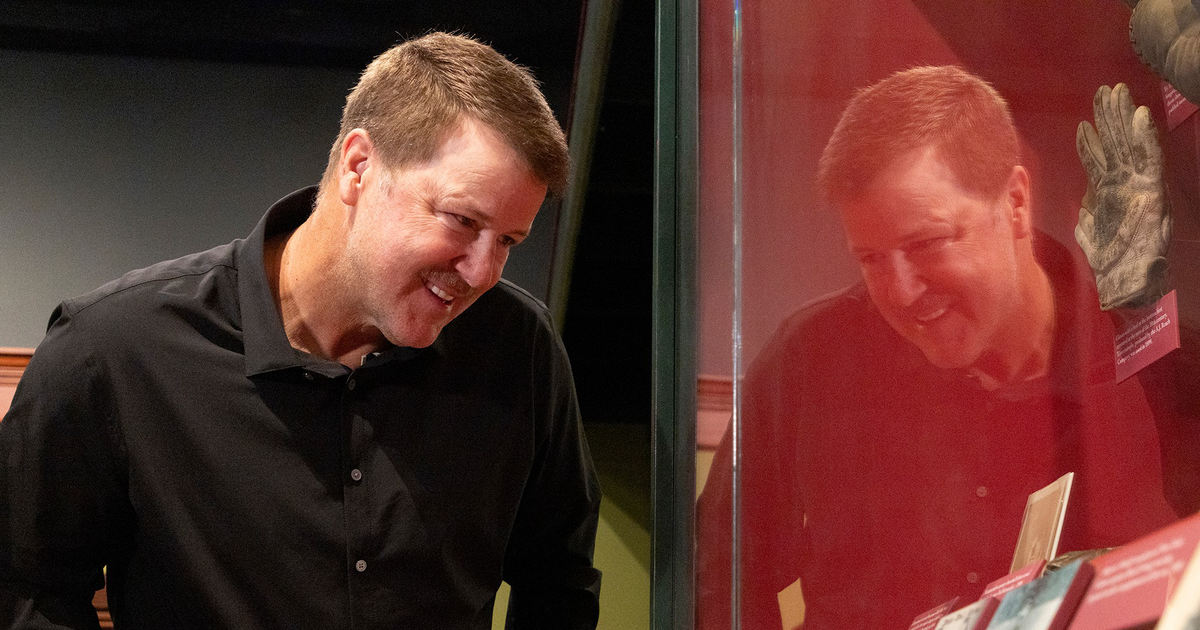
 Kent and his wife, Dana, check out a Hall of Fame exhibit. | Source: John Shea/The Standard
Kent and his wife, Dana, who flew in from Austin, Texas, were guided by senior curator Tom Shieber through the hallowed grounds for nearly three hours, a sentimental orientation for the man who was setting foot in the museum for the first time, viewing artifacts from baseball’s past and hearing classic stories about those who came before him.
“This is continuing to add to the emotional development of my baseball history,” said Kent, who was genuinely touched by the tales behind the displays. “The experience makes you feel that my era, the time that I played, is actually insignificant to what baseball has produced over its generations.”
The first player who’ll go into the Hall of Fame as a Giant since Orlando Cepeda in 1999, Kent essentially is opening the doors at 25 Main St. for several other old Giants to bust through. The class of 2027 expects to be a huge Giants-centric shindig featuring Buster Posey, Bruce Bochy, and Dusty Baker, all eligible for the first time.
Kent mentioned another name, the common denominator to them all.
“I actually think it’s a testament to Brian Sabean,” he said of the Giants’ former general manager. “He had the balls enough to trade for me. He had the knowledge to keep Dusty around. He had a hand in drafting Posey. Bochy had been around a while, so I think that was an easy pick. I think Sabean ought to get a lot of credit for all of that.”
Yes, Kent thinks that Sabean, who had his fingerprints all over the Giants’ championship era, as well as the Yankees’ dynasty of the late 1990s, should be a Hall of Famer as well.
First things first.
Today

3 days ago

Friday, Jan. 30

Kent already is working on his induction speech — “I’ll try not to be so mechanical, and I’ll have tissues in the back pocket” — and accepted an invite from Posey, the Giants’ president of baseball operations, to visit the team’s Scottsdale, Arizona, training camp in late February and be available to assist players and coaches.
The Hall of Fame announced this week that Kent would be inducted as a Giant; it’s where he played his best ball for the longest time. Earlier, Giants CEO Larry Baer phoned Kent to tell him his No. 21 will be retired this summer.
 Kent will autograph hundreds of items when he’s inducted into the Hall of Fame in July. | Source: Milo Stewart Jr./National Baseball Hall of Fame and Museum
Both were formalities, yet both are extremely meaningful to the 57-year-old who was overlooked all 10 years on the writers’ ballot before getting elected in December by the Contemporary Baseball Era Committee, which continues to deny Barry Bonds.
“To be able to go home and have the number retired in front of the fans is going to be a special moment for me,” Kent said, “probably harder for me to hold back tears in that stadium with the fans than this Hall of Fame speech.”
Kent was adored by Giants fans during his six years in orange and black (1997 to 2002), as he averaged 29 homers and 115 RBIs, yet because of some of his well-chronicled actions and words, he was booed when he later visited the Third and King ballpark as an Astro and Dodger.
“That speaks to the greatness of the fans, though,” he said. “I don’t misinterpret that as anything other than that’s how good those fans are, because I would expect them to do it.”
The boos disappeared in 2009, when Kent was celebrated in a ceremony for getting inducted onto the Giants’ Wall of Fame. In fact, fans gave him a 30-second standing ovation, and that love figures to extend to the Cooperstown induction and ensuing number-retirement ceremony at Oracle Park.
With Cooperstown gorgeously covered in snow and Otsego Lake frozen over amid subfreezing temperatures in upstate New York, the tour got underway in the comfortably warm confines of the Hall of Fame museum.
First came an introductory film called “Generations of the Game,” which featured the voices of many Hall of Famers, including Willie Mays. It moved to a room honoring new inductees (the class of 2025 included Ichiro Suzuki, CC Sabathia, Dave Parker, Dick Allen, and Billy Wagner), where Kent was told he’ll eventually be honored.
When the tour arrived at an exhibit containing Joe Morgan’s tiny glove, and Shieber shared stories about the legendary second baseman, Kent said, “I wish I would’ve known more about Joe. My dad always instilled in me watching other players to try to mimic them or try to be better than them. I related more to Ryne Sandberg because he was from my era. Joe came a little before me. I wish I had known more about him. … I know more about him now.”
At exhibits honoring Negro Leaguers and the Black baseball experience, one that featured Hank Aaron, Kent noted that he had heard many stories from Baker about Aaron and Mays, including the strength of their arms and hands and the massive bats they swung.
Kent knows firsthand. He said that during his time with the Giants, when he shook hands with Mays, Willie McCovey, and Bobby Bonds (Barry’s dad), “I felt like I had the littlest hands in the world. I wondered how I could do some of the things they did. They were so strong.”
When the tour went by exhibits showcasing the age of integration and prejudices and how Aaron was badly treated as he approached Babe Ruth’s homers record, Kent said, “That was impressive to me that those guys were strong enough to deal with that pressure. I’m glad they fought the things they had to fight emotionally, which we never had to do, to break ground and make baseball opportunities for all kids.”
A picture of Aaron swinging a bat reminded Kent of the approach he has tried to share with his son, Kaeden, a Yankees prospect. “Hank’s bat is not coming up, his shoulders are square, he had a top-hand strength that I try to teach my son about. It’s what Bobby used to teach Barry all the time.”
Displays showing the international influence on baseball got Kent thinking about his winter ball experience in Venezuela and participation in an All-Star tour in Japan, where he and Hideki Matsui, not yet a major-leaguer, exchanged jackets — one from the San Francisco Giants, the other from the Yomiuri Giants.
In a reflective tone, Kent said, “Baseball brings the world together.”
 Kent holds the bat Ted Williams used to hit his last big league home run in 1960. | Source: Milo Stewart Jr./National Baseball Hall of Fame and Museum
When Kent happened by Hornsby’s 1925 MVP medal, he nostalgically said, “I think this is the era that I really would have enjoyed. The glove and spikes and bats. But I don’t know if I could handle the wool jerseys they wore back then.”
Kent said something similar when he and his wife sat on a bench in front of a picture of the original Hall of Fame inductees from 1939.
“I always wondered if I would’ve enjoyed playing in that era more than playing in my era,” Kent said. “I’ve always said I played in the wrong era.”
Asked to elaborate, Kent said he imagines playing without cellphones or social media or walkup music or computers in the dugout or scoreboards with instant stats and video. A time when the only focus was baseball.
“I didn’t like all that drama,” Kent said. “I just wanted to play a game. Granted, it was a time with wool jerseys and no helmets, but I think I would have been better off, because I could’ve just played the game. I think I would’ve liked that. I’m not saying the game has changed for the worse. It’s just different.”
Near the end of the tour, Kent was ushered to the downstairs vault, where many of the artifacts are stored in a secure, climate-controlled environment and alphabetically stored — Kent’s items will find their place between Kaline and Killebrew.
Hall officials spread several items across a long table to show Kent, who held the 35-inch bat Ted Williams swung for his final homer, felt a jersey worn by Ty Cobb, and marveled over a glove belonging to Rube Waddell, no bigger than your gardening glove.
There was a cap worn by Herman Goldberg, a Jewish catcher, at the 1936 Olympics in Nazi Germany, where baseball was a demonstration sport. Kent said there should be a movie about Goldberg’s life.
Also on hand was a bat used by the winner of a home-run derby following a 2009 Hall of Fame-hosted game featuring former big-leaguers at Cooperstown’s Doubleday Field. The bat belonged to … Kent. He thanked Shieber for including it, and Shieber thanked Kent for donating it.
The day’s experience tugged at Kent’s heartstrings and left him humbled and in awe. He viewed generations of bats, balls, gloves, jerseys, and other memorabilia and embraced stories that he had never heard and vowed to return to learn more.
It was Baseball History 101, and Kent passed with flying colors.