
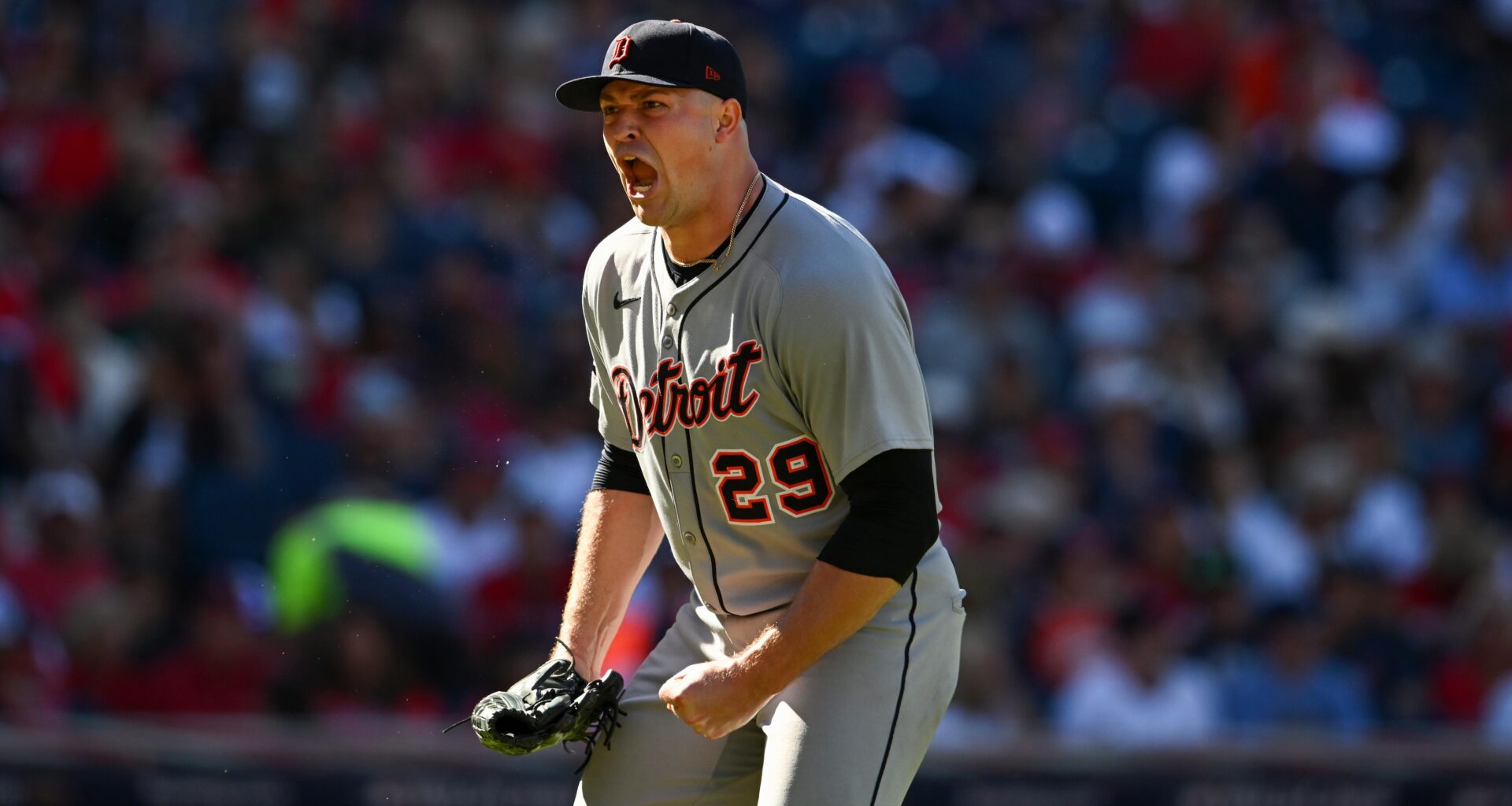
Tarik Skubal took on the Detroit Tigers, and Tarik Skubal won. He’s a richer man as a result, and it’s good news for those who will follow in his footsteps.
This is Skubal’s last year of arbitration-eligibility, and he and the Tigers decided to throw down over it. The two-time Cy Young Award winner filed at $32 million and they filed at $19 million, a $13 million gap that forced a trial.
The case was decided Thursday, with ESPN’s Jeff Passan reporting that Skubal was deemed the winner in the hearing.
That Skubal and the Tigers did not do that by, say, meeting in the middle at $25.5 million was significant. But now, even more significant is that Skubal won.
Salary arbitration is for players in their last three or four years of club control before free agency. Both sides typically adhere to salary precedents when they exchange numbers, and it’s common for player and team to settle their differences before going in front of a panel of arbiters.
Are You Seeing This, Paul Skenes?
Everyone knows the collective bargaining agreement expires at the end of 2026, just as everyone knows a salary cap is going to be the central part of the fight between MLB and the MLBPA.
You can see Skubal’s win over Detroit as more fuel for the fire. He’s the fourth player to set some kind of salary record this winter, following Kyle Tucker (present-day $57.1M AAV), Bo Bichette ($42M AAV for an infielder) and his new rotation mate, Framber Valdez ($38.3M AAV for a left-hander).
The players will, of course, fight tooth and nail against a salary cap. To win that fight, they’ll have to concede something. Passan noted that MLB would love to “shutter” the arbitration process.
If arbitration survives, though, the rules will be different. At least for elite players, who can view Skubal’s stand against the Tigers not as a one-off, but a model.
The name on the tip of everyone’s tongue is Paul Skenes. He’s only been in the league for two years and thus isn’t eligible for arbitration until 2027. Yet already, he boasts a Rookie of the Year, a Cy Young Award, two All-Star starting nods and the lowest ERA ever for a pitcher through his first 55 starts.
Be afraid, Pittsburgh Pirates. Be very afraid. Or, better yet, be willing to put up or shut up when it comes to either trading Skenes or extending him.
Also celebrating the Skubal news should be star pitchers who are already in their arb-eligible years, including Logan Gilbert, Hunter Brown and MacKenzie Gore. And on the position player side, there’s now a new goalpost for Gunnar Henderson, Pete Crow-Armstrong, Elly De La Cruz, Junior Caminero, Wyatt Langford and more to pursue as they get into (or deeper into) their arb-eligibility.
These players and more could become more determined to bet on themselves, which in turn could make them less willing to sign team-friendly extensions. Those guarantee financial security, but not necessarily the riches that await in free agency and, with help from Skubal, arbitration.
The amazing thing is that Skubal didn’t even need to break the rules to do a solid for his peers. He merely recognized that they could be rewritten, and he went for it.
Opportunity Knocked and Skubal Answered
No matter what happened next, it’s worth noting that Skubal was destined to beat expectations as soon as he and the Tigers exchanged figures.
Every year, Steve Adams of MLB Trade Rumors puts out projections for arbitration-eligible players that are accurate enough to be treated as a gold standard. Adams had Skubal projected at $17.8 million for the 2026 cycle, and Detroit did even that one better when they filed at $19 million.
Had Skubal accepted, he would have come only $750,000 shy of the record for an arbitration-eligible pitcher. That was for David Price’s contract for the 2015 season, which ironically was with the Tigers.
So, why did Skubal and his agent, Scott Boras, instead shoot for the moon at $32 million?
While the process tends to play off past results for arb-eligible players, there’s no hard limit on how much players can file for. And Passan outlined how Skubal had two things going for him in aiming higher than Nolan Arenado’s record ask of $30 million from 2019:
Skubal had the right to cite “special accomplishments” after winning his second straight AL Cy Young Award in 2025.There’s a provision that allows players with five-plus years of service time to compare themselves to any player, not just arb-eligible players from years past.
Knowing this, you wonder why Skubal didn’t push even further for the equivalent of the highest average salary ever earned by a pitcher. Justin Verlander and Max Scherzer, three-time Cy Young Award winners in their own right, share that distinction at $43.3 million.
What Were the Tigers Thinking?
There are various ways for teams to go about arbitration, but the Tigers are known as a file-and-trial team.
As demonstrated recently by the Seattle Mariners and Bryce Miller, the deadline for players and teams to avoid arbitration after exchanging figures is technically soft. But the Tigers traditionally treat it as hard, meaning that no agreement by the deadline basically means, “We’ll see you in court.”
Yet even if they were within their rights to do this with Skubal, the immediate question was all too obvious: How, exactly, were they going to win this case?
From the outside looking in, here’s the supporting evidence:
The Case for Skubal: 2 Cy Youngs, 2 All-Star selections, 2 ERA titles and a host of AL- or MLB-leading numbers for the 2024 and 2025 seasons, including ERA, strikeouts and WHIP.
The Case Against Skubal: Ummm…
The only case the Tigers had to plead involved precedents.
Skubal only made $10.15 million in arbitration last year, and a raise to $32 million would blow away both Price’s record for a pitcher and Juan Soto’s record for all players, which he set with a $31 million agreement with the New York Yankees in 2024. Even if there was a case to be made for the former, surely an every-five-days ace can’t be more valuable than an everyday slugging superstar, right?
The panel clearly disagreed, and it’s frankly hard to disagree with the decision. The only question now is how it will ripple across MLB’s future.