
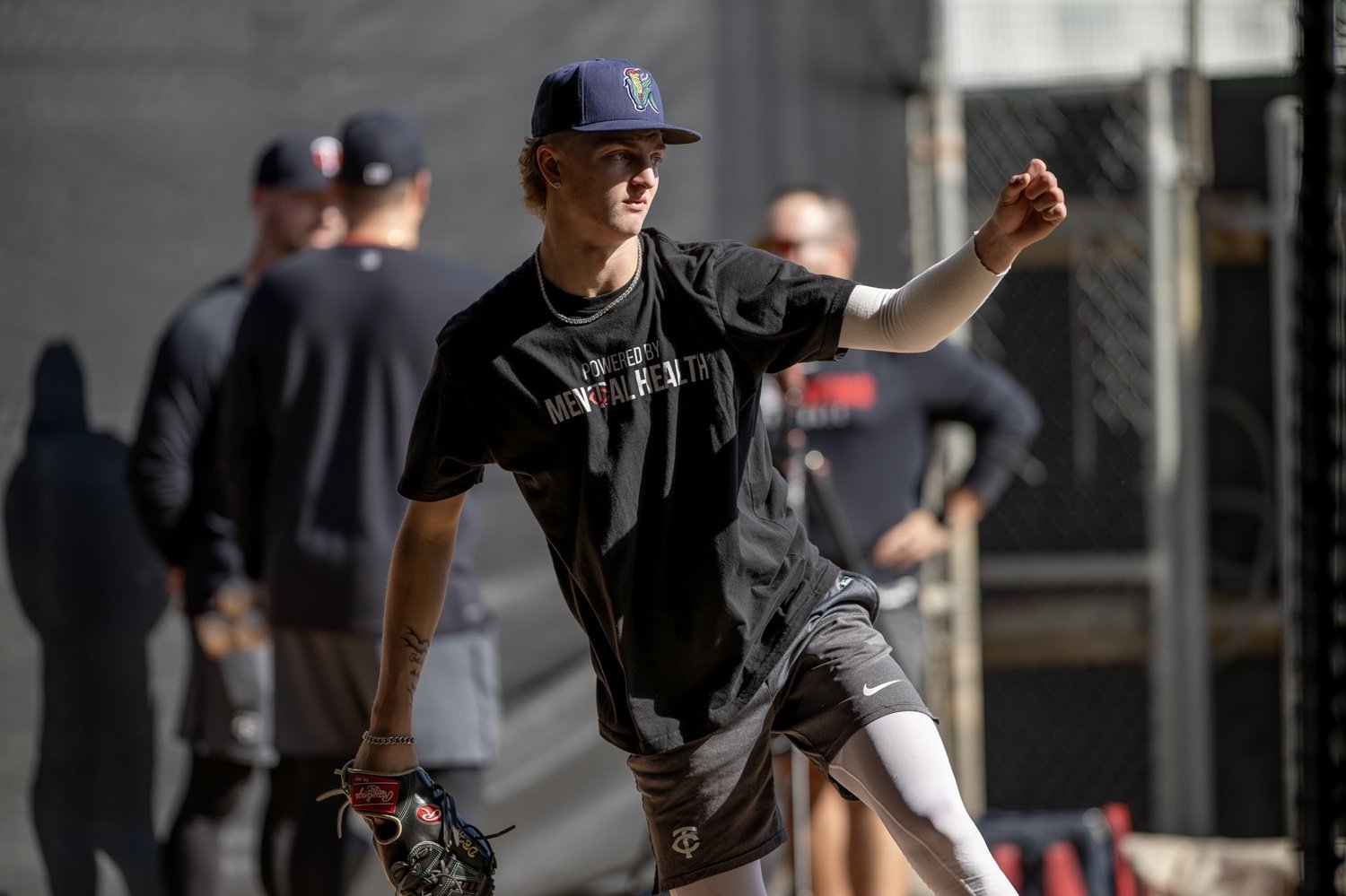
The Minnesota Twins’ farm system has quietly reloaded over the last few seasons, and the national rankings are finally starting to catch up. Depending on the publication, the organization currently boasts as many as six prospects landing on Top 100 lists, a reflection of aggressive drafting, targeted international spending, and meaningful deadline trades that infused the system with upside.
Even with that level of recognition, prospect lists can only stretch so far. Every organization has players just outside the cut line, and in the Twins’ case, several names feel far closer to breaking through than their current status suggests. Some are polished hitters whose statistical profiles lag behind flashier peers. Others are arms with loud tools but have incomplete resumes due to age or health.
Two of the players below arrived via trade, while two were selected in the MLB Draft, a snapshot of how Minnesota has diversified its talent acquisition. None currently carry Top-100 prospect labels, but each has a clear path to forcing that conversation by this time next year.
Gabriel Gonzalez, OF
Gonzalez has already lived the Top-100 life once with MLB.com ranking him 79th in 2024, which makes his exclusion now feel more like a temporary detour than a verdict. Signed out of Venezuela by Seattle in 2021, Gonzalez established himself as a premium bat-to-ball hitter early in his career and reached national prominence before being dealt to Minnesota in the Jorge Polanco trade.
A back injury derailed his 2024 season and robbed him of the impact he showed the year prior. Rather than stagnate, Gonzalez used that lost year as motivation. He reported to camp in better shape in 2025, added strength, and reminded everyone why his offensive foundation is so appealing. Across three levels, he hit well north of .300 with a 148 wRC+ and finished the year as one of the youngest regulars in Triple A, holding his own against advanced pitching.
The profile is built around contact and aggression. Gonzalez rarely strikes out (14.5 K%) and consistently finds barrels, even if his swing plane and approach are not optimized for over-the-fence power. Defensively, he has improved with better conditioning, but still projects best in a corner, which places pressure on his bat to carry everyday value.
2026 focus: Gonzalez tightening his strike zone and lifting the ball more consistently would go a long way. Even a modest power bump would change how evaluators view his ceiling.
Kendry Rojas, LHP
The Twins did not acquire Rojas for what he has already done. They acquired him for what they believe he can still become. Injuries limited his workload in Toronto’s system, but Minnesota saw enough raw stuff at the deadline to part with meaningful big league pieces (Louis Varland, Ty France) to bring him over.
When healthy, Rojas flashes a fastball that creeps into the upper 90s and a slider that misses bats at a high rate. His changeup gives him a third legitimate weapon, and the ingredients are there for a starter who can turn over a lineup. Last season, he posted a 28.8 K% while reaching Triple-A in his age-22 season. The problem has been availability and consistency. His brief Triple-A run highlighted both sides of the coin: dominant stuff paired with erratic command that led to far too many free passes (15.9 BB% after the deadline) .
Rojas will pitch the entire 2026 season at 23 years old, and for the first time in years, the priority is simply staying on the mound. The Twins have a strong track record of maximizing arms with this kind of profile, and even if the rotation path narrows, there is a fallback as a high-leverage reliever.
2026 focus: Health and strike throwing. A full season with improved command would quickly push Rojas into national conversations.
Dasan Hill, RHP
Hill may not have cracked any Top 100 lists yet, but the ingredients scream breakout. A towering right-hander with premium velocity, Hill overwhelmed Low-A hitters with pure stuff in his first full professional season (40.2 Swing%). Opponents struggled to make contact, and when they did, it was often weak.
The challenge was control. Walks piled up as Hill adjusted to longer outings and a professional workload (15.0 BB%), and his late-season jump to High-A exposed how far he still needs to go with fastball command. That said, it is hard to overstate how rare it is to find a teenager with this combination of size, velocity, and secondary pitch quality.
The Twins have been patient with similar arms in the past, and Hill’s development arc suggests his biggest gains are still ahead. If the control comes even a step forward, the upside looks like a rotation anchor.
2026 focus: Throwing more strikes and working deeper into games. Efficiency will determine how fast Hill climbs.
Marek Houston, SS
Houston entered pro ball with one carrying tool that never came into question. His defense. Widely viewed as the best shortstop glove in last July’s draft class, Houston immediately showed why Minnesota valued him so highly with his range, arm strength, and instincts on the left side of the infield.
The offensive side remains the swing factor (pun intended). Houston surprised evaluators with a power spike during his final college season (.597 SLG), but skepticism followed him into his debut due to park factors and underlying contact data. His first taste of pro ball offered a mixed picture, with a strong start at Low-A (.868 OPS) followed by a difficult transition after a promotion (.459 OPS).
The floor here is relatively high because elite defense at shortstop is always valuable. The ceiling depends on whether Houston’s bat settles somewhere above playable. If it does, the Twins may have found a long-term answer at a premium position.
2026 focus: Adjusting to better pitching and finding a consistent offensive approach at higher levels will determine his trajectory.
The Twins system is no longer just top-heavy. Prospects like Gonzalez, Rojas, Hill, and Houston illustrate the depth that exists beyond the headline names. If even one or two take the expected step forward in 2026, Minnesota’s presence on national Top 100 lists could grow even stronger heading into 2027.
Which prospect has the best chance to be on next winter’s top-100 lists? Would you add any other prospects to the ones outlined above? Leave a comment and start the discussion.
Interested in learning more about the Minnesota Twins’ top prospects? Check out our comprehensive top prospects list that includes up-to-date stats, articles and videos about every prospect, scouting reports, and more!