
 Credit: Getty Images
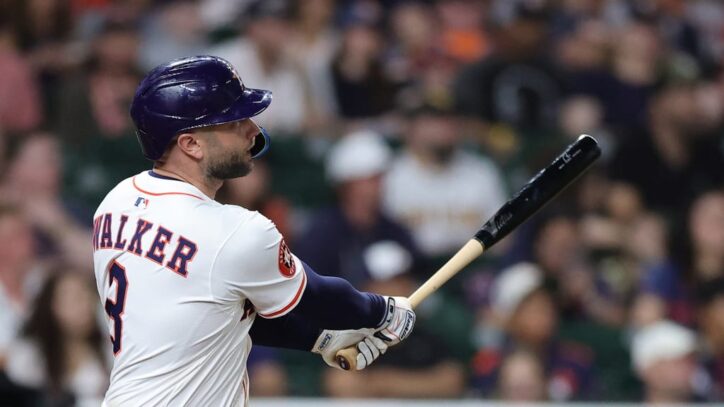
The Houston Astros and the San Diego Padres potentially match well in a trade of Christian Walker.
As Spring Training nears, the San Diego Padres are looking for another bat to add to their lineup. We know the team was linked to Paul Goldschmidt before he re-signed with the Yankees.
This week, the Padres signed utility player Miguel Andujar to a one-year deal, where he is expected to get the bulk of the designated hitter at-bats and platoon with Gavin Sheets.
As of now, the Padres have a complete lineup with Sheets penciled in at first base and Andujar at designated hitter. However, they would still like an additional bat to play first base.

Christian Walker of the Houston Astros is the kind of player who fits the needs of the Padres at this moment in time.
The Houston Astros currently have a logjam in their infield, with infielder Isaac Paredes not having a natural position to play. Paredes is blocked at third base by Carlos Correa, at second base by Jose Altuve, and at first base by Christian Walker. Paredes’ bat is valuable for the Astros, specifically at Daikin Park. Christian Walker has only played one season with the Astros, where he disappointed in comparison to his career with the Arizona Diamondbacks.
Walker is coming off a 2025 where he posted a .717 OPS and a 97 OPS+, becoming slightly below league average in terms of stats.
The right-handed hitter declined in most of his metric stats and saw drastic changes to his walk rate and strikeout rate. They were some of his career lows in the metric. He was able to maintain a decent slugging percentage, but that was also a 47-point reduction from the year prior. It is safe to say that, given his past production, Walker’s value may be perceived as very low.
When accounting for the two years and $40 million left on his contract and the logjam on the Astros roster, Walker becomes a logical trade candidate.
Explaining the down year
His bat speed was down a mile per hour, but it is still well above league average. Walker still ranks well above league average in average exit velocity, max exit velocity, barrels, barrel percentage, hard hit percentage, and outs above average on the defensive side. The bat speed is also in the 80th percentile, which begs the question of how he regressed so much.
In doing a deeper dive into his numbers, nothing jumps off the page explaining why he was significantly worse. There isn’t a pattern of anything he’s doing much differently that would cause his whiff rate and strikeout percentage to be so high. Many of the bits of regression he has metrically can be attributed to being a 34-year-old first baseman.
What jumps off the screen is how drastically different he was at home in Houston compared to away games.
At Daikin Park, Walker recorded a slash line of .202/.279/.342 for a .621 OPS. His home OPS was almost 100 points lower than the league average in a stadium that is tailored for his pulled flyball approach. On the road, those numbers increased to .265/.311/.482 for a .793 OPS. This set of numbers is higher than his career numbers. The first baseman also hit eight home runs at home compared to 19 on the road. Getting out of the ballpark may be the key for him.
The differences between his home and road splits are comparable to the offensive differences between Freddy Fermin and Manny Machado in 2025.
It would appear that the reason for much of Walker’s regression could just be the matter of not being able to see the ball well in that stadium. All of Walker’s main struggles in 2025 were related to his discipline. He struggled with whiffing at pitches and struck out more while walking less. He did not see the ball well. Walker’s strikeout percentage rose 3.6% and his walk rate decreased 3.7%. There’s evidence of him potentially doing better in a new environment.
An interesting tidbit for the Padres is that Walker’s home run total would have risen from 27 to 29 had he played in Petco Park, which would have led the Padres. The three-time Gold Glove winner likely also provides a huge defensive upgrade at first base, which would benefit his infield teammates.
As a veteran with World Series experience, the Padres can also gain some intangible benefits to help new manager Craig Stammen lead this ballclub. When you add in the slugger’s familiarity with the NL West and his reputation as a Dodger killer, the Padres may be wise to prioritize him.
What is the cost?
As is often the case in conversations with potential acquisitions for A.J. Preller, the cost is the complication.
While it is unknown how much money the Padres possess to add this off-season, they likely will need financial help to make a trade with Houston. The Astros might target relief help in a trade and potentially outfield help as well in return.
Since the Padres would likely need Houston to eat some of the contract, they would have to trade a bit more of their assets to complete a deal. The Astros could be enticed by a young controllable reliever. Preller may also look to trade some of his MLB relief corps to make the finances work.
The Padres can afford to give up a few relievers since there are as many as 14 relievers with MLB contracts on the roster. Lefties Wandy Peralta and Yuki Matsui, along with righties Jeremiah Estrada and Jason Adam, are potential target players due to their salaries that could be floated in a potential deal. They would also upgrade the Astros unit significantly.
With spring training fast approaching, the Padres will likely make a move soon to add to their 2026 roster.
Christian Walker is a gutsy move for two years.
The question is, will this addition help the Padres get over the hump of their postseason woes?
30
East Coast Based
Dominican
Continue Reading