
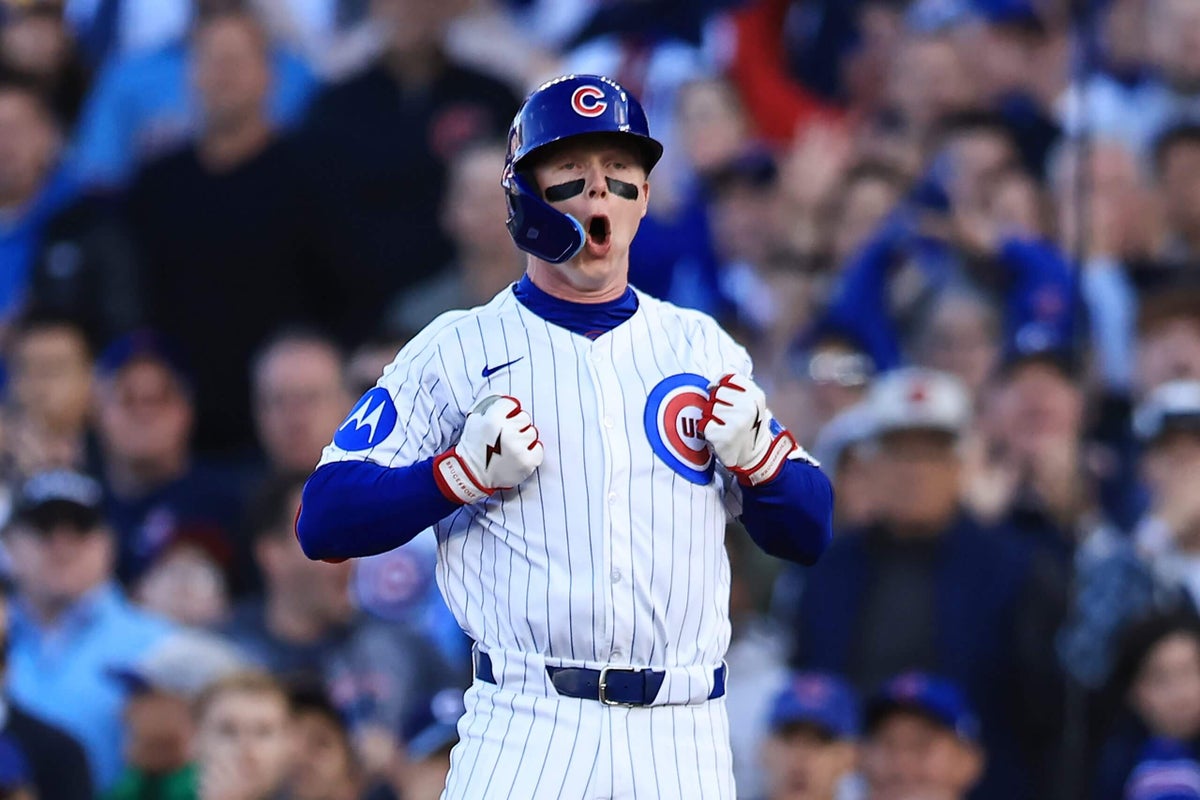
After what closely resembled their “Plan A” offseason, the Chicago Cubs will gather at their Arizona complex this week for the start of spring training. Although an obsession with depth means that Jed Hoyer’s front office will continue to evaluate free agents and trade concepts in February, the biggest building blocks for a solid playoff contender are already in place.
Whether it all comes together will be the larger story of the 2026 campaign, which will begin with familiar faces, new personalities and a bigger baseball budget than last year (but smaller than the payrolls carried by certain big-market competitors). Above all, the organization has clear expectations for October baseball at Wrigley Field, a time and place where seemingly anything can happen.
First, the Cubs will have to get through six weeks of training camp and 32 exhibition games before beginning the 162-game grind. That will take contributions from all over the roster – because everything won’t go as planned – but here are five players in the spotlight at the start.
Alex Bregman’s imprint on the team
The Cubs already considered themselves a close-knit group with good work habits and strong instincts for the game. Now here comes Bregman wanting to know more about individual player plans and the lessons that the organization’s instructors are teaching young hitters.
Bregman’s offensive profile and defensive value lit up the club’s projection system. However, his intangible leadership qualities also led the Cubs to raise their offer to five years and $175 million and revise their policy on using deferred money to close deals for free agents.
This will be an up-close view of how Bregman interacts with teammates and coaches around the batting cage, in the clubhouse and on the field. It will also be an early look at how the All-Star third baseman handles his face-of-the-franchise responsibilities.
In assessing Bregman’s body of work thus far, here is Baseball Reference’s historical list of similar batters through the age of 31:
1. Eric Chavez
2. Bobby Bonilla
3. Kyle Seager
4. Robin Ventura
5. Howard Johnson
6. Ketel Marte
7. Torii Hunter
8. Alfonso Soriano
9. Ken Boyer
10. Gary Gaetti
With 1,250 career hits, 209 home runs and two World Series rings, Bregman does not yet have a Hall of Fame-caliber resume, and he may never reach that Cooperstown level. But this contract gives him a sturdy platform to chase those numbers and a third championship, which is why he will be wearing No. 3.
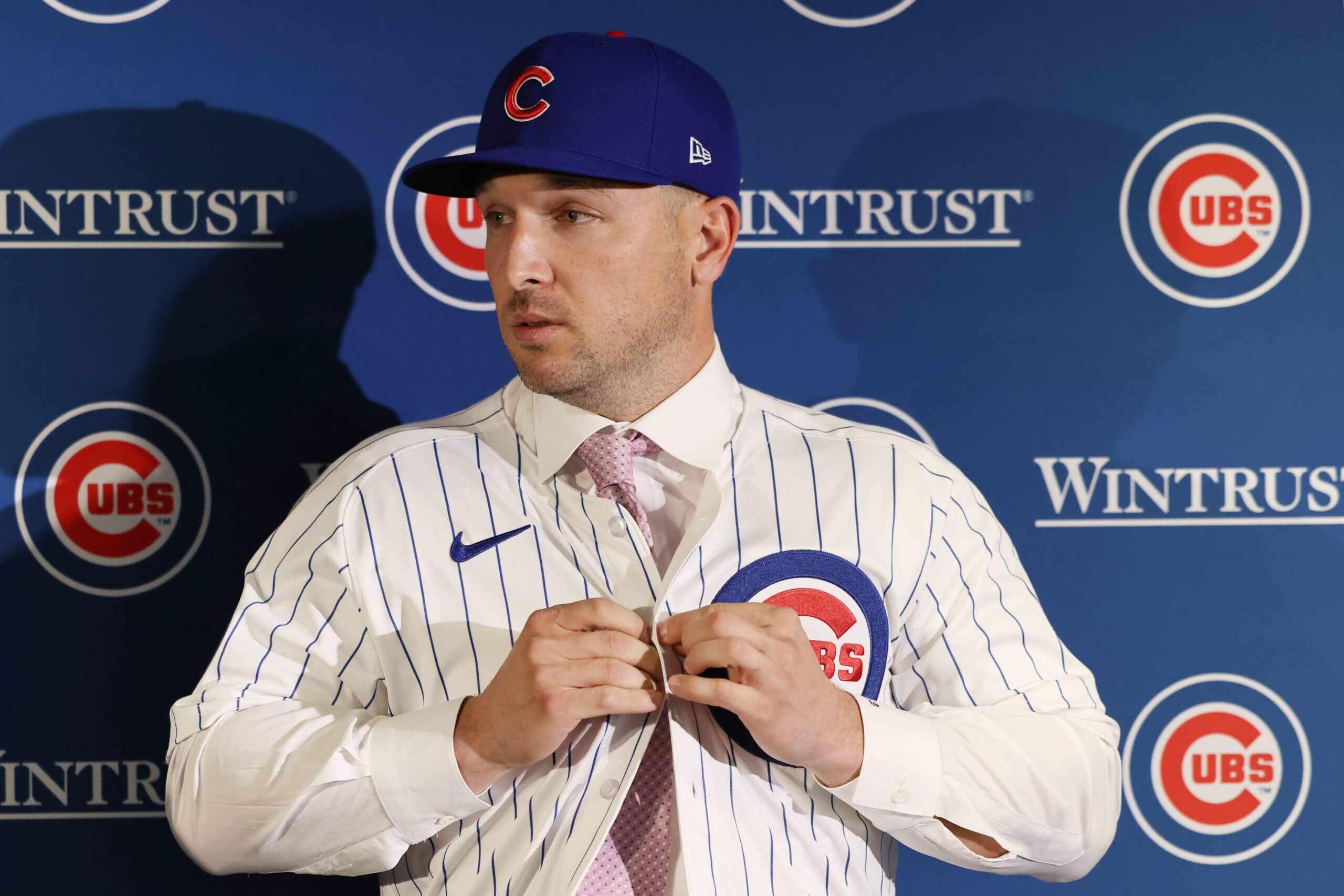
Alex Bregman will also bring his extensive postseason resume (102 games over 21 series) to Chicago. (Geoff Stellfox / Getty Images)
Carlos Beltrán’s recent election to the Hall of Fame showed that the Baseball Writers’ Association of America won’t automatically disqualify someone involved in the Houston Astros’ sign-stealing operation, which followed Bregman earlier in his career. The BBWAA’s increasing support for Chase Utley could also bode well for certain types of infielders in the future, especially if Bregman is as good as advertised.
Pete Crow-Armstrong’s search for the next level
It’s impossible to miss the guy who routinely gets stories written about his hairstyle. Last year’s look was bleached blond with blue stars. Crow-Armstrong went out and created an MVP-caliber first half, fell into a deep slump after the All-Star break and rebounded to deliver some clutch playoff moments.
“That’s Pete,” Cubs manager Craig Counsell said. “We saw some incredible things. We saw some stretches where he was an out at the plate. I think his defense was incredibly consistent and brilliant.”
Putting a number on that production, personality and potential will be a challenge. The baseball calendar allows more time for executives and agents to discuss contract extensions during spring training. The Cubs engaged Crow-Armstrong’s camp last year as both sides exchanged proposals around the season-opening Tokyo Series.
In agreeing to table those discussions, there wasn’t necessarily a sense of urgency or disappointment because Crow-Armstrong remains under club control through 2030. The Cubs recognize his unique abilities as an explosive offensive talent, a Gold Glove center fielder and a magnetic performer.
Crow-Armstrong, who will turn 24 next month, still has plenty of room to grow. As his manager likes to say, no one is a finished product. The consistent message is to always keep improving and never be satisfied.
“That’s what I’d want from Pete,” Counsell said. “As long as that quest never burns out and you keep that alive, he’s going to get to better places and great places.”
Matt Shaw at the center of trade rumors
Handed a job when Bregman picked the Boston Red Sox as a free agent last year, Shaw is currently slotted into a super-utility role. That is, unless the Cubs finish their offseason by trading Shaw to the Red Sox or another club looking for a promising third baseman.
Given the many connections between their methodical front offices, the Cubs and Red Sox have an ongoing dialogue about players and roster needs. Shaw has been identified as a potential option for Boston’s plans to replace Bregman, and the Cubs are always willing to listen.
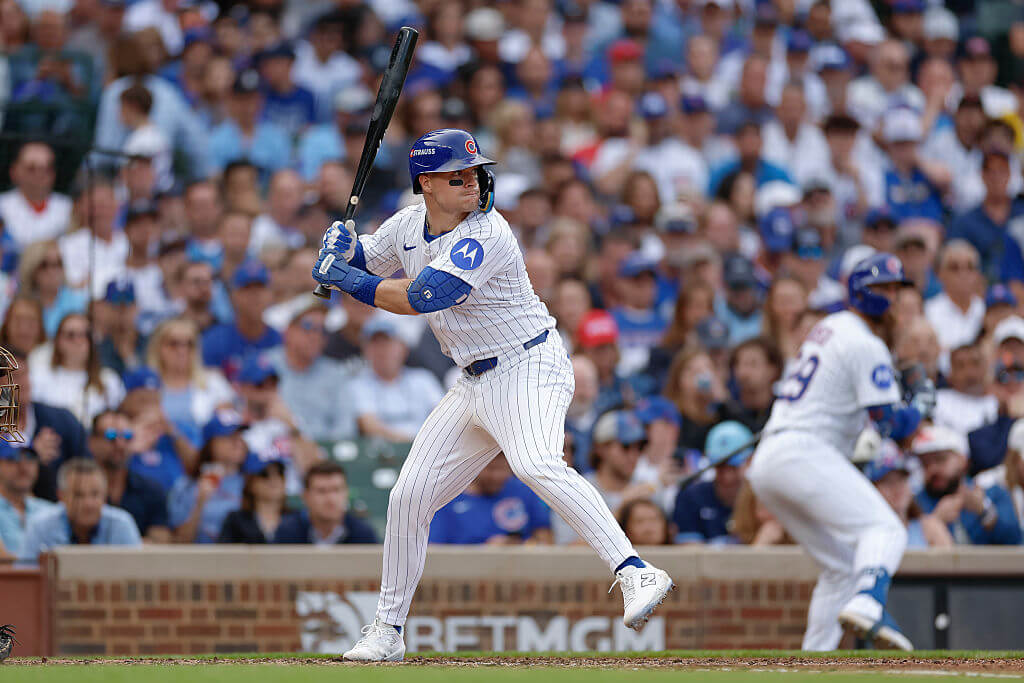
Matt Shaw rebounded in the second half of last year, posting a .736 OPS over 63 games. (Brandon Sloter / Chicago Cubs / Getty Images)
For now, at least, the Cubs are publicly comparing Shaw to Javier Báez and Kris Bryant, pointing out the immense value those versatile players provided during the 2016 championship season. That World Series run may have never happened if the Cubs had moved Báez for a starting pitcher after his major-league debut in 2014 or at the 2015 trade deadline.
Sticking with young talent and staying patient is part of the process. Cubs officials are confident that Shaw can shift between the infield and the outfield and get enough at-bats to continue his development. The 24-year-old is scheduled to remain under club control through 2031. His athleticism and work ethic made him a Gold Glove finalist at third base last year. While learning a new position, he made good second-half adjustments to boost his offensive numbers toward a league-average level.
He also drew attention for his decision to leave the team last September and miss a game to attend Charlie Kirk’s memorial service. Citing Shaw’s friendship with Kirk, the conservative activist, the club framed that trip to Arizona as an excused absence. Shaw also spoke this offseason at an event for Turning Point USA, the political organization founded by Kirk, a Cubs fan who had grown up in Illinois.
Edward Cabrera’s untapped potential
After the Cubs acquired Cabrera in a January trade with the Miami Marlins, Chicago pitcher Jameson Taillon received a message from Daniel Moskos. As Miami’s pitching coach and a former pitching instructor with the Cubs, Moskos had unique insight into the deal.
“Moskos instantly texted me and said, ‘(Cabrera’s) a great dude. Everyone’s going to love him,’” Taillon recalled.
After spending his entire career in a sleepy baseball market, Cabrera is about to enter the Wrigleyville experience. During their extensive discussions with the Marlins, the Cubs inquired about Cabrera after the 2024 season and again at last year’s trade deadline. It’s time to see what the fuss is all about.
“Cabrera’s super exciting,” Taillon said. “He looks how a pitcher should look. He’s got the prototypical power pitcher body. We’re definitely going to have more stuff in the rotation.”
Cabrera’s vast potential checked the boxes in terms of measurable pitching characteristics, scouting projections and financial considerations. He will earn $4.45 million this season, turn 28 in April and remain in the arbitration system through 2028.
Availability, though, is a real concern. The club control won’t be as valuable if Cabrera makes frequent trips to the injured list. He reached career highs in starts (26) and innings (137 2/3) last year, totals that fall well short of the traditional definition of a top-of-the-rotation starter.
Clearly, the Cubs think they can draw out more.
“He’s been a favorite of some of our pitching infrastructure guys for a long time,” Hoyer said. “It feels like a guy who’s just kind of scratching the surface of what he can do. That was a big part of it. The analytics matched up, the age matched up, the service time matched up, and the fact that there were some guys who had conviction on him for a long time.”
Shota Imanaga begins his comeback
As much as the pitching group gets credit for a good game-planning system and an individualized approach to instruction, the Cubs failed in their efforts to reset Imanaga for the playoffs.
“Shota got off track last year,” Counsell said. “But maybe one of the reasons we were collectively unable to help him get back on track is that it was so close that it was hard to see.”
Perhaps those mechanical changes were almost imperceptible after Imanaga came back from a hamstring injury last summer. The Cubs may have overreached with their previous offseason program, trying to get more from Imanaga after a spectacular rookie year. Overall, the 2025 results across 25 starts were good enough (9-8, 3.73 ERA) to believe that he might be ready for October.
Instead, the Cubs avoided using Imanaga in their final elimination game against the Milwaukee Brewers and then declined their three-year, $57.75 million option on his contract. For a pitcher who’s this competitive and cerebral, Counsell said those disappointments can be “the best teacher” and “the best motivator.” The partnership between the club and the Japanese pitcher has been tested.
Imanaga wound up declining his player option with the Cubs and then accepting a one-year, $22.025 million qualifying offer. He visited a noted facility in Florida, Cressey Sports Performance, for a full breakdown of his delivery.
“I think Shota is going to take his lessons from last year and be better for them,” Counsell said. “I’m very optimistic about what we’re going to get from Shota.”