
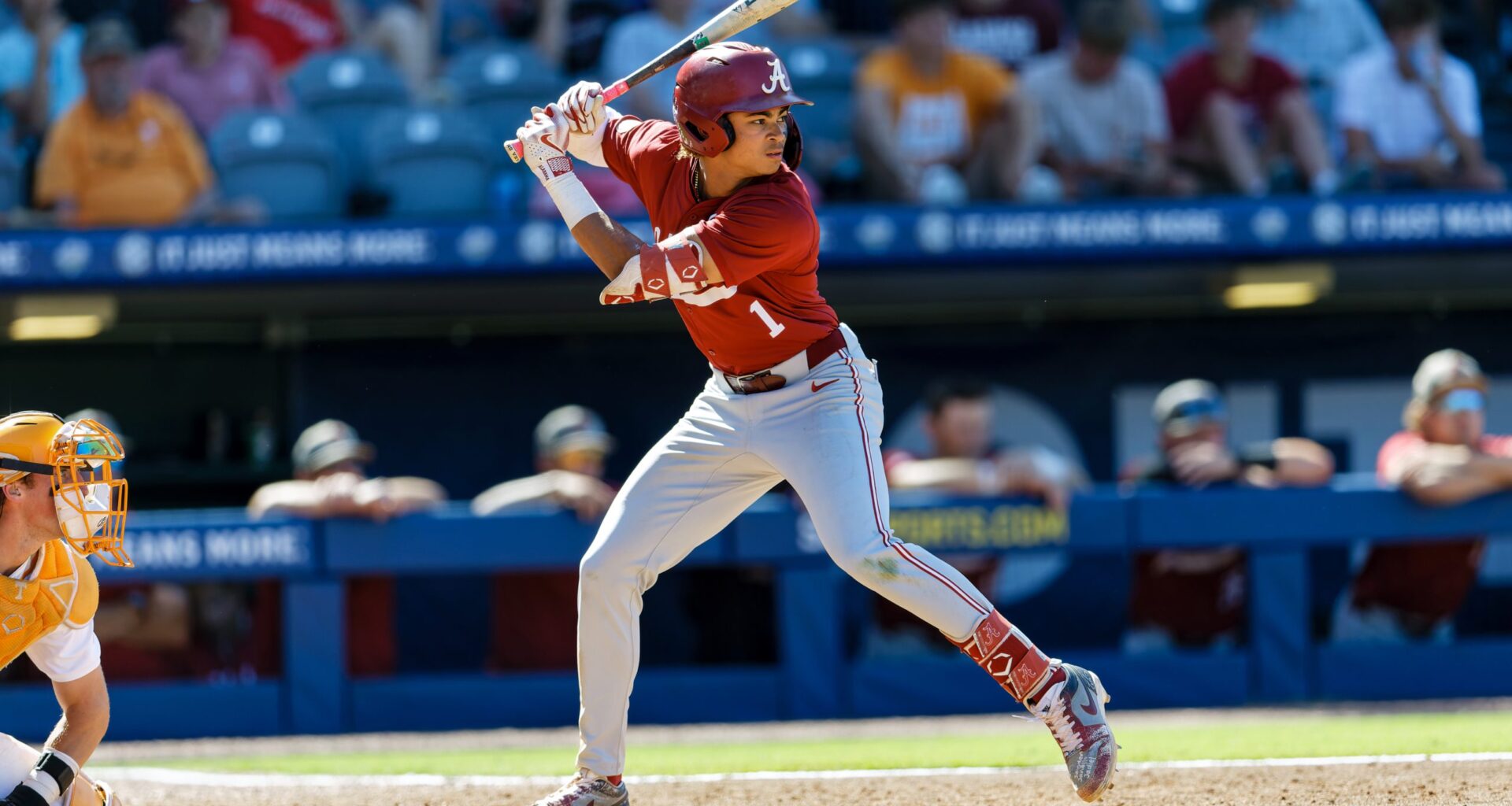
Image credit:
Justin Lebron (1) Alabama Crimson Tide vs Tennessee Vols in Game 5 of the SEC Tournament at Hoover Met Stadium in Hoover, Alabama on Wednesday, May 21, 2025 (Photo by Eddie Kelly/ ProLook Photos)
Each year before the college season starts we like to take a look at the top 30 players in the class and address to-do list items that can help them improve their draft stock.
This is the ninth year we’ve done this exercise. You can see each of our previous to-do lists below:
Notable up-arrow players from the 2025 class include Oklahoma RHP Kyson Witherspoon, SS Aiva Arquette and SS Eli Willits. Witherspoon dramatically improved his control and handled a starting role all season. Arquette improved his selectivity slightly, but also looked the part as a defensive shortstop while putting together one of the best offensive seasons in the country. Willits became the first overall pick in part because he had the most well-rounded toolset in the class.
There’s no shortage of down-arrow players from the 2025 class to mention, headlined by Texas A&M OF Jace LaViolette and Tennessee SS Dean Curley. LaViolette failed to address his contact concerns and also had the worst season of his college career, while Curley not only failed to improve his defensive profile but added significantly more questions to it.
Below are the to-do list items for the top 30 players in the 2026 draft class.
30. Aiden Ruiz, SS, The Stony Brook (N.Y.) HS
Areas to improve: Add strength
Ruiz is perhaps the best defensive shortstop in this class. He does a lot of things well beyond that, including controlling the zone and making a lot of contact. The biggest question Ruiz will have to answer: what’s his impact potential? He’s a smaller switch-hitter with just a 5-foot-10, 165-pound frame. Many teams will wonder if he’ll ever grow into even below-average power. Showing more strength, physicality and raw power would go a long way toward answering that question this spring.
29. Caden Sorrell, OF, Texas A&M
Areas to improve: Production against spin
Sorrell’s OPS jumped nearly 300 points from his freshman season to his sophomore season, and he brings an exciting combination of athleticism and power. His performance against breaking balls is an obvious area of improvement. In two seasons with Texas A&M, Sorrell has managed a 1.081 OPS vs. fastballs and offspeed pitches compared to an .855 OPS vs. breaking balls. His miss rate jumps from 26% against fastballs and changeups to 41% against breaking balls.
28. Gavin Grahovac, 3B, Texas A&M
Areas to improve: Health and contact ability
Grahovac has a pro body, pro bloodlines and pro power potential. Now, he needs to stay healthy for a full season and show improved contact skills to make the most of that upside. He missed the majority of 2025 with shoulder surgery, and in his 73 games with Texas A&M he is a .293/.387/.593 hitter with a 28.5% strikeout rate. Grahovac has never hit over .300 in a college season and his overall miss rate sits at 32%. His best contact comes against fastballs, but against all secondary pitch types, Grahovac has at least a 39% miss rate. Improving in these areas will be key.
27. Kevin Roberts Jr., OF/RHP, Jackson Prep, Flowood, Miss.
Areas to improve: Defensive positional clarity, make strides with hit tool
It wouldn’t take Roberts Jr.’s name long to surface on a list of the best athletes in the class. His combination of size and physical tools is tremendous. That said, he had some offensive struggles on the 2025 showcase circuit—despite a solid natural feel for the barrel—and will need to look in control during every at-bat this spring in Mississippi. It can be difficult to change a hit tool evaluation against Mississippi high school pitching, but two years ago Konnor Griffin showed some swing refinement and demolished the competition during his senior spring season. Doing that, as well as showing he’s more of a center fielder than right fielder, will make things easier for teams to pull the trigger on Roberts in the first round.
26. Ryder Helfrick, C, Arkansas
Areas to improve: Make more contact
Helfrick is a college catcher with loud tools and big offensive upside, making him an obvious up-arrow candidate with a strong season. Helfrick’s bat speed and pullside power as a catcher is a real separator. However, getting to his power does come with some real swing-and-miss tendencies. Helfrick’s 69.8% overall contact rate and 78.3% in-zone contact rate from 2025 are both below-average marks for a first-round college hitter, as is his 23.8% career strikeout rate.
25. Vahn Lackey, C, Georgia Tech
Areas to improve: Show more offensive impact
Lackey is a polished defender with great contact skills, but he needs to show more accessible in-game power this spring. That makes him an offensive contrast with Helfrick—his primary competitor for catcher-1 status in the 2026 draft. Lackey actually hits the ball quite hard. His 90th percentile and max exit velocities aren’t too far off Helfrick’s, but he’s more frequently passive within the heart of the strike zone and his hardest contact too often comes on the ground. He made strides in this area as a sophomore—cutting his groundball rate from 56.9% to 46.0%—and doing more as a junior could help him hit more than the six home runs and 14 doubles he tallied in 2025.
24. Logan Schmidt, LHP, Ganesha HS, Pomona, Calif.
Areas to improve: Distinguish and separate breaking balls
Schmidt throws a breaking ball in the upper 70s and low 80s that at times looks like a slurvy curveball and at other times looks like more of a solid, sweeping slider. Creating more distinction between these breaking balls shapes would help him round out and crystalize his arsenal. Adding a bit more power would help in this area. If he can push the slider more into the mid 80s this spring and create a bit more depth with his upper-70s curveball, he’d have a complete four-pitch mix that pairs nicely with his mid-90s fastball and upper-80s changeup.
23. Jensen Hirschkorn, RHP, Kingsburg (Calif.) HS
Areas to improve: Add strength
It’s difficult to find a clear flaw in Hirschkorn’s game. He has a loud three-pitch mix with a smooth delivery and advanced control to go with it. At 6-foot-7, 205 pounds, Hirschkorn is lean and projectable with plenty of room to fill out, so perhaps making strides with his strength and physicality could amplify his entire mix. Adding strength to his lower half and learning to incorporate his legs a bit more in his delivery could translate into more velocity and perhaps an ability to hold that velocity deeper in games.
22. Coleman Borthwick, RHP/3B, South Walton HS, Santa Rosa Beach, Fla.
Areas to improve: Show deeper arsenal, maintain body
Borthwick is more than capable of dominating high school hitters with just two pitches, and that’s largely what he’s done with a heavy fastball/slider diet. On the national circuit in 2025, Borthwick overwhelmingly pitched off his mid-90s fastball and powerful mid-80s slider. Both are plus offerings. He has an occasional mid-80s changeup that he uses rarely against lefties, but could show that pitch more frequently this spring to give scouts more confidence it’s a viable piece for him at the next level. Borthwick is also one of the most physical players in the class at 6-foot-6, 255 pounds, so showing an ability to maintain that frame will also be key for him.
21. Blake Bowen, OF, JSerra Catholic HS, San Juan Capistrano, Calif.
Areas to improve: CF defense, show great zone recognition
Bowen’s power/speed combination, 2025 circuit performance and big league body give him first-round potential, but there are some areas to refine. He has the pure foot speed to get a shot in center field, but there are plenty of scouts who think he will eventually move to a corner outfield position. The right-right corner outfield profile out of high school is heavily criticized, so showing he’s definitely a center fielder will help alleviate concerns. Additionally, Bowen has a track record of being an extremely aggressive hitter who will expand the zone. He has made strides in this area, but continuing to show impeccable swing decisions and plate discipline will go a long way in proving he’s a well-rounded hitter.
20. Chris Rembert, 2B, Auburn
Areas to improve: Show more power and speed
Rembert is a natural hitter who might be one of the best pure bats in the college class. He could move up boards by showing more power and speed. Rembert homered 10 times as a freshman with Auburn in 2025, but has both the strength and contact ability to improve on that mark in 2026. Scouts think he’s an above-average runner and solid athlete, so showing a bit more on the bases will also help. He went 6-for-10 in steals in 2025.
19. Gio Rojas, LHP, Stoneman Douglas HS, Parkland, Fla.
Areas to improve: Consistent command, especially with the slider
Rojas’ pure arm talent is among the most impressive in the class. Rojas was a bit less precise on the 2025 circuit with his control and command, however, which makes that a clear area for improvement for him this spring. In particular, Rojas showed less feel to consistently land his slider. The pitch has plenty of movement, which might always make it a tricky pitch to throw at an extremely high rate, but his release point and consistency can be improved this spring to make it even more effective.
18. Sawyer Strosnider, OF, TCU
Areas to improve: Stay inside the strike zone
Strosnider was one of the most productive hitters in college baseball in 2025, with plenty of extra-base damage and 10 bags to go with his 1.070 OPS. One obvious area for improvement this spring is his selectivity. Strosnider was an aggressive hitter as a freshman who swung 47% of the time and had a 31.4% chase rate. That led to just an 8% walk rate. Showing a bit more selectivity and patience in 2026 could improve the quality of his contact overall and also give him a bit more on-base value.
17. AJ Gracia, OF, Virginia
Areas to improve: Trade some patience for power
In contrast to Strosnider, Gracia almost seems too patient at times. His combination of contact skills and raw power is among the most impressive in the college class, but he has “just” 14 and 15 home runs in each of his first two college seasons. Those are rock-solid numbers for a college hitter, but also seem a bit lighter than Gracia’s raw power suggests. He swung at just a 37% rate in 2025, and can be a bit passive in the heart of the zone—though that has helped him walk at an 18.7% rate and post a career .445 on-base percentage.
16. Carson Bolemon, LHP, Southside Christian HS, Simpsonville, S.C.
Areas to improve: Add power w/o sacrificing touch, make strides w/ CH
Bolemon is regarded as one of the most advanced pitchers in the class, with pristine control and a solid three-pitch mix fronting his arsenal. He sits in the low 90s and has been up to 96 mph with his fastball. If he can add more power to that pitch—as well as his breaking stuff—without losing any of the command that separates him, it might be difficult to view him as a player who doesn’t belong in the top 10. Bolemon does have a solid changeup, but it’s the fourth piece of his repertoire right now. As a lefty it will be key to his game at the next level. So showing a bit more of it this spring could help further round out an already well-rounded profile.
15. Eric Booth Jr., OF, Oak Grove HS, Hattiesburg, Miss.
Areas to improve: Refine routes, show better arm, clean up swing mechanics
There’s no doubting Booth Jr. has some of the best pure speed in the class. He ran the fastest 60-yard dash at the 2025 East Coast Pro. Like many speedy high school outfielders, he often uses that speed to overcome less than ideal routes. Adding some polish to this area could elevate the ceiling of his center field defense, as could showing a stronger throwing arm. Currently, Booth’s arm is fringy at best. Lastly, Booth’s swing looks a bit unorthodox. There are a number of moving parts and he can get a bit choppy at times, but it’s also a swing that has worked well for him. If he can create a bit more efficiency with his bat path that could unlock even more offensive potential.
14. Tyler Bell, SS, Kentucky
Areas to improve: Show more strength and power
Bell has a well-rounded game and does a lot of things on the baseball field, but he also has some of the lightest exit velocity data among top-20 college hitters. He did hit 10 home runs and 17 doubles in 2025, so it’s not an empty average offensive profile, but he does have more room on a lean frame to add strength and thump. At the moment, a lack of impact is his biggest critique. If he can show more offensive upside by way of added power, it’ll be more difficult to keep him outside of the top 10.
13. Eric Becker, SS, Virginia
Areas to improve: Contact vs. secondaries, pull-side impact
Becker’s offensive track record is impressive. He’s a polished hitter who has hit over .360 in two full college seasons. His contact ability is strong, but not elite, and to get into that tier he will need to cut down on some of his miss tendencies against secondaries. Becker’s miss rate on fastballs is just 18% in his Virginia career. It’s 28% vs. sliders, 33% vs. curveballs and 38% vs. changeups. He’s an all-fields hitter who can line the ball to the gaps. That might ultimately be his best batted ball profile, but he does have more power in the tank if he can elevate to the pull side with a bit more frequency.
12. Chris Hacopian, SS, Texas A&M
Areas to improve: Show better defense and speed
Hacopian is in a small group of players who are in the mix for the best hit tool in the college class, with multiple strong seasons with Maryland. He’ll now get a chance to perform in the SEC with Texas A&M. In addition to replicating his performance against better competition, Hacopian could elevate his profile by showing improved defense and speed. He’s a below-average runner and many scouts think he’ll ultimately slide to third base or second base in pro ball, but he’ll play shortstop this spring. If he can change that defensive evaluation his profile starts to look even more enticing.
11. Ace Reese, 3B, Mississippi State
Areas to improve: Walk more, prove 3B defense
Reese is coming off a monster 2025 season with Mississippi State where he hit .352/.422/.718 with 21 home runs. He was one of 36 Division I hitters with at least 20 home runs, but among that group his 9.9% walk rate stands out as a lower mark. Most hitters with that much power walked at least 10% of the time, and the average walk rate for the group as a whole was just over 13%. Reese wasn’t quite as aggressive as Strosnider in expanding the zone, but he should be able to add more walks and more on-base ability with a touch more patience and selectivity. He could also reinforce his profile by removing any doubts about his ability to play third base.
10. Tyler Spangler, SS, De La Salle HS, Concord, Calif.
Areas to improve: Flash bigger tools
Spangler is a proven pure hitter with one of the better swings in the class and a well-rounded, polished game. He does get questions about his ultimate upside or what his carrying plus tools are. If he can show more power, or more speed, or a flashier defensive profile at shortstop that would help boost his stock. Most of the players in front of Spangler are ahead simply because of a louder toolset.
9. Liam Peterson, RHP, Florida
Areas to improve: Sharpen command, perform in the SEC
Peterson has the physical tools and pure arm talent to be the best pitcher in this class. What he’s lacked so far is the sort of precision and performance that make him a no-doubter for that designation. He owns a career 5.30 ERA in 31 starts and 132.1 innings. While no one is purely scouting the statline in the draft, that’s still not the sort of line you tend to see from a top-10 pitcher in the class. The same is true of his career 12% walk rate. He’ll need to improve in both those areas and continue the growth he showed from his 2024 freshman season to his 2025 sophomore season.
8. Derek Curiel, OF, LSU
Areas to improve: Prove CF profile, show more power
Curiel was LSU’s primary left fielder in 2025 and this spring he’s going to move to center. He has played the position well in the past, but he also lacks the typical speed of big league center fielders. Showing his polish and removing any doubts about whether he’s a center fielder or corner outfielder will be important. Additionally, Curiel has perhaps the least raw power of any college hitter inside the top 20. It’s of the doubles variety at the moment, with seven home runs and 20 doubles in 2025. His contact ability is exceptional—among the best in the class—but showing more home run power, and more raw power generally, could elevate him further.
7. Drew Burress, OF, Georgia Tech
Areas to improve: Production against changeups
Burress is one of the most difficult players to find a real to-do list item this spring. His profile is incredibly well-rounded, and I can’t exactly write: “get taller.” If you drill down into his performance against specific pitch types you see that he’s been least effective against changeups. He has an OPS north of 1.100 on both fastballs and breaking balls, but against changeups in his career Burress has hit .267/.371/.533 with a 40% miss rate. That miss rate is far and away the biggest he has compared to any other pitch type.
6. Jacob Lombard, SS, Gulliver Prep HS, Miami
Areas to improve: Cut down swing and miss
Lombard’s physical tools and athleticism rival any player in the class. His upside potential is sky high. To maximize that upside, he will need to make far more contact. He swings and misses regularly, and as a South Florida high schooler he is playing in one of the better areas of the country to help meaningfully address his pure hitting questions. Dominating his competition and making tons of contact will give teams a bit more confidence that this is more of a refinement issue than a real red flag.
5. Justin Lebron, SS, Alabama
Areas to improve: More contact, especially vs. secondaries
Lebron is the college counterpart to Lombard’s profile. He’s immensely athletic and toolsy, but has a clear contact issue to address. Lebron’s 70.4% contact rate in 2025 is the worst of any college hitter inside the top 20 of the class. Those miss questions were heightened against conference competition, where his strikeout rate ballooned to 31.9%. The biggest culprit here seems to be Lebron’s ability to recognize and connect with secondaries. He has a 20% miss rate against fastballs in his Alabama career, but a 39% miss rate against breaking balls and offspeed pitches.
4. Jackson Flora, RHP, UC Santa Barbara
Areas to improve: Expand arsenal
Flora’s fastball/slider combination is among the best in the class and gives him two clear plus pitches to build on. He also threw one of those two pitches 96% of the time in 2025. He has been working on a kick changeup and a curveball this fall, and the feedback with both has been loud, but he still needs to implement them in games. If he can prove they are legit offerings, it will help him profile as a starter who can keep hitters off-balance at the next level. Lefthanded hitters have had more success against Flora in his college career, and a big part of that is because he’s a 64% fastball pitcher against them.
3. Cameron Flukey, RHP, Coastal Carolina
Areas to improve: More confidence in changeup vs. lefties
We’re solidly into the nitpicky realm. The players in this range are among the most polished, well-rounded and advanced prospects in the class. Flukey has a real four-pitch mix with two distinct and reliable breaking balls, but he only used his changeup 7% of the time against lefthanders (and 3% overall) in 2025. The pitch has around 10 mph and 12 inches of vertical separation off his fastball, and generated a 48% miss rate last spring. That miss rate trailed only his curveball, and perhaps the changeup will need to be more of a weapon at the next level for Flukey to continue having success—especially in right-on-left matchups. It seems like a solid pitch now, he just rarely uses it.
2. Grady Emerson, SS, Fort Worth Christian HS, North Richland Hills, Texas
Areas to improve: Show more game power
Emerson is an excellent pure hitter, a plus runner with a plus arm and should stick at shortstop as a reliable and gifted defender. About the only tool that isn’t definitely above-average or plus is his in-game power. He certainly has strength and the barrel feel to hit his fair share of home runs, but his swing and approach has always been more geared for contact and line drives to all parts of the field. If Emerson begins to show more juice this spring, he will be a fairly comprehensive hitting prospect with very little to critique.
1. Roch Cholowsky, SS, UCLA
Areas to improve: Show more speed, cut down chase
Cholowsky enters the year as the overwhelming 1-1 favorite. To make his case ironclad and retain that status on draft day, he could show a bit more speed and continue to refine his swing decisions. Cholowsky could wind up with four plus tools, but his run tool is the one that looks the most lacking at the moment. He’s a fine runner, but not a burner, and so if he shows a bit more in the footwork department this spring he’ll be talked about as a legitimate five-tool player. His 27% chase rate from 2025 is a solid but not spectacular figure. Cholowsky has made strides in this area over the years. He pushed his walk rate from 10.2% in 2024 to 13.9% in 2025. If he can end the season with a sub-20% chase rate, that would put him alongside the most selective hitters in the class.