
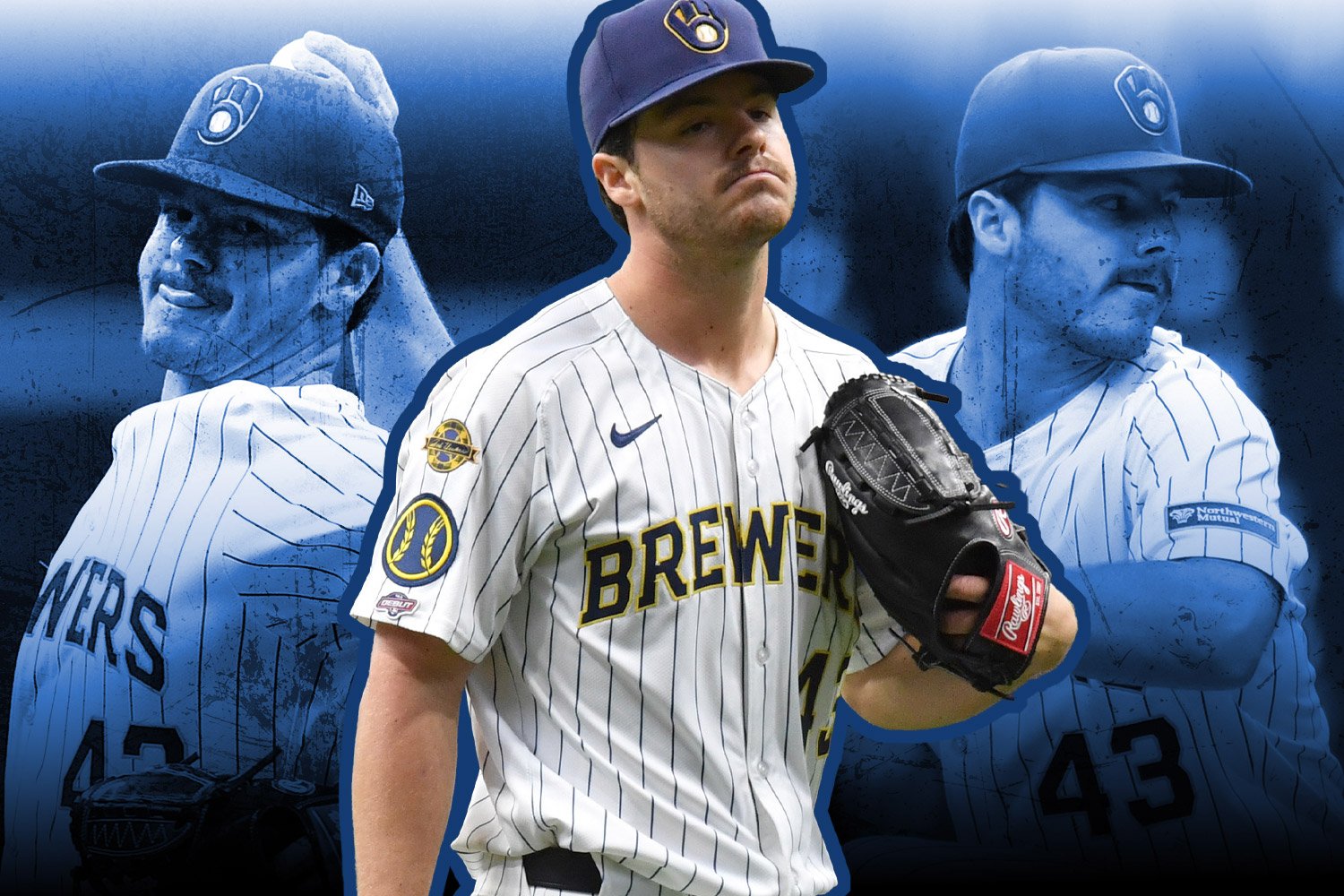
There are multiple reasons the Milwaukee Brewers felt comfortable trading away ace righthander Freddy Peralta this offseason. One of the big reasons was the presence of controllable righty starter Logan Henderson.
The soon-to-be 24-year-old has scaled the ranks of Crew prospects, currently ranked No. 7 by MLB Pipeline, and made his big-league debut early in 2025. Overall, he had three call-ups: a one-start sneak peek in April, three turns as an injury fill-in in May, and one more in August before a right flexor strain ended his season.
This article is the second in a series of breakdowns of the Brewers pitchers in ambiguous positions at the outset of spring training. To see the first entry, on left-handed starter candidate Robert Gasser, click here.
A fourth-round draft choice in 2021 out of a Texas junior college, Henderson has now been a hot prospect name for long enough that his pedigree feels better than that. He was really good in those five starts in the majors, too. In 25⅓ innings, allowed just five runs, with eight walks and 33 strikeouts. As a bonus, the Brewers won all five starts. At Triple-A Nashville, Henderson had 16 outings with a 3.71 ERA, notching 24 walks and 87 strikeouts over 77⅔ innings.
Alas, his season was derailed by the flexor strain in early August. He rehabbed and worked his way back to be in consideration for the NL Championship Series against the Los Angeles Dodgers. He didn’t make the roster for that series, but the good news was that he was ready then, so he should be fine entering spring training.
With two spots to be claimed in the rotation behind fellow righties Brandon Woodruff, Quinn Priester and Jacob Misiorowski, Henderson is in prime position to make his first Opening Day roster.
Logan Henderson’s Stuff
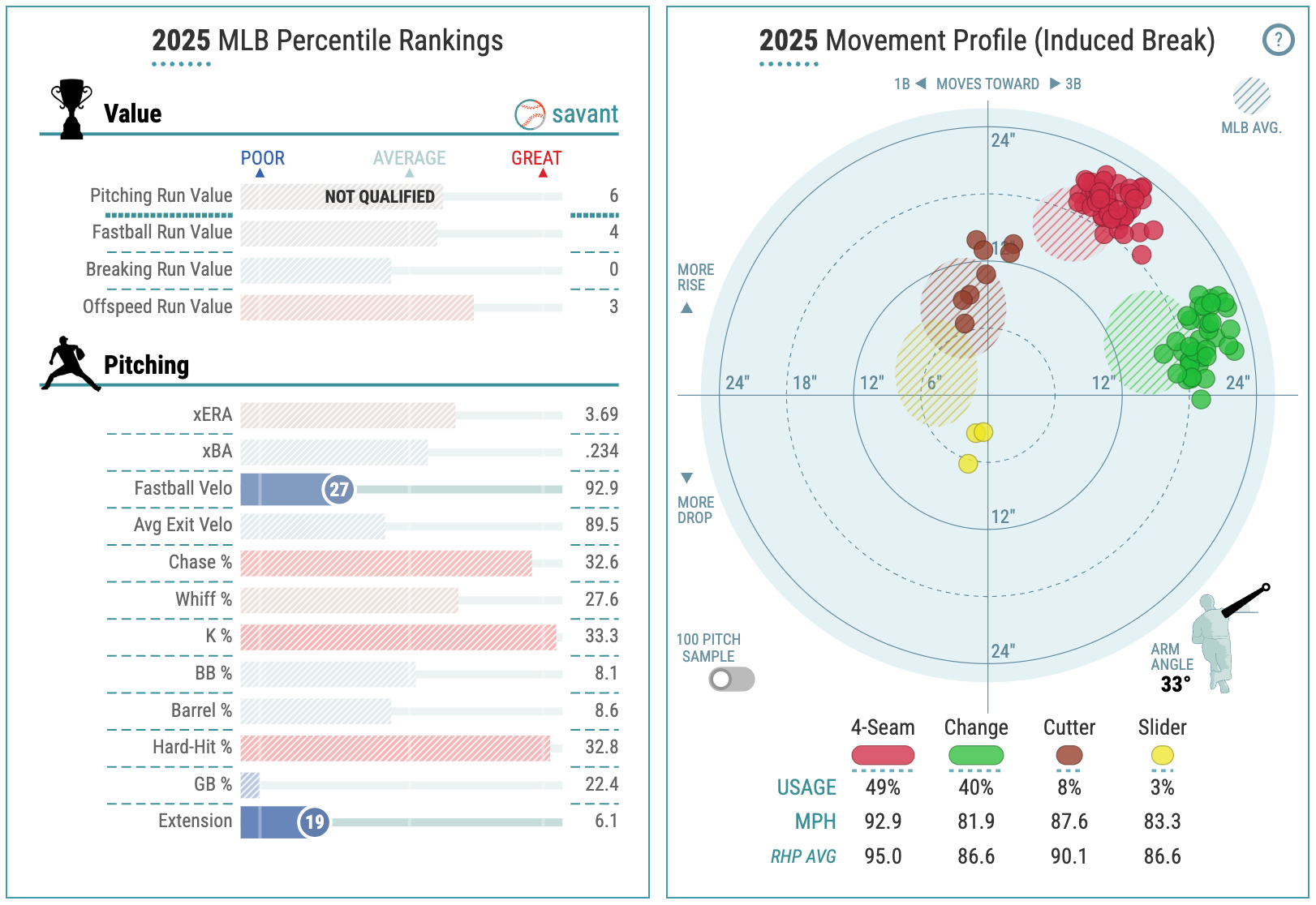
Due to the injury, we have a small sample of big-league data with which to work. However, Henderson worked relatively deep into each of his appearances, so there is a solid sense of what he does to be successful. He relies on a four-seam fastball and a changeup to get most of his work done.
Henderson’s four-seamer is effective due to having 3.4 inches more arm-side run than that of an average right-handed pitcher, while his changeup has 4.4 more inches of horizontal movement. After accounting for his low-three-quarters arm slot, the horizontal movement is a bit less deceptive than the raw numbers suggest, but the rising action on his four-seamer is more so. Using his unique combination of arm slot and movement, he limited right-handed batters to a .216 average and .473 OPS, while left-handed hitters had a .167 average and .602 OPS. All three homers he allowed were to left-handed batters on four-seamers.
The movement and deception are vital, because Henderson’s velocity is below average on each of his pitches, with his four-seamer coming in 2.1 mph below the typical big-league righty’s.
Logan Henderson’s Pitch Arsenal
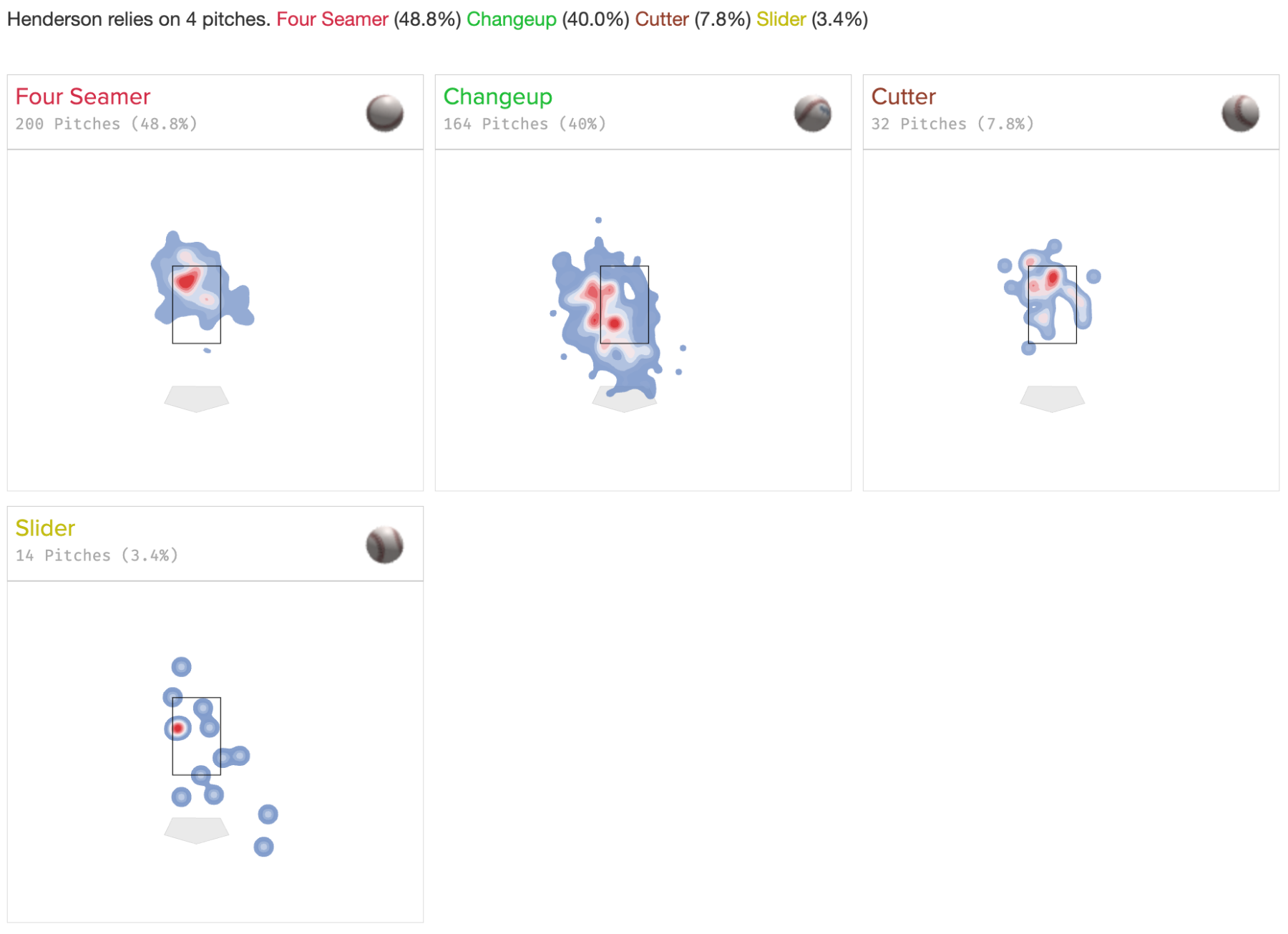
As mentioned above, Henderson uses two of his four pitches a bulk of the time. In fact, eight of every nine pitches he threw in the majors were either four-seamers or changeups. In the minors, he was a bit less extreme, throwing his cutter and curveball about 10% of the time each. Henderson used those last two pitches depending on the type of batter he was facing. He used his cutter only against left-handed batters in the big leagues, while he went to the curveball (or slider, as Statcast tags it) almost exclusively against right-handed hitters. Regardless of batter handedness, he throws the fastball around half the time, and the changeup plays against lefties and righties, alike. No batters got a hit off his cutter (0-for-5, 32 pitches), but his breaking ball was tagged a bit (2-for-4, 14 pitches).
To be successful at the highest level, Henderson will need those two pitches to achieve greater utility, especially as he works his way through the order again and faces teams multiple times.
What Should Logan Henderson’s Role Be In 2026?
Henderson has made 65 appearances as a professional, and the only non-start was a four-inning piggyback appearance last year in Triple A. The Brewers have a defined role for him: rotation or bust. He, Robert Gasser, Chad Patrick and Brandon Sproat will be the top contenders for the final two starting spots this spring. Patrick showed his versatility in the postseason by being a quality reliever, so he has that experience and could easily slide into the bullpen and be ready to jump into the rotation as needed. Sproat is like Henderson, in that he’s been a starter throughout his pro career. Gasser would be the only lefty in the team’s rotation, which might give him an edge on the other three.
If you were to pencil in a rotation entering spring training, Henderson would have one of those final two spots. Had it not been for his right flexor strain, Henderson would have been a solution for the Crew’s lack of starters in the postseason. He does have two minor-league options remaining, though, should others surpass him this spring. Eventually, if enough other hurlers stay healthy and he struggles enough to refine the cutter and the breaking pitch, he might make more sense in the bullpen, where he could find an extra tick of velocity and be played as a reverse-split matchup guy with the great changeup. For 2026, though, he enters camp as a starter who will get a chance to fill that role with the parent club. The fallback plan is still to start, but in Nashville.