
Baseball is all about probabilities, and that theorem also applies to prospects trying to become big leaguers. All players in professional ball have talent, of course; it’s just that the competition level is so high and the margin for error so thin that there is a chance of failure for just about everyone.
So what makes for a high-probability position player talent? Being able to consistently hit pitches very hard is deeply important. Plate discipline—both in the ability to draw walks and avoid striking out too much—is also important. So, too, is the ability to play competent defense, especially at a premium position. And while good tools are nice, players who utilize their toolsets to dominate competition in the Minor Leagues are more likely to succeed than those who struggle.
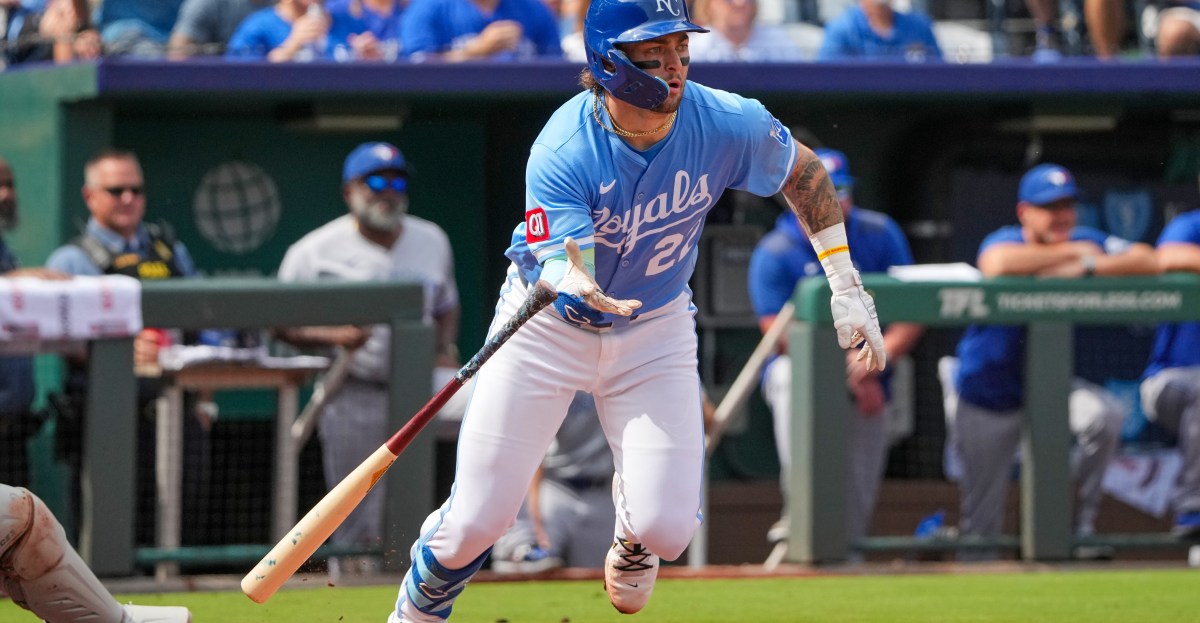
If that previous paragraph sounds like I’m describing Carter Jensen, that’s because it is. The Kansas City Royals selected Jensen with the 78th pick in the 2021 MLB Draft out of Park Hill High School, whose campus is a quick 25-minute drive away from Kauffman Stadium. And while all high schoolers have high risk, Jensen has blossomed into a really promising player and made his MLB debut last September.
Prospect lists aren’t everything, but they give a good sense of how industry professionals who have watched and evaluated more baseball than you or I ever will think of a player—and Jensen is regarded quite well. MLB.com lists Jensen as the 18th best prospect in the game. The Athletic has Jensen at 10th overall. Baseball Prospectus has Jensen at 44th overall. Baseball America lists Jensen as the 11th best prospect.
And yet, man, I think people are still sleeping on Jensen.
That’s because of the third factor, the secret sauce if you will, in the cauldron of traits that contribute to probability that a minor leaguer will make it: age. We see players hit well all the time in Minor League Baseball, and even do so at the upper levels. Most players who do so, however, are old for the league. Remember deep cut Royals prospect Balbino Fuenmayor? He hit an absurd .358/.384/.589 across Double-A and Triple-A in 2015. But he did so while already playing in his age-25 season.
Jensen has been excellent throughout the minor leagues, and has consistently done so at very young ages. And in fact, last year’s campaign put Jensen in extremely rarified air. I went and pulled all players who met this qualifications over the last decade:
In age-21 or younger seasonMinimum 400 plate appearancesAt least 1 PA in Triple-AWalk rate above 12%Strikeout rate below 25%Isolated slugging percentage above .200wRC+ of at least 130
Jensen was one such player. But across the thousands of players who have played in the Minors during that time, there are only eight other players who qualify. It’s a good list, featuring three Rookie of the Year winners, a Rookie of the Year top-three finalist, an MVP award winner, a current top prospect, and multiple other productive big leaguers.
#NameTeamLevelAgePABB%K%AVGOBPSLGwRC+2025Jett WilliamsNYMAA,AAA2157213.3%22.9%0.2610.3630.4651362025Carter JensenKCRAA,AAA2149212.2%24.8%0.2900.3770.5011362024Roman AnthonyBOSAA,AAA2054014.6%23.5%0.2910.3960.4981472023Coby MayoBALAA,AAA2161415.1%24.1%0.2900.4100.5631532022Gunnar HendersonBALAA,AAA2150315.7%23.1%0.2970.4160.5311522022Corbin CarrollARIAA,AAA,CPX2144215.2%24.2%0.3070.4250.6101442022Francisco AlvarezNYMAA,AAA2049514.1%24.8%0.2600.3740.5111372021Spencer TorkelsonDETA+,AA,AAA2153014.5%21.5%0.2670.3830.5521502016Cody BellingerLADAA,AAA2047712.6%19.7%0.2710.3650.507147
But Jensen didn’t stop there: he is one of only four players in the last decade to fit all of those categories and also make his MLB debut the same year. The three players who qualify for that extra category are Gunnar Henderson (2023 AL RoY winner), Corbin Carroll (2023 NL RoY winner), and Francisco Alvarez (career 105 wRC+ and 6.6 fWAR in only 304 career games).
To quote the indomitable Adam Savage, failure is always an option; Coby Mayo’s big league career to date is a testament to that truth. Jensen could always end up on the Mayo path. And yet, probabilities are what they are, and given the skills that Jensen has already shown—elite exit velocity, excellent plate discipline, solid contact ability, and a knack for adjusting to continually more difficult pitching at a young age—it is very likely that Jensen is very good very quickly.
Despite a very strong resume, Jensen is viewed mostly as an afterthought in the American League Rookie of the Year prediction circuit. MLB Pipeline recently interviewed 44 front office officials, and only three of them predicted that he’d win.
Maybe that’s good for Jensen. We all saw what kind of pressure Jac Caglianone was under last year. In any case, Jensen should be getting more buzz. He’s ready. He’s gonna be good. And it’ll be fun to watch.