
Prepare to be amazed.
You know, catcher, that black sheep of a position that’s often as frivolous and frustrating as tight end is in Fantasy Football? What if I told you it’s actually good now?
Heard that one before, have you? Gotten burned more than once by some young upstart who ultimately fell victim to attrition, playing-time chicanery, or plain old-fashioned failure? Yes, all three are pretty common at catcher, largely because of the physical demands it places on its participants.
But this time, I mean it. It’s not mere wishcasting over some hypothetical somebody. It’s not naively whitewashing some deeply flawed data, darling. The influx of talent here has been so extensive over the past couple years that the redundancies run deep. And these are all players who, to some degree or another, have already demonstrated what they can do.
Position Strategies: C | 1B | 2B | 3B | SS | OF | SP | RPPosition Tiers: C | 1B | 2B | 3B | SS | OF | SP | RP
There are, for the purposes of a 12-team league, 18 deserving starters by my count — one more if a particular DH-only player regains catcher eligibility as expected — and if you also wanted to rope in Austin Wells, Dillon Dingler, and Logan O’Hoppe as well, I wouldn’t fight you over it. What it means is that if you pick the wrong one in your one-catcher league, you have more than half a dozen others to fall back on. Ain’t nobody rostering two catchers.
Am I saying that catcher, of all positions, is attrition-proof? Shoot, I’m saying it’s foolproof. The potential to miss goes up in two-catcher leagues, of course, but even there, the expectation was always that your second catcher would stink. More likely than not now, he won’t.
So if a position is foolproof, why invest anything in it on Draft Day? Hey, I’m asking myself the same question. Surely, they are gradients within the surplus, but they’re not as steep as you might think. To whatever degree I’m about to sort these players, understand that it’s with low conviction.
With one glaring exception, of course.
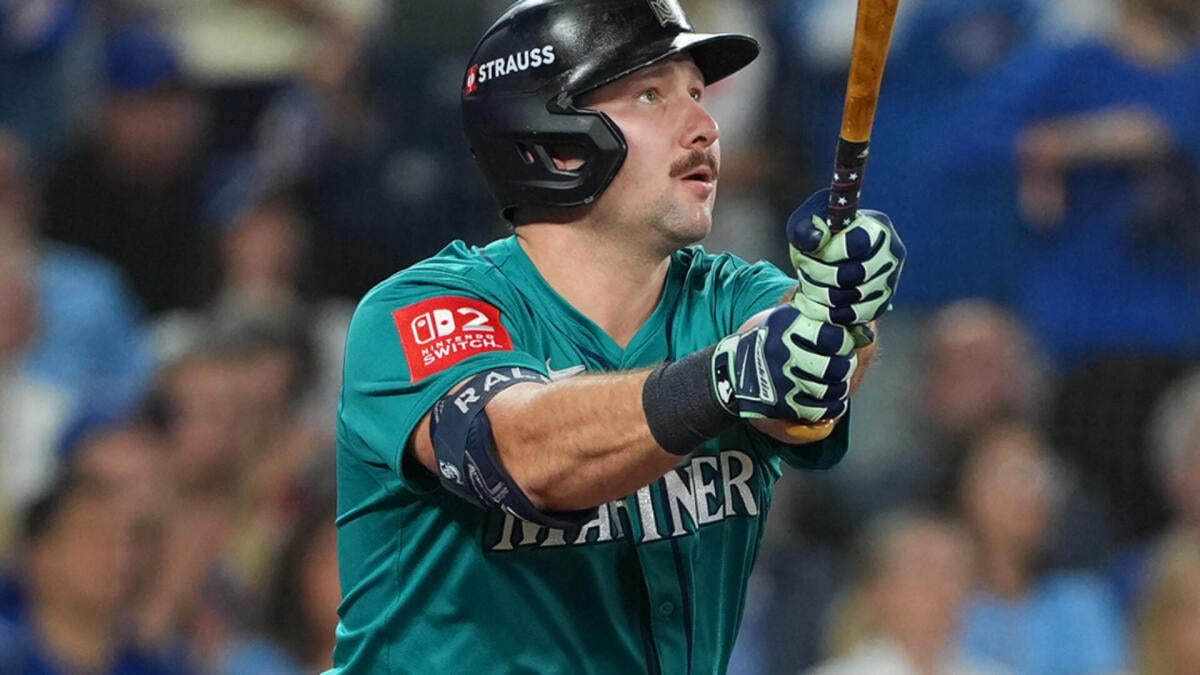
In the long and storied history of the most revered American sport, only seven players have ever hit 60 home runs in a season. One, against all odds, is a catcher. I never would have thought it possible, given the wear and tear inherent to the position and the off days normally required to address it, but Raleigh has always had a reputation as a workhorse. Of course, he’s always had a reputation as a batting average drain, and even his .247 mark last year was by far the lowest for a 60-homer guy.
Historic achievements are, by their nature, unlikely to be repeated, so the question is how much of this one Raleigh gives back. Giving it all back would mean he’s a .230-hitting, 30-homer guy again, which would still be plenty valuable but a disappointing outcome relative to his cost. Genuinely, nobody can predict where he goes from here, so the best way I know to account for both the upside and downside is to split the difference and project something like 45 home runs, which would basically make him Kyle Schwarber with catcher eligibility and, thus, deserving of his price tag. He’s your best chance of distinguishing yourself at a position where it’s difficult to do so, on account of all the depth, so while I wouldn’t reach for him, also on account of all the depth, I wouldn’t pass him up in the middle of Round 2.
I might quibble about the order of these four, but they deserve to be the next four, all capable of finishing second to Raleigh in 2026 or overtaking him outright if he “gives it all back.” William Contreras, in fact, was the gold standard at the position the previous two years, and after playing with a broken finger in the first half, he was back to a familiar .281/.361/.472 slash line in the second half. Hunter Goodman’s 31 homers and 91 RBI made him one of the season’s biggest surprises, but one who I believe proved his mettle. He played almost as regularly as Raleigh and held a steady stat line all season long.
Goodman seems less risky to me than Shea Langeliers, who showed real improvement as a contact hitter but hit about seven more home runs than Statcast thought he deserved, and Ben Rice, who only began to scratch the surface of his potential last year but remains a platoon risk, particularly with the Yankees bringing back Paul Goldschmidt. Langeliers may have a higher floor and Rice a higher ceiling than those in the group to follow, but I wouldn’t say they’re any more proven. The distinction is so thin, in fact, that I’m unlikely to pay the upcharge for any of The Studs, Contreras, and Goodman included, unless one finds himself in free fall, which can happen in one-catcher leagues.
You see what I mean about the distinction being thin? Between Agustin Ramirez’s point-per-game average, Salvador Perez’s home run total, Will Smith’s batting average, and Drake Baldwin’s overall stat line, you may wonder why those four in particular are grouped separately from the studs. For Ramirez and Baldwin, it’s because they haven’t been vetted as thoroughly, and for Perez and Smith, it’s because they have some clear restraints on their upside. But clearly, there’s a lot to like here. Ramirez is the position’s single best bet for a worthwhile stolen base total and, judging by his expected stats, left about as much meat on the bone as Ben Rice as a hitter. Baldwin, meanwhile, has a near-perfect hitting profile, combining premium exit velocities with a high contact rate and up-the-middle approach, and now that Sean Murphy is projected to miss the first quarter of the season due to hip surgery, the impediments to his playing time are gone.
As for Perez and Smith, what they lack in intrigue they make up for in reliability, and honestly, we could wrangle Yainer Diaz and Adley Rutschman into this group of near studs as well. Rutschman has the pedigree of a former No. 1 pick and used to hang out with William Contreras at the top of the catcher rankings. Diaz is held back by some truly awful plate discipline, but is arguably the best bet for batting average at the position and was being drafted as high as second in some leagues last year.
The chances of any of the aforementioned six performing like studs are high enough that I think they represent the best bang for the buck at the position. Some may not be as predictable as the previous group, but you might as well go the thrifty route when you can be sure not all the quality options will be drafted. Plenty to fall back on.
Two of those fallback options are Alejandro Kirk and J.T. Realmuto, who fit the description of deserving starters for Fantasy but simply don’t measure up in terms of upside.
*minor-league stats
Something to keep in mind as you read through this series of articles is that while The Starters are listed ahead of The Sleepers, they don’t all need to be drafted ahead of them, and the ADP reflects this as well. The distinction is more that The Starters are already established, while The Sleepers have something to prove. What they end up proving, though, could be enough to propel them ahead.
All Ivan Herrera has to prove is that he’s actually a catcher. He won’t be eligible at the position to begin 2026, which means I’m kind of cheating by including him here, but the expectation is that he’ll get back to participating there after an elbow injury prevented him from doing so for most of last year. In the meantime, he’ll be clogging up your DH spot, which suppresses his draft stock, but seeing as he hit for a high average and homered at a near-30 pace last year, with all the data to back it up, he’s a potential top-five catcher.
Samuel Basallo and Carter Jensen, meanwhile, have all the prospect shine you could ask for. Basallo is more of a middle-of-the-order masher than a true catcher, but he retains eligibility there for now. Jensen ranks a little further down prospect lists but made the stronger impression of the two in a late-season debut, generating exit velocities akin to the best sluggers in the game — and with good plate discipline to boot. His playing time seems more secure, too, with the expectation being that he and Salvador Perez will switch off between catcher and DH. I might actually prefer Jensen to Basallo even though his cost is lower.
But that’s hard to say. They’re all so enticing, and since, again, I’ll have the opportunity to fall back on any of the undrafteds in a one-catcher league, I wouldn’t at all mind waiting until this group to take my top catcher, possibly even with my very last pick. Even Gabriel Moreno and Francisco Alvarez, who’ve been around for a while, are young enough to inspire new optimism. Just check out their second-half numbers.
Would it be disingenuous to say the biggest surprise of Cal Raleigh’s 2025 was his 14 stolen bases, making him one of just two catchers with double digits? He tripled his career total with that performance, but it’s hard to imagine it’ll be a big priority for him going forward. In fact, the only catcher for whom stealing bases may be a priority is Agustin Ramirez, who led the position despite a late arrival and had a 22-steal season in the minors. Harry Ford, who’ll be looking to overtake Keibert Ruiz on the Nationals after coming over from the Mariners this offseason, was a prolific base-stealer in the minors before a precipitous drop-off in 2025. I remain hopeful, but he has to play and has to hit before he can run, obviously.