
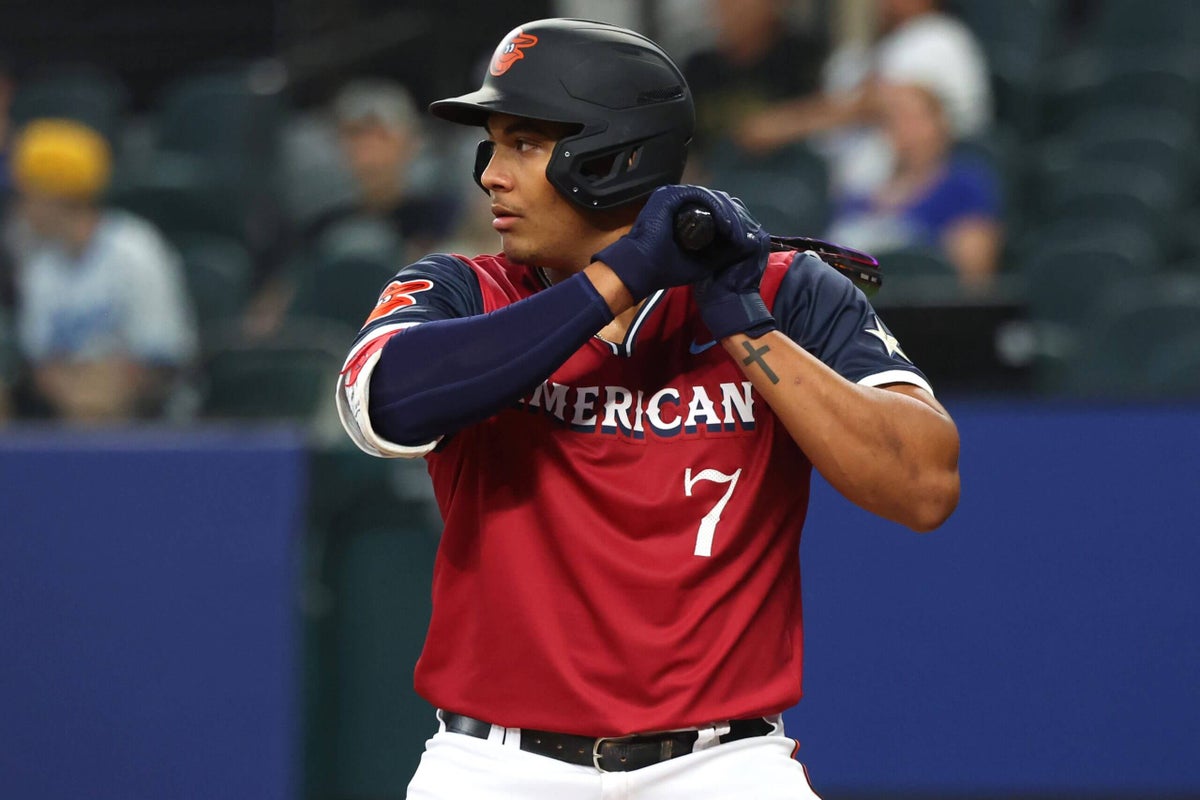
Even after the Baltimore Orioles traded four prospects, two of whom would have (probably) been in their top 10, they still have a strong farm system that’s in the upper third among MLB organizations. It’s very hitter-heavy at the top, followed by a big group of arms who might be starters and all have relief risk. If two of those guys reach their ceilings as starters, though, that’ll be a tremendous outcome for the O’s, especially if they arrive in time to help their young lineup.
(Note: Tools are graded on a 20-80 scouting scale; ages as of July 1, 2026. EV = exit velocity.)
Height: 6-4 | Weight: 180 | Bats: L | Throws: R | Age: 21
Basallo’s meteoric rise to the majors has somehow received less attention than you might expect from the profile: He’s a catcher, easily the best catching prospect in the minors right now, who hits and has significant power, and reached the majors four days after his 21st birthday. Basallo was the only player under 21 to get even 300 plate appearances in Triple A last year, hitting .270/.377/.589; that slugging percentage was sixth among Triple-A hitters, and his ISO was second to that of 27-year-old Matt Mervis. He’s got power to all fields, peaking at 116 mph and hitting a third of his Triple-A homers the other way, and his Barrel rate was 21 percent. Only two MLB hitters last year topped that, and each won his respective league’s MVP award. While Basallo did walk at a very high rate (13.7 percent) and didn’t strike out excessively (23.7 percent), his swing decisions do leave something to be desired: He chased pitches well out of the zone 30 percent of the time, and with two strikes, that jumped to 42 percent. He’ll work the count once he’s ahead, but once he’s behind, he gets much more aggressive, to his detriment.
He’s got at least a 70 arm, and he’s improved significantly on defense in the minors, but he’s still a below-average receiver and would need more time at the position before he could take over as a full-time catcher. It’s possible that will never come to pass, with Adley Rutschman also in Baltimore, and Basallo’s bat close to major-league ready. I am ranking Basallo here on the belief that he could, in a neutral environment (e.g., if he’s traded tomorrow to a team without an incumbent catcher), become a 45 all-around defender, in which case his potential for 25+ homers would make him an All-Star. If he ends up at first base or DH for the majority of his time in the majors, he could still end up an All-Star because of the power — which might be more 30 to 35 homers — but he’ll have to show better command of the strike zone before he gets to that point.
Height: 6-2 | Weight: 200 | Bats: R | Throws: R | Age: 22
Aloy is a true shortstop with power, showing plus defense as an amateur with good lateral range and plenty of arm for the left side of the infield, while he led a loaded Razorbacks lineup with 21 homers and a .673 slugging percentage. Baltimore took him with their second selection, pick No. 31, as part of a very strong Day 1 draft class that included Ike Irish and two of the players they just traded to acquire Shane Baz. Aloy has the hard-contact data that many teams seek in the draft, with a 54 percent hard-hit rate with Arkansas, thanks to great bat speed and hand strength. He does have trouble with breaking stuff and generally with swinging at pitches beyond the strike zone. He’s got a big leg kick and gets his front foot down somewhat late, which might be contributing to some of his timing issues, although I think there’s some pitch-recognition issues mixed in as well. His future is going to come down to the choices he makes at the plate; he would have gone in the first round proper had he shown better swing decisions, but model-heavy teams rated him lower than that primarily because his swing decisions were a net negative. He has 20-plus homer upside in a shortstop who should be at least a 55 defender — or a 60-plus if he ends up at third base — with his ultimate value coming down to whether he can pick up spin and cut down on the chase.
Height: 6-0 | Weight: 200 | Bats: R | Throws: R | Age: 20
George plays like his hair’s on fire, and while that phrase gets thrown around a lot, in his case it seems to make him a better player in every aspect of the game. He’s a twitchy athlete with quick hands at the plate, and he shoots line drives to both gaps, with fringy power right now. Then he runs like a madman out of the box and doesn’t stop until he reaches third base. He’s the kind of runner who’ll throw his helmet off because it’s slowing him down, which at least gets him points for artistic impression. He also shows plenty of range in center, thanks to his 80 speed and solid reads already, although he doesn’t have the same instincts on the bases and can be overly aggressive. The Orioles drafted George in the 16th round out of an Illinois high school about 50 miles south of Chicago, and when he went off at the plate in the Florida Complex League, I was kind of skeptical. He kept it up in Low A, where he hit .337/.410/.491, and even earned a promotion to High-A Aberdeen (RIP) and hit .291/.380/.392 there in 21 games. He has All-Star upside, if he gets to 55 or so power (I think that’s his max), and could be an everyday player if he just gets his tendency to expand the zone in check.

A scapula injury forced Ike Irish to move from catcher to the outfield last season for Auburn, but his bat will carry him regardless of position. (Gary McCullough / Associated Press)
Height: 6-2 | Weight: 201 | Bats: L | Throws: R | Age: 22
Irish was the Orioles’ first pick among their passel of selections on Day 1 of the 2025 draft, going at No. 19. He slid a little in the draft because of uncertainty over his position but still presented great value at that pick given what he can do at the plate. He started last season as Auburn’s primary catcher, but after fracturing his scapula he went mostly to right field, and the Orioles had him play more in right and at first than they did behind the plate. His upside is all about the bat: He makes very hard contact, works the count well and uses the entire field, with the potential for 20 to 25 homers if he trades some contact to try to pull the ball more. In the spring, he hit the ball the other way quite a bit more than he did to his pull side, so perhaps there’s a happy medium here where he pulls the ball somewhat more often without surrendering that now-rare skill of being able to go to the opposite field to discourage pitchers from attacking him on the outer third.
The current plan is to develop Irish away from catching, although he may still get some reps back there, and focus on his offense instead. He’s about a 40 defender in right, but if that gets to even a 45 he should hit enough to be an above-average regular. And since I’m sure some regular readers will ask: Irish is lower here than he was in the predraft rankings, relative to other players in this draft class, based on feedback I received after the draft from teams that passed on him and from pro scouts who saw his brief time in Low A. I don’t usually shuffle or move recent draftees much from their predraft order, but after they’re picked, I do get new information that teams didn’t want to share beforehand.
Height: 6-0 | Weight: 170 | Bats: L | Throws: L | Age: 24
Bradfield is still an 80 runner and a 70 or 80 defender in center field — it’s hard to call him an 80 when Vance Honeycutt is in the same system and he makes 80 look insufficient by a factor of 10 — with enough command of the strike zone to see a high floor for him as a second-division regular who generates 2 WAR in many seasons just on defense, speed and contact. Two and a half years after the Orioles took him with the No. 17 pick in the 2023 draft, his swing is still a work in progress; he got the ball off the ground more last year, but the net result was more flyouts and pop-ups to the left side, which is not what we’re going for here. With his speed, line drives to the gaps would be more than enough, and he has enough strength to do that even with below-average power.
He’s going to save a ton of runs with his glove, as he combines good instincts with elite speed to cover a huge amount of ground and has already made a number of highlight plays, including a catch in the Arizona Fall League last year when he stole a home run to end the game. I have long hoped he’d get to a consistent enough swing path to be that line-drive hitter who can rack up doubles and triples with his speed, figuring the Orioles would simplify his overly complex swing over time. It still could happen, but I think he’s more likely to be near his floor than his ceiling right now.
6. Dylan Beavers, OF (Just missed)Height: 6-5 | Weight: 206 | Bats: L | Throws: R | Age: 24
Beavers has been tinkering with his swing since the Orioles took him with their second pick (pick No. 33) in 2022. This past year was his best yet, as he hit .304/.420/.515 in Triple A, earning his first call-up to the majors. He still has a little bit of a hitch in his swing, but it’s much reduced, with his hands higher when he loads and a little farther out from his body. He’s very strong, leading to high exit velocities even with just average to slightly above-average bat speed, and he should be a 20-homer guy for a few years in the majors.
The Orioles did finally get him out of center field last year; it looked as if he might stay there when they drafted him, but the past few years have shown he’s better off in a corner and could be above-average in either spot. I think he’s a regular and ready to step into a job right now, more capable of playing every day than Colton Cowser as Beavers gets on base against lefties at a solid clip. I don’t know if his swing shape is going to let him hit for a high average and power at the same time, and given that he’s a corner outfielder he has to do a good bit of both to be an above-average regular.
7. Esteban Mejia, RHPHeight: 6-3 | Weight: 175 | Bats: R | Throws: R | Age: 19
Mejia pitched all of last year at age 18, finishing with three short starts in Low A before the Orioles shut him down for the year. He’s already hit triple digits with his fastball, and he has a long but very loose arm action. Mejia can really spin a tight upper-80s slider, and he has the rudiments of a changeup but not a ton of feel for it yet. He’s definitely still learning the craft, overpowering guys at two levels with pure stuff while still walking too many batters (13.7 percent). It’s a starter-ish look in body and delivery, and certainly pure stuff, especially for someone so young and still projectable.
8. Luis De León, LHPHeight: 6-3 | Weight: 168 | Bats: L | Throws: L | Age: 23
De León is 95-97 mph with a 55 changeup and an average slider, enough of an arsenal to see him as a future starter. It’s not a great delivery for that role, however, as he’s very upright and stiff at his release, spinning off his front heel, and generally struggling to repeat the delivery to get to strikes. He’s long and lean with clear projection to the frame, and if he has to go to the bullpen he might throw 100. He had an excellent year after a fairly pedestrian 2024 season, working through three levels in 2025 to finish at Double A, striking out 28.5 percent of batters he faced while walking 10.9 percent across the entire season. If he’s a starter, he’ll be a good one, but I think it’s 70/30 he goes to the bullpen.
9. Boston Bateman, LHPHeight: 6-8 | Weight: 240 | Bats: R | Throws: L | Age: 20
Bateman came over from the Padres in the Ramón Laureano/Ryan O’Hearn trade along with five other guys (about whom you can read here). Bateman didn’t pitch well for the Orioles during the last month of the summer, as he walked a left-handed batter for the first time in the 2025 season after walking none in four months before the deal. He’s 6-foot-8 and works in the mid-90s with a plus slider, using a low three-quarters arm slot that gets some angle to the latter pitch. It’s a cross-body delivery that he doesn’t repeat well, exacerbated by his size, although he does get good extension out front. He does look like he’s playing catch out there, even at 96. He’s got as much upside as any pitcher in this system, but I wouldn’t be shocked if it took him longer than it does for most pitchers to figure out his delivery and command, just given his sheer size.
10. Trey Gibson, RHPHeight: 6-5 | Weight: 240 | Bats: R | Throws: R | Age: 24
Gibson got knocked around in High A to start last season, entering May with an 8.04 ERA, then flipped the switch right as I happened to see him strike out 10 in 4 2/3 innings on May 3, so I’ll take all the credit for his season. He rolled through High A and dominated Double A before some tough sledding in seven Triple-A starts. He throws seven different pitches, per Statcast, sitting 94-97 with a hammer slider that’s probably his best pitch; despite throwing breaking balls about half the time, he had a huge reverse platoon split last year and a small, still reverse one the year before. He comes from a high three-quarters arm slot, so all of his stuff breaks downward, and lefties just don’t seem to see the ball as well. He’s also not quite as sharp with men on base, getting crushed with runners on last year, although it’s more a marginal decline in stuff. The Orioles have a bunch of pitchers in their system who were undrafted (like Gibson) or lower-round draft picks; of that group, Gibson has the best chance to start, but he still has major relief risk. I’d love to see him face off against Nick Martini; the only way we could tell them apart would be if Gibson wore an onion on his belt.
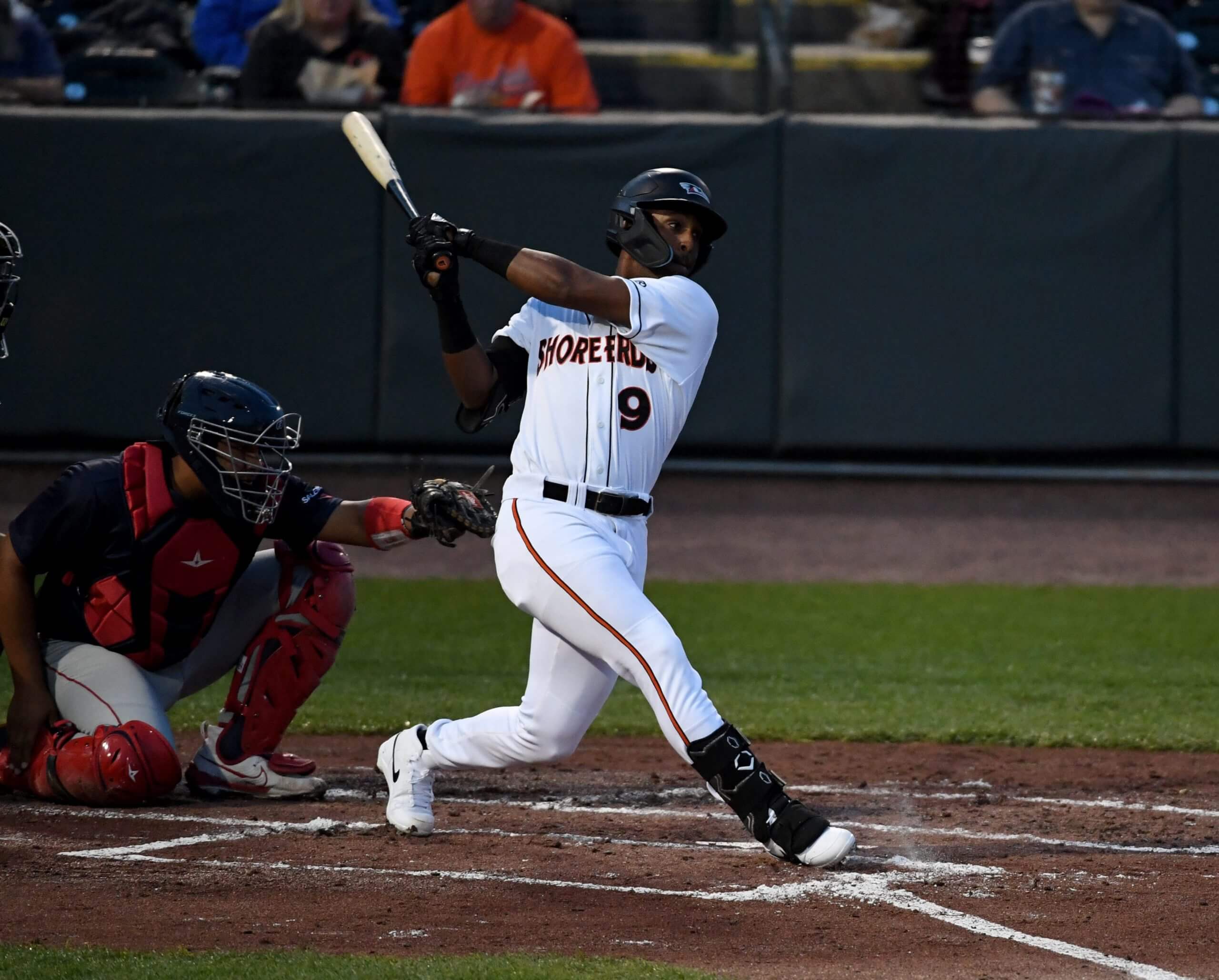
Aron Estrada has huge offensive potential, but his defensive home remains unclear. (Lauren Roberts / USA Today Network via Imagn Images)
11. Aron Estrada, 2BHeight: 5-8 | Weight: 142 | Bats: B | Throws: R | Age: 21
Estrada has elite bat speed and is going to hit for at least average power even though he’s pretty fun-sized; if he had a clear position, he might be a top-100 prospect. He’s an aggressive, swing first and ask questions later kind of hitter, chasing a few too many pitches out of the zone (29 percent) but rarely missing when he swings with two strikes, so he’s continued to hit for average up through his stint in Double A, with a combined line last year of .288/.366/.447. He’s an above-average runner who should be able to play somewhere, but his position is like Planet X: People have looked but no one’s found it yet. He’s not good at second base, shortstop is a non-starter, and left field wasn’t so hot, either. If he can make himself a 45 defender at second, he’ll be a regular because he can hit so many pitches and hit them hard enough to make it count.
12. Nestor German, RHPHeight: 6-3 | Weight: 225 | Bats: R | Throws: R | Age: 24
German comes right over the top with a 91-96 mph fastball that gets nearly 20 inches of vertical break, pairing it with a deadly splitter with big bottom (RIP Rob Reiner) and several mediocre breaking pitches that still get some whiffs because his slot is deceptive. He was an 11th-round pick in 2023 out of Seattle University, ripped through both levels of A ball in 2024 and was pretty successful in Double A last year, stumbling only in two starts in Triple A to end the year. He could be a fourth starter as is, although I’m concerned that a lot of the contact he does give up is pretty hard contact, which he’s mitigated by not giving up that much contact overall. If he isn’t a starter, he’d be a very good candidate for long relief in a three-inning role rather than short relief.
13. Levi Wells, RHPHeight: 6-2 | Weight: 216 | Bats: R | Throws: R | Age: 24
Wells’ velocity jumped significantly in his second year in pro ball, as he was up to 97 in 2024, then sat 97-98 last year while hitting 102. It’s a four-pitch mix with a cutter, slider and curveball, but despite that huge velocity, nothing’s plus or even clearly above average; none of those four pitches generated even a 30 percent whiff rate last year. He does have enough control to hope for a fifth starter, which seems crazy given the velocity; it’s not like moving him to the bullpen will help him throw much harder.
14. Joseph Dzierwa, LHPHeight: 6-8 | Weight: 200 | Bats: R | Throws: L | Age: 22
The Orioles took Dzierwa with the 58th pick in the 2025 draft, making him the highest-drafted pitcher of the Mike Elias era in Baltimore. He’s a fastball/changeup guy, with the changeup plus, working with a stiff, no-windup delivery and no average breaking ball. He walked just 22 in 91 2/3 innings (5.9 percent) for Michigan State last year, so at worst he should be a fifth starter; whether the Orioles can find a third pitch will determine if he can ever be more.
15. JT Quinn, RHPHeight: 6-6 | Weight: 210 | Bats: R | Throws: R | Age: 22
Quinn sat 94-96 for Georgia last spring with a sharp, downward-breaking slider that was very effective against righties, but he had no third pitch for lefties and got lit up as a consequence. He does have a starter’s delivery and build, coming from an arm slot just above three-quarters that might be good for a splitter if he can’t throw a true changeup.
16. Braxton Bragg, RHPHeight: 6-2 | Weight: 207 | Bats: R | Throws: R | Age: 25
Bragg was in the midst of a breakout season in 2025 when he tore his UCL, undergoing Tommy John surgery in July that probably puts him out of action until at least this fall. It’s great stuff from a brutal delivery, 94-96 with a changeup that dies over the plate and a sweepy slider that gets some extra life from his very low arm slot. It’s a slinger’s arm action, though, with his arm late and still well behind him as his front foot lands, making it impressive that he could have the control he did, with a 7.2 percent walk rate between High A and Double A last year. You don’t see many starters who throw like this because they can’t hold up or they have massive platoon issues or they don’t throw strikes. The latter two points have not been true for Bragg so far; we’ll see about the first one.
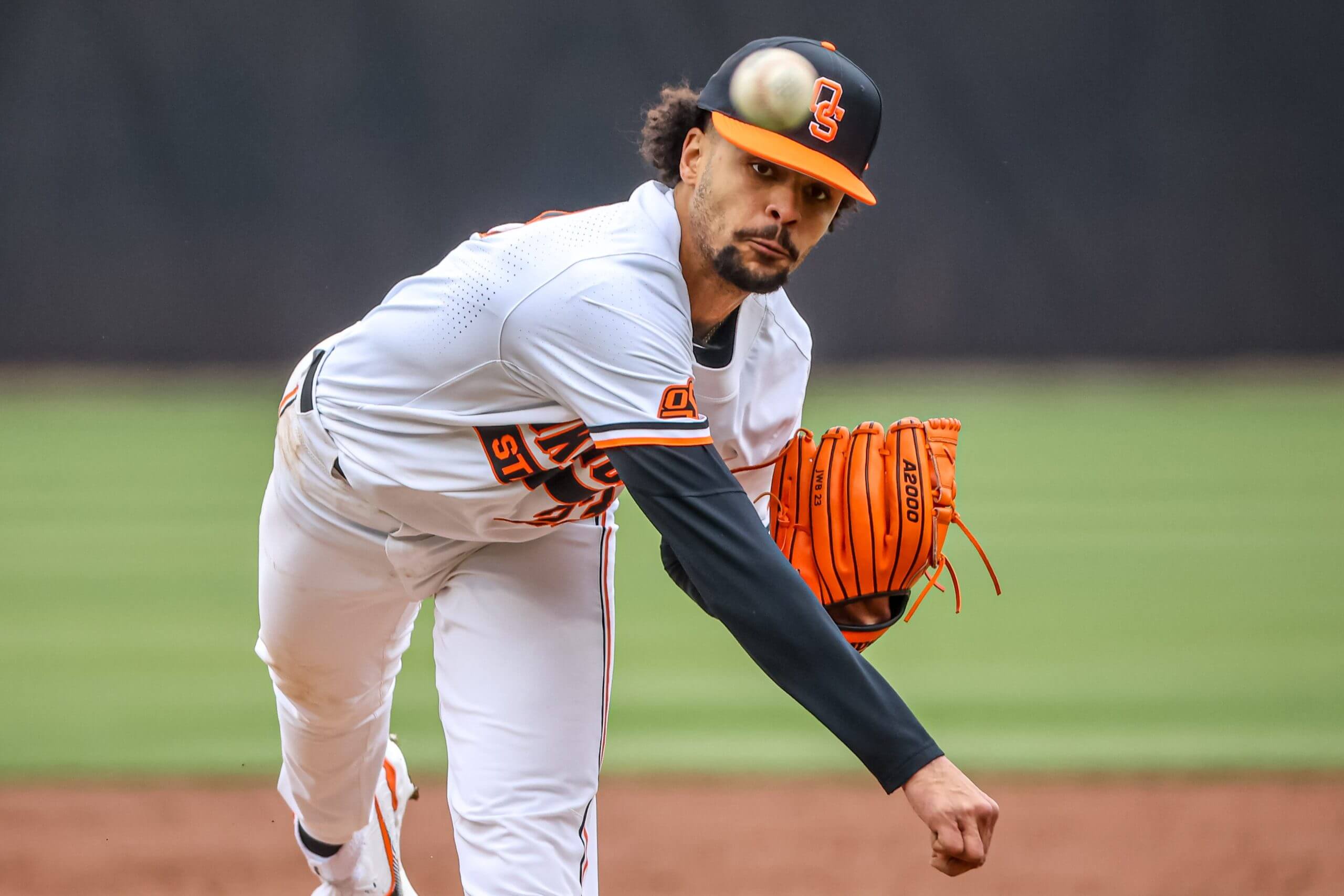
Juaron Watts-Brown pitched for Oklahoma State in college. (Nathan J. Fish / The Oklahoman / USA Today)
17. Juaron Watts-Brown, RHPHeight: 6-3 | Weight: 190 | Bats: R | Throws: R | Age: 24
Acquired from the Blue Jays for Seranthony Domínguez, Watts-Brown is 91-96 with two above-average breaking balls, an athletic delivery and a problem with hard contact. His four-seamer got hit hard before the trade, and it didn’t improve afterward: He made seven starts for Double-A Chesapeake and gave up 10 homers in 35 1/3 innings. It’s a hilarious stat line, because he gave up only 20 hits total, so half of them were home runs. He’s very athletic and repeats his delivery well, so maybe if he finds a functional fastball — a two-seamer, a cutter, even a four-seamer that maybe gets some more ride? — he could be a mid-rotation starter. Right now, I can’t see him as a starter of any sort because even if he throws his fastball only 40 percent of the time, that might be too much.
18. Andrew Tess, CHeight: 6-0 | Weight: 200 | Bats: R | Throws: R | Age: 19
The Orioles went slightly over slot in the 12th round in 2024 to take Tess out of a Florida high school, a month before he turned 18, and he has been one of the few bright spots from their 2024 draft class. He hit .256/.457/.368 in the Florida Complex League, taking a ton of pitches, then moved up to Low-A Delmarva and did the same in 11 games, although he whiffed quite a bit on offspeed stuff against the better pitching. He has a borderline plus arm and the right build for a catcher, although his receiving definitely needs some work. He’s physical and strong already and should come into a lot more power than he’s shown. It’s a promising start for that rarest of beasts, the high school catching prospect.
19. Stiven Martinez, OFHeight: 6-4 | Weight: 198 | Bats: R | Throws: R | Age: 18
Martinez projects to plus power, probably more like 70 power, but has yet to hit much in his two years in pro ball, with a .217/.368/.362 line in the FCL last year before he moved up to Low A for a month and struck out in nearly half his plate appearances. He turned 18 only in August, and the ball already comes off his bat unusually well for a teenager. I just have no idea if he’s going to hit.
20. Colin Yeaman, SSHeight: 6-2 | Weight: 200 | Bats: R | Throws: R | Age: 22
Yeaman was Baltimore’s fourth-round pick last year out of UC-Irvine, where he hit .336/.447/.591 after transferring there from a junior college. He has average power and has shown he can hit a good fastball. He’s not likely to stick at shortstop given his body, with third probably the most valuable option he has a chance to play. There isn’t enough top-end power here to see a regular at a corner, with more of a bench/utility upside unless he either starts hitting the ball much harder or can stay somewhere up the middle.
2026 impact
Basallo should be on the Opening Day roster in some capacity, maybe spelling Adley Rutschman twice a week behind the plate to try to keep Rutschman healthy and at his most productive. Beavers should be the Opening Day right fielder.
The fallen
Rather than naming a specific player, I’m going to do something a little different here, as the Orioles’ 2024 draft class couldn’t have gotten off to a worse start. First-rounder Vance Honeycutt, who I believe struck out more times in his draft year (83 while at UNC) than any first-round pick in history, went to High A and did it again, striking out 40.8 percent of the time, and making so little good contact that he hit just five home runs. I don’t think it’s mechanical, or just a matter of picking up spin; I think he doesn’t see the ball well at all, and he often swings as if he’s just guessing at everything. He remains an incredible defensive center fielder, and there is 70 raw power in there — I saw at least one of the home runs live — so there is some hope he can figure it out, but I can’t buy it.
Griff O’Ferrall hit .228/.322/.304 and is still trying to lift and pull everything when he should just try to put it in play. Ethan Anderson came on a little in the hitter-friendly Arizona Fall League, but he slugged .339 in the regular season, and I don’t think he can catch, which makes him a first baseman with power that would be bad for a shortstop. Austin Overn hit .249/.355/.399 and did steal 64 bases in 72 attempts, but he’s probably a left fielder and he does not take good at-bats. They went for one high schooler, going over-slot in the sixth round for infielder DJ Layton, and he hit .183/.366/.231 in the Florida Complex League with a 27 percent strikeout rate.
George and Tess were in that draft class, so the Orioles aren’t in any danger of a goose egg, and I have to emphasize that it is too early to just write all these guys off. I’m merely saying that it was a very bad year for that group as a whole, and at least some of these guys aren’t going to make it.
Sleeper
This was originally Wellington Aracena, but the Orioles traded him for a utility infielder between when I first wrote it and publication day.