
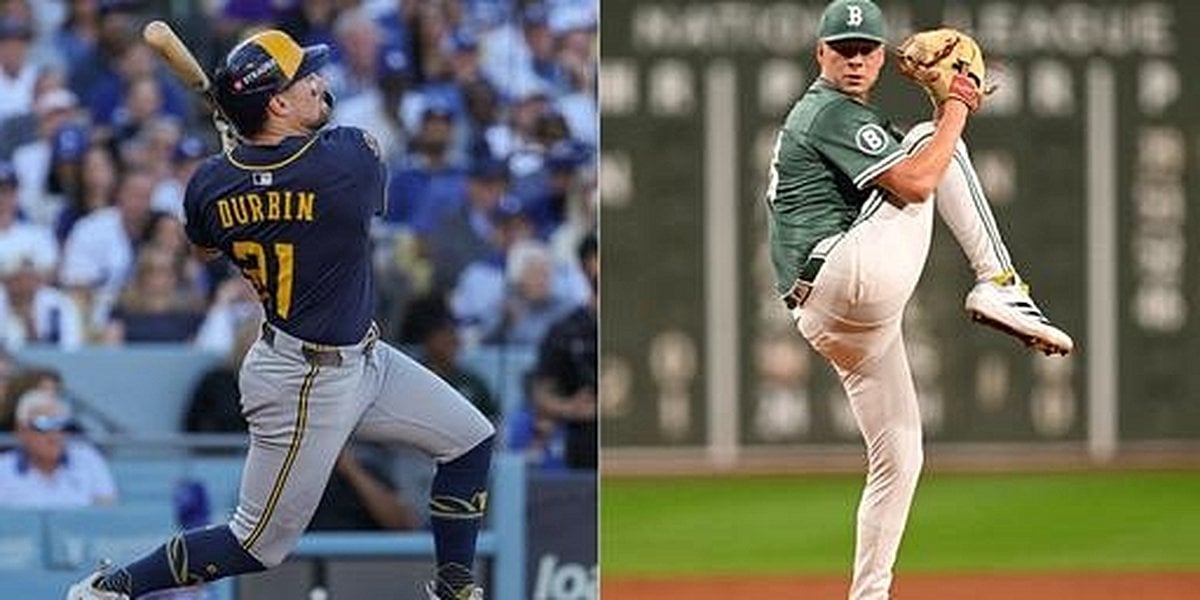
In a blockbuster move that has shaken up both the American League and National League landscapes, the Boston Red Sox and Milwaukee Brewers have executed a six-player trade, dramatically reshaping their infield and pitching rosters just as Spring Training looms. The deal, finalized on February 9, 2026, was officially announced by both clubs, with all six players involved already occupying spots on their respective 40-man rosters—meaning no corresponding moves were necessary to accommodate the influx of fresh talent.
Headlining the trade is third baseman Caleb Durbin, who heads to Boston after a breakout rookie campaign with the Brewers. Durbin, who will turn 26 in a couple of weeks, finished third in the 2025 National League Rookie of the Year voting, slashing .256/.334/.387 with 11 home runs, 25 doubles, 53 RBIs, and 18 stolen bases in 24 attempts. His combination of offensive spark and defensive reliability—Durbin posted five Defensive Runs Saved and two Outs Above Average at third base—made him a coveted target for the Red Sox, especially in the wake of Alex Bregman’s departure via free agency.
“We really like a lot of what Caleb brings to the table: strong defender, strong bat-to-ball skills,” said Red Sox chief baseball officer Craig Breslow, according to MLB.com. “Really versatile, right-handed hitter. And I also feel like he’s a good fit for our park just given the profile of hitting the ball in the air to the pull side…I feel like that will play well at Fenway. Versatility, in terms of where he can play, [is a plus] and we still feel like his best days are ahead of him given his age and control. We’re excited to get him into our organization.”
The Red Sox didn’t stop at Durbin. They also acquired infielders Andruw Monasterio and Anthony Seigler, along with a Competitive Balance Round B draft pick for the 2026 MLB Draft—currently projected as the 67th overall selection. Monasterio, 28, is coming off a career-best showing in the majors, slashing .270/.319/.437 over 135 plate appearances, and is known for his versatility and right-handed bat. Seigler, a switch-hitter and ambidextrous thrower, offers depth at both catcher and infield, despite limited major league experience. The draft pick, valued at over $1.2 million in last year’s slot figures, gives Boston additional flexibility for future roster-building.
In exchange, the Brewers received left-handed starter Kyle Harrison, infielder David Hamilton, and left-handed pitching prospect Shane Drohan. Harrison, 24, brings a high-upside arm to Milwaukee’s rotation, with five years of team control remaining and a 4.39 ERA across 42 major league outings (37 starts) since his 2023 debut. Once regarded as one of baseball’s top pitching prospects—peaking at No. 23 on MLB Pipeline’s list in 2024—Harrison’s fastball-slurve combination and prospect pedigree make him a potential anchor for the Brewers’ rotation for years to come.
Hamilton, 28, returns to the organization that originally drafted him. Though he struggled at the plate with Boston (.198 average, six home runs, 19 RBIs in 91 games last season), Hamilton is a plus defender at second base with elite speed—57 career steals in 68 attempts—and will see plenty of reps at third base for Milwaukee this spring. Drohan, 27, is a left-hander who posted a 2.27 ERA in 11 Triple-A starts last year, impressing scouts with his improved fastball and slider. Despite injuries limiting his recent seasons, Drohan’s strikeout-heavy profile (35.3% K rate in Triple-A) and versatility offer the Brewers another intriguing arm as they continue to build pitching depth.
The trade comes as both franchises pivot strategically. For Boston, the loss of Alex Bregman left a glaring hole at third base and signaled a need for defensive versatility and run prevention. Durbin’s arrival, coupled with the acquisition of Monasterio and the signing of utilityman Isiah Kiner-Falefa, gives manager Alex Cora a wealth of options. Veteran shortstop Trevor Story and recently signed first baseman Willson Contreras are locked in, but second and third base will be hotly contested. Top prospect Marcelo Mayer, who has flashed defensive promise but struggled offensively in 2025, is now in a position battle for second base, while Romy Gonzalez and Kiner-Falefa provide further flexibility across the diamond.
“I think consistency is very important,” Cora told reporters. “I know the value of being versatile, but having the second baseman and shortstop play as many games as possible together is very important. So, who’s going to be at second? Who’s going to be at third? We don’t know. But from my end—we’re going to try to be as consistent as possible.”
Durbin’s offensive approach—low strikeout rate (9.9%), aggressive on the basepaths, and a pull percentage of 43.3%—should play well at Fenway Park, particularly with the Green Monster looming in left. Breslow highlighted Durbin’s ability to put the ball in play, noting that Boston’s team strikeout rate was among the highest in baseball last year. “When you think about some of the deficiencies that our team had last year in terms of putting the ball in play, not expanding the strike zone, catching up to fastballs—those are all things that he excels at, and we think that he’s a really good defender as well.”
Meanwhile, Milwaukee’s front office, led by president of baseball operations Matt Arnold, has doubled down on pitching depth. With the departures of Durbin, Monasterio, and Seigler, the Brewers’ infield depth is suddenly thin, especially at third base. Hamilton is expected to compete for the hot corner, but further moves may be on the horizon. The Brewers’ reputation as a “pitch lab”—having helped turn around pitchers like Quinn Priester and Trevor Megill—suggests they see untapped potential in Harrison and Drohan. As for the infield, the club may look to free agency or trade for reinforcements, with shortstop Joey Ortiz and second baseman Brice Turang possibly shifting to fill the gaps.
While the trade may appear to clear up Boston’s infield puzzle, it also raises the floor for both teams. The Red Sox gain controllable, versatile defenders and a valuable draft pick, while the Brewers secure young, big-league-ready arms and a familiar, speedy infielder. As pitchers and catchers prepare to report, both clubs have signaled their intent to compete—and adapt—throughout the 2026 season.
With the dust still settling on this late-offseason blockbuster, fans on both sides will be watching closely as Spring Training opens. The Red Sox’s infield looks deeper and more dynamic, while the Brewers’ pitching staff is primed for experimentation and growth. One thing’s for sure: the ripple effects of this trade will be felt well beyond Opening Day.