
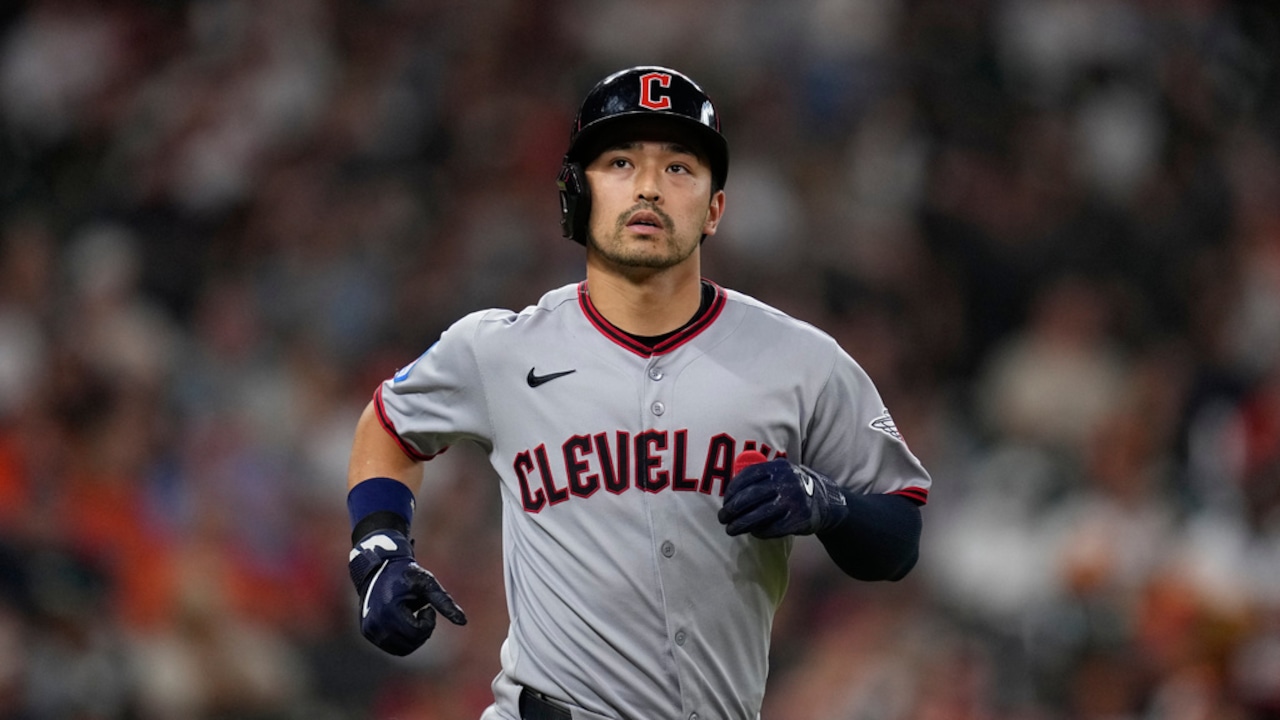
CLEVELAND, Ohio — The Guardians still face a defining moment with one of their most valuable assets. As pitchers and catchers report to Goodyear, Ariz. this week, the organization finds itself at a crossroads with Steven Kwan, their Gold Glove left fielder and spark plug leadoff hitter who has just two years of team control remaining before free agency.
The clock is ticking louder with each passing day.
Guardians President Chris Antonetti recently addressed the situation during the José Ramírez extension press conference, attempting to downplay the urgency. According to cleveland.com Guardians beat reporter Paul Hoynes, Antonetti said, “We’ve still got two years left with Kwan. We’ve got plenty of opportunities to talk to him about an extension.”
But Hoynes sees a more pressing timeline. “I would think if you want to sign him to an extension, you’ve probably got to get it done this spring,” Hoynes said on the Cleveland Baseball Talk Podcast. “Because if you don’t get it this year, he’s one year away from free agency, and that’s nearly impossible to sign a player to an extension then, unless you just blow them away.”
The situation creates a fascinating dynamic between player and organization. Kwan has already expressed openness to extension talks following last season, but as he inches closer to the open market, the siren song of free agency grows louder. Six years in the majors plus multiple minor league seasons represent significant investment before a player can test the open market.
The stakes are particularly high for Cleveland, a franchise that has historically operated with payroll constraints. Kwan represents everything the organization values – elite defense (a four-time Gold Glove winner), on-base skills, contact hitting, and a prototypical leadoff profile that perfectly complements their lineup construction.
Trade interest remains high. During last season’s trade deadline, Antonetti noted how highly other teams valued Kwan, with multiple organizations expressing interest in the outfielder.
What makes the decision particularly complicated is the Guardians’ offensive situation. After a quiet offseason with minimal offensive additions, losing their table-setter would be devastating.
“I imagine he’ll open the season with Cleveland,” Hoynes told podcast host Joe Noga. “They did nothing to improve this offense, and to trade Kwan before the season even starts would put them even further behind the eight ball.”
The approaching 2026 labor situation adds another layer of complexity. With the potential for a lockout following the expiration of the current Collective Bargaining Agreement, both Kwan and the Guardians must factor this uncertainty into any long-term commitment.
For Cleveland fans, the situation creates a tense backdrop to spring training. While the organization has succeeded with midseason trades of expiring contracts in the past, Kwan represents a particularly difficult case given his perfect fit with the team’s philosophy and his role setting the table for José Ramírez.
The extension clock is ticking, and the next few weeks could determine whether Kwan remains a long-term cornerstone or becomes the next high-profile trade piece in Cleveland’s perpetual balancing act between present and future.
Want to hear more insider perspectives on Steven Kwan’s future and other pressing Guardians questions heading into spring training? Listen to the full Cleveland Baseball Talk Podcast with Joe Noga and Paul Hoynes for more expert analysis on what promises to be a pivotal season for the franchise.
Read the automated transcript of today’s podcast below. Because it’s an AI-generated transcript, it may contain errors and misspellings.
Podcast Transcript
Joe Noga: Welcome back to the Cleveland Baseball Talk Podcast. I’m Joe Noga, joined by Paul Hoynes. Hoynsie, the Super Bowl is over. That means Major League Baseball is on the clock. The day after the super bowl always sort of turn our attention to pitchers and catchers reporting. And that date is rapidly approaching for the Guardians. Actually, it’s, I believe this Wednesday is report date and the first workout is. It’s Thursday, the 12th, first full squad workout, the 17th. The. The Guardians are getting ready to get on the field. You know, really, the. There’s a lot of questions still to be answered here by this camp. This is a big camp for, for Stephen Vogt. A lot of changes, lot different that’s going to look, you know, a lot different from the way it did at this point last year. Obviously, Kai Correa, Craig Albernaz won’t be there running things in camp as sort of the first lieutenants for Stephen Vogt. So a lot of different, you know, things that they’re facing. What are some of the big differences and big changes that you’re looking forward to seeing this year, Joe?
Paul Hoynes: I think there’s, you know, several questions there always are with every team going into spring training. And, you know, it’s always fun to kind of go over these questions, kind of speculate on them and try to answer them before they, you know, a pitch has been thrown. You know, I would think the first question we want to dive into, Joe, is Stephen Kwon. How long will he be with the organization? Will he be the opening day left fielder? And if so, is he going to make it through the season?
Joe Noga: Yeah, it’s, it’s one that we’ve been asking. Pretty much. It’s the biggest question that we’ve been asking since the, the end of the regular season was they were heading into the offseason. Kwon remained the biggest question at that point. And even through his, his arbitration process and getting his contract all squared away for this season, really the big question is will they trade him at some point? Will they be able to work out an extension? Hoynsie, what’s the timetable in terms of what, what this front office really looks for in terms of signing an extension or getting players, their own players to agree to extensions if they haven’t done it, by what point do we start, you know, looking forward to the season and saying it’s not going to get done?
Paul Hoynes: Yeah, I think they like to do it as early as possible, Joe. We saw that with Tanner Bibee last year. I think, you know, he wasn’t even eligible for arbitration, and they signed him to an extension. So I think that’s the ideal thing, probably from the team perspective, you. You get to control your payroll, you get to lock up one of your better players, and in turn, the player gets the security he’s looking for. With Kwon, he’s only got two years left behind before free agency. I thought it was interesting when we talked to Chris Antonetti just recently at the Jose Ramirez extension, the press conference, to announce that. That he said, we still got two years left with Kwan. We’ve got plenty of opportunities to talk to him about an extension. So, you know, I guess the door isn’t closed from the Guardian standpoint, but I would like to hear Stephen Kwan’s version of that.
Joe Noga: Yeah, and that’s. You always talk about, you know, players get to that, you know, two years away from arbitrary or two years away from free agency, they start to hear that siren song and that. That sort of maybe changes their plans or their approach or whatever. Do you think maybe this. This might be a case of Stephen Vogt, you know, or. I’m sorry, Stephen Kwan not wanting to sit down and negotiate because he. He says, I’ve been, you know, I’ve waited out this long. Why not just wait the extra two years?
Paul Hoynes: I think that’s a temptation. Last season ended, said he was interested in listening to an extension. Usually talks, you know, are. Are kind of, you know, Joe, I think, you know, they really are. You know, they. They start. Talks can go on for over a year. You know, I’m sure they, you know, they talked to Kwan. They’ve talked to Kwan last spring at some point or last season at some point. You know, if there was any momentum. They’ve been working on that behind the scenes. And, you know, I would think if you want to sign him to an extension, you probably got to get it done this spring, which is, you know, usually when. When they announce, you know, contract extensions, but. Because if you don’t get it this year, he’s one year away from free agency, and that’s nearly impossible to sign a player to an extension then, unless you just blow them away, because, you know, the guys have worked hard for that. That’s. That’s six years in the big leagues for Kwan. You know, he’s. He’s played several years in the minors, so, you know, he. The goal is free agency. And. And I don’t know, Joe. I mean, maybe. What. What does the labor situation come into with this? I mean, if there’s no. If the. If the players get locked out after the 2026 season when the basic agreement expires. Does that influence Kwan’s thinking?
Joe Noga: Yeah. And from the team’s perspective, are you going to want to be, you know, signing a big contractor for a guy that’s not going to be necessarily playing in 2027 if the season is delayed or, or you know, held off in any way? There’s a lot of different factors that go into that, that the, the labor situation can, you know, change or alter certainly. But as for Kwan, we know why the Guardians want him. We know why every team in baseball values him. As Chris Antonetti has, has said on many occasions, going through the trade deadline process with Kwan last year, every team sort of expressed how, how highly they value him and what sort of they’re going to get in return for him in that way. But you’re talking about a four time Gold Glove left fielder, a prototypical leadoff hitter, a contact guy, a guy who, who can get on base and make things happen that way. Stephen Vogt calls him their spark plug. Rankings among the top left fielders in baseball over the last several seasons. In 2023, he was ranked number two by Major League Baseball Network. Back in 2025, he was ranked number eight. This past, you know, most recent ranking, he was, he was left out of that top 10 list. So it fluctuates from, from year to year. But still one of the elite guys, a two time all star and we understand why a lot of teams would, would like to have him hitting at the top of their lineup. But, but he, he fits in that Cleveland lineup so well and, and sets the table for Jose Ramirez so well. I just said why the Guardians want to keep him around, but it’s going to have to be at, you know, a fair price or a deal that works for both sides, not just for Stephen Kwon.
Paul Hoynes: No, no doubt about it. I would, you know, I imagine he’ll open the season with Cleveland, Joe. I mean they did nothing to improve this offense and to trade Kwan before the season even starts would, you know, put them even further behind the eight ball.
Joe Noga: All right. Another question that really is sort of facing the Guardians heading into the opening of camp. Here is Chase the Lauder. We saw the most brief flash of him at the end of the season. We got two games worth at the end of the postseason in his major league debut just to see what he could do. This is a guy who, when he’s healthy, is an elite prospect and one of the most, you know, valued, you know, sort of Properties in all of the guardians farm system. I think they have a lot of faith in what this kid can do when he’s given a chance and if he can stay healthy on the field. Do you see him breaking camp with the club at the end of spring training?
Paul Hoynes: You know, that’s a great question. I, you know, I kind of, I feel strongly about it both ways, Joe. I think if he can stay healthy, they certainly have opened a Runway for him to play center field and they didn’t bring him up in the postseason last year to make his big league debut by accident. I think they’d love to see this guy in center field. I just don’t know if they want to start his clock, so to speak, by opening the season with them or having to go, go through, you know, a cold April in, in Cleveland and because it can be a cruel month, as Terry Francona often said to a young player. Not used to it. But still, I think to me the key to, to DeLauter is one, he has to stay healthy, he has to get to camp, get through camp in one piece where he’s not on the il, where he doesn’t have an injury that takes him out of contention for, for a spot on the 26 man roster. And two, what, what do the guardians, how do they approach, you know, controlling his service time? And I would think, Joe, at this point, the way they, you know, have talked about clearance space for their young players, I think if the Lauder is playing well, he gets through camp. Well, I think he’s on the 26 man roster.
Joe Noga: Yeah. A couple of things, you know, just sort of stand out in my mind with, with Chase DeLauter, like you said, obviously healthy and on the field and available is paramount. That’s the number one thing with him. And for sure, I think at the end of the year, we saw him in center field in those two games in the postseason. And every time that they talk about him, every, every, you know, sort of the sense that we’re getting every time we talk to the executives and the coaches is he’s a center fielder, they see him as a center fielder. They’re comfortable with him out there in center field. But does that mean if Chase the Lauder is on the opening day roster, does that open up maybe an opportunity or more of a likelihood that guys like Angel Martinez and Stuart Fairchild are also going to be around and get an opportunity? Because you’re not going to sort of put all of that responsibility and all that weight of being the every down, every inning center fielder on Chase the Lauder, if you’re not 100% confident in his health and his ability to stay out there. So, you know, you want to sort of ease him into it maybe by June or July, he’s the everyday guy no matter what, but certainly in April and May you want to be able to give him a day or two off or sit him against a tough lefty or something like that. Especially when you’ve got Martinez the option that maybe Fairchild makes the makes club does. If Chase DeLauter is on the roster, do you think one of those two guys or both of those two guys have a better chance of being on the roster as well?
Paul Hoynes: Yeah, I think that’s a good point, Joe. You know, even in talking to manager Stephen Vogt during the off season, they said they want to get a look at the Lauder in spring training, but we want to be careful with them as well. So if they’re, you know, they’re not going to run them out there every day in spring training. I don’t think they’re going to do that in the regular season. If he opens with the ball club. So, you know, someone is going to have to be, you know, be able to platoon with him in a, so to speak. And you know, Stewart and I mean Fairchild and Angel Martinez. Angel is a switch hitter and Fairchild’s a right handed hitter. Delauter hits left handed, so it makes sense.
Joe Noga: Yeah, and Martinez hits lefties pretty well too. That’s sort of one of his things that he does decently. Also the other advantage when you think about Chase the Lauder and making the opening day roster, if he, if he projects out and he performs the way that they’re hoping he will, having him on the opening day roster could benefit, you know, down the line. If, you know, if he takes off and he’s in contention for end of the year, postseason rookie awards, things like that, you’re talking about the potential to reward yourself with draft picks if, if you’ve committed to him and you keep him on the roster the entire time.
Paul Hoynes: With the clause under the basic agreement. That’s a good point. And hopefully season, Joe, I’m sure the Guardians are pulling for that.
Joe Noga: Yeah, if he, if he finishes in the top three in American League Rookie of the Year voting and he’s, he’s played the entire season on the, the 26 man roster, that’s, you know, a big, a big bonus for the Guardians. This was, was a clause that was put in to sort of promote to, to prompt teams to, to put their, their highly rated Prospects and call them up earlier and, you know, put them on the opening day roster so that the fans could get to see them more as opposed to waiting to manipulate service time. I just think, you know, the Guardians fans have been waiting for Chase the Lauder for so long that manipulating his service time and holding off on him until May or so. That’s, to me, that would just be crazy. They’ve waited long enough for this guy to get healthy and get out on the field. If he’s ready, just put him out there from day one.
Paul Hoynes: Yeah, Joe, that, that makes sense. You know, Antonetti said, almost said, you know, it said as much when they said one of the reasons we didn’t bring in a free agent outfielder was we give this guy 500 plate appearances, you know, a free agent. But what if this is the year DeLauter or Valera stay healthy and they, they could play 500 at bat. 500 plus they could give them 500 plate appearances and we’d miss out on that. So yeah, I think that that’s a good way of looking at, at things.
Joe Noga: Another guy whose health is going to be a big factor in a lot of things this year for the Guardians is David Frye. Obviously last year David Frye was coming off of off season elbow surgery that he underwent in 2024. Took, you know, quite a while for back to being able to get out there and dh. He did not play in the field defensively at all in 2025. All of his contributions were at the plate as a, as a designated hitter, as a pinch hitter late in games. You know, obviously David Fry gives them a little bit of something from the right side of the plate, which this, this lineup definitely needs. But he also gives them that defensive versatility. And I go back to Stephen Vogt’s first, you know, two, three months of managing in the big leagues in 2024 when he was able to use David Frye as a, as a weapon all over the field. He could go behind the plate, he could go to first base, he could move to the outfield for an inning. There were games where he played three different positions in a game. The defensive versatility of the David Frye, when he’s fully healthy, offers, you know, Stephen Vogt. It allows him to mix and match and find the best matchups and win matchups in and that results in victories. You saw that early in the 2024 season and then midway through that year, you know, votes suffer or Fry suffered the elbow injury and he was his, his role was reduced in that regard and Then obviously last year he was sort of one dimensional. What’s it going to mean for Stephen Vogt to have David Fry back if, if he’s fully back healthy this year?
Paul Hoynes: Oh, I think it’ll mean the world to him. You know, expands his, gives him another, you know, another kind of, you know, tool in his toolkit. A guy that is really, as you pointed out, a valuable guy that can play multiple positions, especially Joe. I think it, it really gives him some versatility to work the catching position, you know, with, along with Hedges and Naylor. I mean, you know, we, we saw, I thought, you know, when Fry was healthy and could catch, he made probably some of his biggest contributions to the club as a catcher. In the late innings, switching between catcher and first base and the outfield. I thought that was, you know, really, that really helped Vogt as a rookie manager.
Joe Noga: Yeah, and to be able to go back there and be able to trust him. I mean, Stephen Vogt was a catcher and Sandy Alomar, you know, they had Craig Elmerdez on the staff last, the last two years. They were surrounded by a lot of really good veteran catching knowledge. And to be able to trust David Fry to go back there and handled the pitching staff as much as he did when he was healthy, that was, that’s, that’s, he’s, he’s going to be focusing pretty much throughout all of this training camp on being behind the plate. We talked to, to Stephen Vogt when we asked him about that and he said eventually, as camp gets a bit later on, as they get into the regular season, Frei will start working around to the other positions that he’s able to play. But you know, the focus early on is going to be on him getting back to being a catcher and feeling comfortable back there and really the pitchers comfortable with him. So, you know, big step in the development for David Fry and a big, you know, option available to Stephen Vogt more, you know, this season we’ll, we’ll have to monitor just in the first couple of months how much of a factor it is when you’ve got that three headed monster back there at catcher. You know, you might see games where you have three different guys behind the plate at some point. Speaking of the, the pitchers who will be throwing to those catchers. Let’s start with the rotation. The big question, I guess right now you’ve got, you’ve got three guys who are pretty much we can pencil in to the top three rotation spots in Gavin Williams, Tanner Bibee and Slade Cecconi. That leaves three guys Three lefties fighting it out for two spots in the rotation. Joey Cantillo, Parker Messick and Logan Allen. How do we see that shaking out? Do we see that as a big competition? And who could emerge from that as the name that, you know, sort of turns heads this spring and into the summer?
Paul Hoynes: Yeah, I think it’s going to be really a big part of the competition in spring training, Joe. Those three left handers, you know, Allen has the experience, Joey Cantillo is out of options, and Parker Messick is kind of the new guy in town that came up last, last season, late last season and made a big impression. So you’ve got, you know, you’ve got some interesting arms to choose from if you’re Stephen Vogt. And we’ll just have to see how it works out, Joe. I mean, I guess you could put Joey Cantillo in the bullpen. He’s done that before. But, you know, I think there’s a lot of Cantillo pushing for him to be in the rotation.
Joe Noga: Yeah, and Joey Cantillo has shown us flashes as a, as a starter. He’s, he’s given us reason to sort of believe in him as a starter, especially in that last month of the season. I believe he was the American League Rookie of the month in September last year based on his performance as a starter. It wasn’t out of the bullpen. Just because you can go back there and, you know, have the right approach and the right mentality to be effective out of the bullpen as Cantillo has done. It just feels like they were jerking him around a little bit parts of the last two years. You know, he was in the bullpen, he was in the rotation, he’d do a spot start here or there. I just think you commit to him one way or another. One of those two spots, I think, really just does have to go to him. And then you’ve got Parker Messick, who was at times really good, but again, this is a kid who gives up a lot of hits, pitches to a lot of contact, and you’re going to have to live with what you get out of him if you put him in the rotation now. Or maybe he’s just best suited to start the season at Triple A. And you let Logan Allen take that number five spot and go with it from the beginning of the year.
Paul Hoynes: Yeah, you know, Allen has the experience. He’s coming off, you know, a season in which he set a lot of career highs. Innings pitched, I think, I believe starts, you know, he did a nice job for them, was really a Durable guy, answered the bill. You know, he posted and you know, Messick, you know, Messick as well, you know, a nice left hander came up, you know, really pitched well for them. But I don’t, you know, it wouldn’t hurt him to start the season at AAA and hit the ground running there, get ahead of steam going and come back and you know, get recalled if they need him with some good momentum. I mean, ideally that’s how I think most teams like to, you know, bring up a young player when he’s going good and you know, just have him continue that at the big league level.
Joe Noga: Yeah, I think all things being equal, I think that that’s probably the way the rotation is going to shake out. But again, this is the beginning of spring training, not the end. And we’ll see how things go and everybody’s got to get through it healthy and ready to go. So, you know, finally I want to talk about the Bull. Actually two more things I want to talk about. I want to talk, talk about the bullpen. A lot was made. We’ve made a lot of the, the additions that they’ve, they’ve brought in all the right handed relievers that they’ve, the veteran guys and the guys on minor league contracts. Let’s start with Sean Armstrong. What kind of impact is he going to have on this bullpen? The Guardians have a history over the last, you know, five, five years or so of finding guys like Armstrong, veteran guys to support, to sort of support the back end, the closer. It was Emmanuel Clase for so many years and now it’s going to be Cade Smith being that guy in the ninth inning. You know, they went back in 2022, they brought back Brian Shaw and you know, they had his veteran presence there. 24, it was Scott Barlow. Last year it was Paul Seewald. They sort of roll the dice on some of these veteran setup guys to sort of be there in support of and guys who have sort of seen everything and no, no situation is going to phase them. What are we expecting from Armstrong? Is that something that they can get out of him this year to support Hunter Gaddis and Cade Smith at the back end of the bullpen?
Paul Hoynes: I think that’s the plan. They paid Armstrong, he was the highest paid free agent. They signed this, this offseason. So I would think he’s coming off a really good year with Texas. I would think they’re looking at him for between 60 and 70 appearances and right Joe, just to set up Gaddis and Cade Smith pitch in the late innings and, you know, just give the opposition a kind of a different look. You know, Cade Smith and Gaddis are power guys and Armstrong has a little different repertoire. So, you know, I think, you know, they envision that working out as well as can be expected. And as you said, you know, they are no strangers to, you know, working a bullpen, rearranging a bullpen and adding the right arms for the right spot.
Joe Noga: Colin Holderman, Connor Brogdon with major league experience, guys who, you know, probably would have been candidates to sign minor league deals with spring invites for most other teams, maybe it was the guardians, you know, pitch to them, hey, we’ll sign you to a major league contract. If you sign here, you’ve got Holderman, you’ve got Brogdon, you’ve got Peyton pellet, the Rule 5 draft pick from Chicago. Who. The more of these guys that they bring in, the less likely it is that he’s going to be sticking around on the roster for the entire, that they’ll be able to hold a spot for him in the bullpen, you know, all season long. Just, you know, what do you think of that group of guys that, that they’ve sort of, that they’re going to be bringing to camp and, and what we can expect out of them?
Paul Hoynes: Yeah, I think that’s an interesting group. And, you know, they always seem to be able to hit on these guys. You know, one or two of these guys that they bring in, you know, Matt Festa’s, I think a great example last year came in and gave them, you know, 50 to 60 quality appearances, pitched well for them from start to finish. And I would imagine, you know, Holderman and, and Brogdon are experienced guys. They’ve been in the big leagues. You know, Pellet is, you know, kind of shot in the dark, a gambles, but we’ll see how that works. I’m sure they’d love to keep him, work out some kind of deal or work out some, some kind of deal with the White Sox where they would be able to keep him in their minor league system. If they can’t, they don’t carry him on the, you know, the big league roster all year. But, yeah, definitely two, you know, some three interesting arms there. And that’s the one thing Cleveland does well, I think. Well, they do a lot of things well, but they really excel and in finding kind of, you know, kind of under the radar relievers and making them a big part of the bullpen.
Joe Noga: Yeah, and a couple of those guys are actually back on minor invitations this year. Colby Allard and Pedro Avila, two guys who from the last two seasons have had a big impact on that bullpen. They will be in camp competing for spots and I, I could maybe see them keeping one of those two guys on the opening day roster, but probably not both thinking at least one of them is going to have to start the season in Columbus.
Paul Hoynes: It’s really crowded there. I mean, they’ve got arms all over the place. You can only carry eight guys. You know, maybe Colby and Pedro would. Would, you know, would, you know, agree to open the season at AAA Columbus, you know, even though they’re veterans and, you know, wait for a call up, but, you know, that’s something that’ll be worked out at the end of camp.
Joe Noga: A couple of new faces in the dugout next to Stephen Vogt, you know, the guys sort of who have his ear throughout the game, obviously, the last couple of years, his good friend Craig Albernaz, and also Kai Correa, who had come over from San Francisco. They’ve moved on to roles with other Alvarez, the manager in Baltimore. Correa gets the bench coach job in with the Mets in New York. They’re replaced by Andy McKay, who’s the major league field coordinator now, and Tony Arnerich, who’s the bench coach. So, you know, Stephen Vogt, not necessarily flying blind. I think he’s got a good foundation, you know, first two years, manager of the year, the first two years he’s on the field and, you know, he’s got his feet under him there. And now you sort of expand that coaching tree. You bring in, you know, McKay and Arnerich and you basically, you know, start anew with, you know, how they run training camp. And then we’ll have to wait until we’re, we’re into games during the season to see what their influence is going to be on decisions that Stephen Vogt’s able to make.
Paul Hoynes: Yeah, it’s always, you know, you have to have a good relationship between the bench coach and the manager. That’s critical. And I think Vogt knows both those guys from Seattle, right. When he was on the Mariners coaching staff. So, you know, that’s a good thing that, like you said, they’re not going into the situation blind.
Joe Noga: Yeah, McKay actually coming from the front office there in Seattle. But. But obviously the biggest, you know, thing about Stephen Vogt’s coaching staff this year is the return of Carl Willis. You know, he’s just maintaining that continuity and that familiarity. I think that’s his. That’s, that’s votes sort of biggest help right there is to be able to have Carl Willis and all of his years of experience and sort of knowledge there at his disposal. That will be the biggest difference I think, for, for both this year is to be able to have that after, after losing Albernaz and Correa, he. He maintains having Willis there on the bench with him.
Paul Hoynes: Yeah, that’s critical. Not only for Vote, but the Guardians pitching staff, they’re pitching group, all the, the assistant pitching coaches. Carl does a great job. He’s done a, you know, he’s done a great job wherever he’s been. Seattle, Boston, Cleveland. He has a wealth of knowledge and he, he has a way of approaching pitchers and working with pitchers that really make them feel comfortable. Vote feel comfortable as well. Vote is always says he loves being in the dugout with them, loves talking, pitching with them during games. And, you know, you have to have that communication, especially in the dugout, especially, you know, at tense moments in a ball game.
Joe Noga: All right, Hoynsie, that’s going to wrap up today’s edition of the Cleveland Baseball Talk podcast, getting closer to training Camp. We’ll, we’ll get back with you tomorrow for more discussion.
Paul Hoynes: Good deal.