
Remember back in December when I wrote about about “tractability?”
This was a concept discussed in Pedro Moura’s 2022 book How to beat a broken game: The rise of the Dodgers in a league on the brink. The term essentially refers to a player’s willingness to accept instruction.
In this column, I want to look at a second concept Moura discusses, “optionality.”
Here, he explains how Dodgers president of baseball operations Andrew Friedman approaches decision-making:
Every decision he made was governed by the guiding principle of optionality [emphasis added], a term co-opted from Wall Street, where he had his professional start. The idea is to render no decision absolutely necessary, to preserve as many possible choices as long as possible. It manifests in many ways, most notably in the Dodgers’ relative lack of desperation. Desperate teams make decisions they will regret. Because of Friedman’s patience and ownership’s resources, the Dodgers stand perpetually ready to seize on opportunities created by another team’s desperation.
So, for Friedman’s Dodgers, maintaining flexibility for as long as possible was key. We watched the 2025 Rockies play from a place of desperation — that’s why players were promoted before they were MLB ready — and we saw the results. The Dodgers would have never allowed themselves to get into that position.
But let’s return to the idea of optionality. The poster child for this concept is Mookie Betts. Here’s Moura:
Betts is the human embodiment of optionality, always available to boost the team in one facet or another. He could connect on a home run. He could beat out an infield single. He could unleash an unreasonably accurate throw. He could make a leaping, or diving, catch. He could steal second base, or he could score from first on a single, as he did to finish his final game with the Red Sox. He could demand his teammates establish a new, higher standard of effort, as he did before his first game with the Dodgers.

TORONTO, ONTARIO – NOVEMBER 01: Mookie Betts #50 of the Los Angeles Dodgers warms up before the game against the Toronto Blue Jays in game seven of the 2025 World Series at Rogers Center on November 01, 2025 in Toronto, Ontario. (Photo by Emilee Chinn/Getty Images) Getty Images
Look, the Dodgers moved Betts from the outfield to shortstop with very little effort. That’s how versatile he is. He gets hits; he’s athletic; he makes plays; and he does whatever is asked of him. It’s why he’s such a valuable player.
Finally, let me cite one more passage from Moura, this one on Max Muncy:
In 2019, Max Muncy became the fifth major leaguer to appear at least sixty times at both first base and second base. This flexibility, or optionality, is essential to how the Dodgers operate. It frees them to pursue off-season and midseason improvements at more positions than their peers, because somebody can always slide somewhere to accommodate a newcomer. It liberates Roberts to use the best available pinch-hitter in any game situation and not burn another reserve to defend, because, again, somebody on the field can always slide somewhere. And it insulates the team against the impact of injury. No matter where the hurt player played, the team’s best reserve can move from the bench into the lineup, because, of course, somebody—or somebodies—can always slide somewhere.
The ideas in this passage are key to the Rockies’ rebuild. It’s less about having “specialists” — though every team needs a few, say Will Smith at catcher and Freddie Freeman at first — than having highly athletic players who are willing to learn and, to quote a favorite Josh Byrnes phrase, “max out” and play a number of positions with ease.
(I’ll have more to say about “maxing out” in a separate column. I asked Byrnes about it, and his answer was interesting. I also have some ideas about the Rockies’ possible Mookie Betts, but they’re too undercooked to share right now.)
Here’s my working theory as we head into the 2026 season: Whenever you wonder what are president of baseball operations Paul DePodesta and general manager Josh Byrnes doing, ask yourself, “What would the Dodgers do?”
That’s probably influencing their thinking.
Okay, hold that thought, and let me return to the spring training and non-roster invitees list we got last week.
Let’s leave pitchers out of this and just talk about position players.
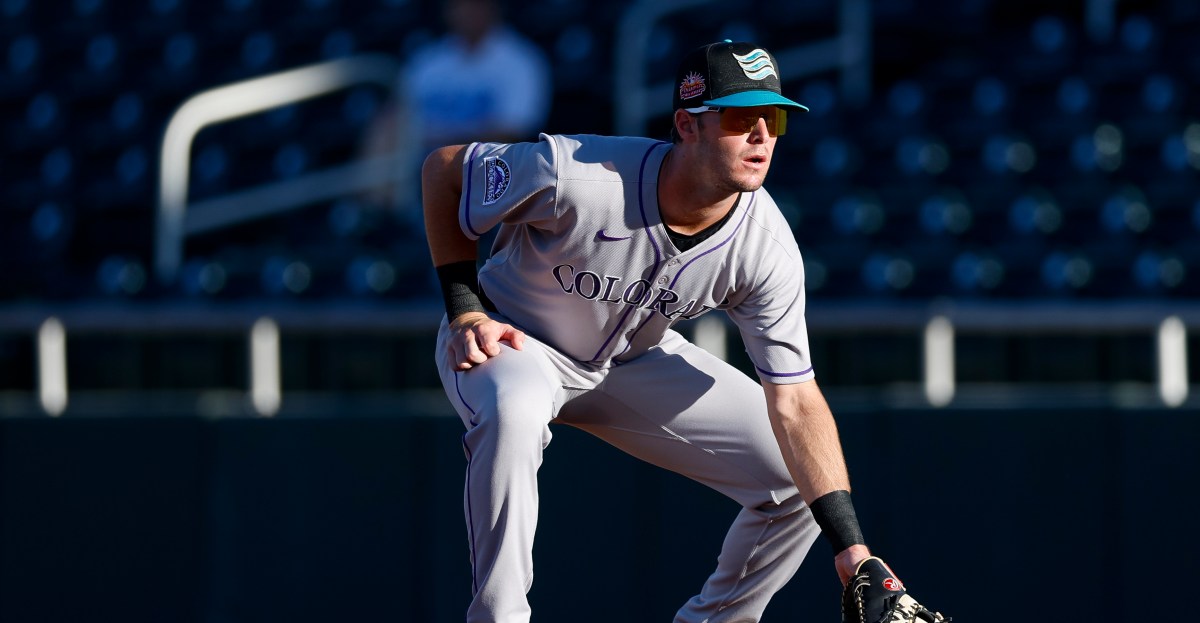
Look at all those utility players. The Rockies have listed seven utility players. (I know: Kris Bryant? I just work with the list I was given.) Tyler Freeman is no longer just an outfielder; they view him as a utility player. And Troy Johnston, generally seen as a first baseman, is also a utility player. Willi Castro was signed because of his versatility.
Here’s perhaps the most interesting point. As Cory Ryan Knowles pointed out last week on the Purple Row board, “The thing I am most intrigued by is that they designated Condon as a utility player. That says to me that the current front office may not be locked in to him being a 1B exclusively going forward.”
Under the former front office, it was just assumed Charlie Condon (No. 2 mid-season PuRP) would become a first-base specialist in the tradition of Todd Helton.
DePodesta et al are more interested in seeing what Condon — and a lot of other players — can do.
At Rockies Fest, DePodesta made an off-hand comment that has stayed with me: Fans should expect to see players at spring training playing positions that they perhaps hadn’t expected to see those players playing.

GLENDALE, AZ – MARCH 16: Cole Carrigg #86 of the Colorado Rockies catches during the game between the Colorado Rockies and the Chicago White Sox at Camelback Ranch on Sunday, March 16, 2025 in Glendale, Arizona. (Photo by Rob Leiter/MLB Photos via Getty Images) MLB Photos via Getty Images
I’ve called this an “inventory” year for the Rockies as the new front office tries to figure out what they have — and I think that’s still true — but part of that inventory involves determining who’s tractable (or teachable) and comfortable with optionality.
A comment on the Purple Row board last week was that the Rockies had replaced their worst players with less-worse players. I agree. But they’ve also been replaced with more athletic and versatile players. It’s like a table reading for the first season of a television drama as the show runner figures out who they have and what they’ll need.
Clearly, not all the non-roster invitees will make the roster, but I expect a number of those players to break camp with the Rockies. Most fans are not going to be excited about an Opening Day roster with Blaine Crim and Troy Johnston platooning at first; Edourard Julien at second; Ezequiel Tovar at short; and Willi Castro at third with, say, Tyler Freeman, Chad Stevens, and Vimael Machín as depth pieces.
The Rockies are going to delay decision making and give themselves options, both in terms of their roster and in-game decision-making. This approach will also give their prospects time to develop more fully in Albuquerque or Hartford. (How DePodesta will approach Albuquerque is another interesting question.)
And DePodesta et al are going to be implementing a system not just for players but also for the coaching staff. Manager Warren Schaeffer will need to change his approach to in-game management. I’m not worried about that because Schaeffer has shown he’s as eager to learn as any player on the roster, but that’s going to take some practice.
My sense right now is that fans are not going to get the Opening Day roster they think they want.
The payoff will come later in the season.
Who will break camp with Rox? Let’s take an early guess | MLB.com
Thomas Harding breaks out his crystal ball to predict the Rockies’ Opening Day roster.
FanGraphs weekly mailbag: February 7, 2026 | FanGraphs
SDS asked, “Would you please ask Dan to give us a projection for just how much worse that lineup would be than the weakest MLB team’s starting nine?” Dan Szymborski’s answer does not disappointment as he explores how the Colorado Rockies would fare in this scenario.
Please keep in mind our Purple Row Community Guidelines when you’re commenting. Thanks!