
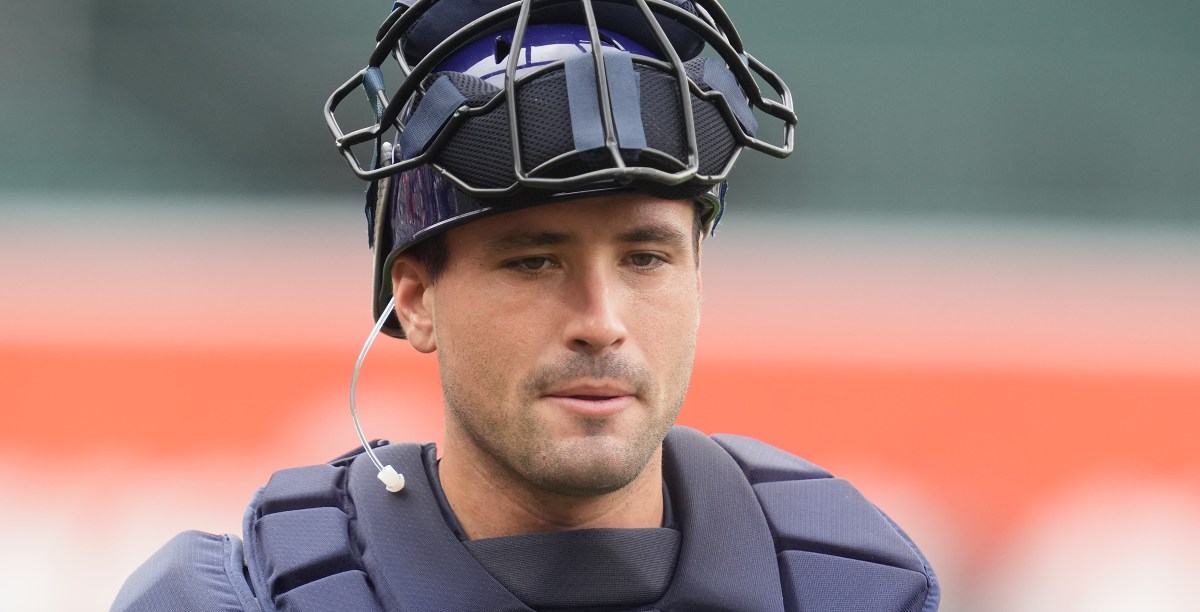
The Rays catching group last season performed far below the standard we’ve historically seen from them. They were one of the worst groups in the league on both sides of the ball. Thankfully, the front office spent time addressing the need at the deadline. Now, the guys they brought in will have already had experience working with the pitchers under the organization’s catching and pitching philosophies.
I’m excited that Nick Fortes was acquired to solidify the group; he’s a plus defender across the board with a relatively safe contact-oriented offensive profile. I think Hunter Feduccia could be a long-term contributor at the position to compliment Dom Keegan as he looks to establish himself in the majors over the next couple seasons.
Below are some key offensive performance indicators for the players who contributed as a catcher in the majors last season, and how the group overall compared to the rest of the league.
In-zone minus out-of-zone swing rate helps measure plate discipline, contact rate can show bat-to-ball ability, 90th percentile exit velocity is one of the best ways to measure raw power, and looking at line drive plus fly ball rates lets us see how much a player’s contact ability and power can lead to real production in-game.
PlayerPAZ-O Swing%Contact%EV90LD+FB%Danny Jansen25943.8%78.1%102.2mph73.3%Hunter Feduccia10238.4%73.4%103.7mph56.6%Nick Fortes10127.3%81.0%104.4mph44.9%Matt Thaiss8039.9%70.4%103.5mph54.3%Ben Rortvedt7038.7%78.3%100.0mph51.1%Total61239.3%76.6%102.8mph62.1%League Average 202537.1%76.6%105.1mph58.9%
The group surprisingly had above average swing decisions and average bat-to-ball ability. They were well below average in raw power so even though they collectively hit the ball at good angles, there wasn’t much to show for it.
Defense has historically been more important for catchers. I think offense from the position will be a little more important as the challenge system comes into play, but receiving, throwing, and blocking will still be valued at the position.
The Rays catchers had the third lowest framing strike rate among all catching groups last season to go along with below average pop times. They were tied for 4th in the league in blocks above average per game, but the difference between the best and worst blockers hasn’t been as drastic as the difference between the best and worst receivers and throwers so there’s less of an advantage to be had for being a good blocker – unless the challenge system affects that going forward.
I expect the offense to improve now that Jansen, Rortvedt, and Thaiss are no longer with the team. Working Keegan into the mix as the year goes on should also help with the offensive production from the group. Let’s look at the key performance indicators with a 45/45/10 split for Fortes, Feduccia, and Keegan. I’ll use MLB data for Fortes from 2024-2025 and AAA data for Feduccia in that same window, and just 2025 AAA data for Keegan.
PlayerPlaying TimeZ-O Swing%Contact%EV90LD+FB%Nick Fortes45%32.1%86.0%102.5mph56.5%Hunter Feduccia45%43.3%78.0%104.4mph51.7%Dom Keegan10%23.1%69.2%106.9mph65.5%Total36.2%80.7%103.8mph55.2%League Average 202537.1%76.6%105.1mph58.9%Rays Catchers 202539.3%76.6%102.8mph62.1%
The offensive outlook for this group is interesting; it follows the same trend we’ve seen in the rest of the position player group where they’ve emphasized plate skills and contact. However, this catching group has the potential to show some more impact than last year’s unit because of the power Feduccia and Keegan can supply. Keegan’s swing decisions and contact ability are better than what he showed in AAA, where he was likely over matched and not fully healthy. But his power is plus and should give him a chance to help at the major league level later in the 2026 season.
Defensively, Fortes is the most polished of the group and I wouldn’t be surprised to see him get the bulk of playing time because of that – at least early on. He’s a plus receiver (82nd percentile in framing strike rate last season), thrower (66th percentile pop-time), and blocker (76th percentile blocks above average per game), and the Rays were lacking a strong defensive catcher for the majority of last season.
Feduccia looks to be at least an average receiver based on his defensive actions shown in a limited sample (50th percentile framing strike rate since 2024 in AAA), and his throwing could get to at least average as he continues to develop (arm strength above average, but his exchange is slow and below average).
Keegan will need to continue to refine his below average pop times and receiving in AAA (18th percentile framing strike% in 2025), but I think he can get to at least Feduccia’s level of defense thanks to his athleticism and arm strength.
As long as there aren’t any major injuries this spring, I expect this unit to be the most stable and predictable of the different position player groups. I’m confident they’re collectively better on both sides of the ball than the catchers we had last season. They’re stronger defensively than any combination of catchers who contributed in 2025, and a late season debut for Keegan could infuse the group with some plus power.