
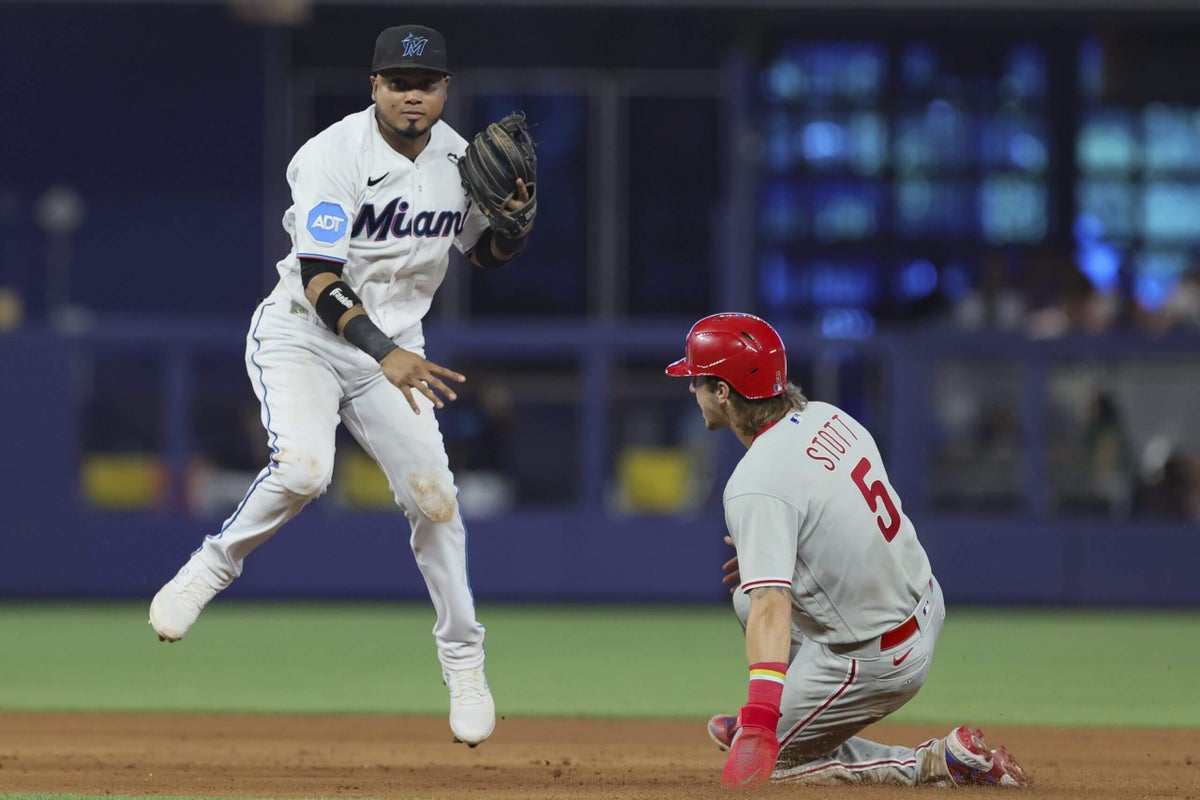
The San Francisco Giants made the Luis Arraez signing official Tuesday, moving Randy Rodríguez to the 60-day IL to make room on the 40-man roster. For the first time since Rich Aurilia in 2002, the Giants’ roster will include the reigning hits leader in the National League.
However, it’s not the hits you’re worried about. It’s the lack of power, the lack of speed and his concerning attitude toward sacrifice bunts (he appears to like ‘em!). And, of course, it’s Arraez’s defensive abilities that are of the most concern. The Giants announced him as an infielder, and by gum, that’s where he’s going to play. He’ll be the second baseman sprinting to the bag to help turn a double play. He’ll be the one diving to his left and right to prevent the kinds of hits that he specializes in.
It’s easy to read too much into the Giants’ defensive plans for Arraez, considering there should be plenty of at-bats to be had for him at first base and DH. The Giants are also guaranteed to have a nice complement for Arraez on the roster, a right-handed hitter with sparkling defense and some measure of speed, whether it’s Casey Schmitt, Christian Koss, Tyler Fitzgerald, or some combination thereof.
Even with all that in mind, though, you want reassurance. Arraez is going to be fine at second base, right?
Buddy, I have no idea. Let’s find out together. To have some kind of idea what to expect, we’ll have to look at the last time Arraez played the position. So hop into the DeLorean, and set the time machine back to … a couple of months ago. Apparently, the Giants got this wacky idea from the Padres, who spent a little bit of time on it toward the end of last year, and it went smoothly. Arraez had 26 chances, 14 assists and 12 putouts at second, which is good for a cool 1.000 fielding percentage. He made the routine plays, and he even looked pretty darned capable starting a would-be double play:
Now pretend we are all little Carols from “Plur1bus,” with a whiteboard reading “What we know about Luis Arraez’s defensive abilities at second base.”
Here are our bullet points:
• His experience at the position is more recent than a lot of people assume
The only reason Arraez stopped playing at second for the Padres last season was that Xander Bogaerts came off the IL, which shifted Jake Cronenworth back to second. Before that, though, the Giants got a helpful little sneak peek at what they might expect.
So if Arraez looked capable in his brief stint back at second, the next step would be to retrace the steps back further to the point where someone made the decision to move him off the position. At some point, there had to be a gaffe or a flub or an easy grounder up the middle that turned into an RBI single. There had to be a breaking point, where the front office met with the manager, and the manager had to break the news. It’s not an easy thing to do, telling a professional baseball player that he’s not good enough to keep doing what he’s always done. It’s something that has to get pretty bad before a team feels like it has no choice.
Except, I’m not sure that ever really happened. The Marlins traded Arraez to the Padres on May 4, 2024. He played second for the Marlins on May 2. He played second for the Padres on May 5. The Padres acquired a second baseman. That’s what Arraez was, and continued to be, for them until Manny Machado, Bogaerts and Cronenworth were healthy together.
One more bullet point for the whiteboard, then:
• He was never really moved “off” the position
At least in the sense where someone had to call him into the office and tell him a hard truth. He was a guy who could do a few things, and the Padres needed him to be at second base less often.
OK, but that leaves one more thing unsettled. Even if all this is true, there has to be a reason why the Marlins were playing him at first base at all, right?
Not really. He was playing at first for the Twins as a 25-year-old because he was The Guy Who Played Everywhere, and first base was where the need was. Before that, Arraez was even playing in the outfield. Look at the then-25-year-old scamper around out there:
His outfield days are, mercifully, behind him. But if you’re like me, you had this idea that Arraez was a second baseman, first and foremost, until he couldn’t hack it at the position. That isn’t really close to what happened. His defensive career path has hewed closer to Casey Schmitt’s than Rod Carew’s.
When the Giants revealed that their plan was to use Arraez at second, my broken brain immediately thought of Dave Roberts, who signed a three-year deal to be the Giants’ center fielder, but lasted only four months. It was a defensive disaster from the beginning, and everyone knew it. (Nobody knows what happened to Roberts after he left the Giants. Might be time for one of those “Where are they now?” articles.)
But that analogy doesn’t hold. Roberts was 35 and playing the most important position in the outfield when he signed with the Giants. Arraez is 29 and playing an easier position, one that requires much less foot speed.
However, let’s be clear: The conclusion here isn’t that Arraez has been a secret defensive stalwart this whole time. Because he hasn’t. Oh, no, he most certainly has not been a secret defensive stalwart. Statcast’s defensive metrics don’t just dislike Arraez wherever he plays. According to Outs Above Average, he’s consistently one of the worst defenders in the game. First base, second base, third base, outfield, heck, he even got a few innings at short once … it doesn’t matter. Wherever he’s been, the stat has followed him around, booing him.
One more for the whiteboard:
• He probably won’t be, uh, a good defender
Yes, that’s diplomatic. If there’s any consolation, it’s that he’ll be bad in a way that you can visually confirm, but doesn’t make you pull your hair out. He’s actually pretty sure-handed, and he even led the National League in fielding percentage at second base in 2023. His limitations will be more visible on balls to his left, right, back and front. All of the places that baseballs go, mostly. He has trouble getting to those baseballs, relative to his defensive peers.
The last time Arraez was penciled in at second base and mostly left alone was 2023, when he led the NL in fielding percentage … and finished in the 1st percentile in Outs Above Average. It could be a long, long season if Logan Webb’s sinkers keep finding holes to the right side.
But he shouldn’t be someone who looks like a converted DH, someone completely out of position. That doesn’t exactly get you fired up for baseball season, but it would if it came with a .300 average. (And if you bristle at the mention of an archaic stat like batting average, I have long been a “batting average is fun” apologist. It’s fun. Making contact helps. Lighten up.)
A closer look at Arreaz’s defensive history, though, shows that the idea of him as a second baseman isn’t exactly coming out of nowhere. He never really stopped being one, he just joined a Padres team that needed a first baseman more. There’s still a chance that the experiment could fail, but there’s enough evidence to suggest that we probably shouldn’t be calling it an experiment at all. We have the results. Get ready for ‘em.