

SURPRISE, Ariz. — On his first day with his team, or at least most of it, a day when changing the culture goes from theory to application, this is how Rangers manager Skip Schumaker chose to make his first impression on his pitchers and catchers: By listening.
Sometimes you can say more without saying anything at all.
There was no fiery welcome-to-camp speech. He didn’t explain any camp rules or policies or schedules. No quips or inspirational quotes. He simply sat and let new pitching coach Jordan Tiegs take center stage, allowing him to start building rapport with the pitching staff immediately.
“I want my coaches to coach,” Schumaker said Tuesday between that first meeting and the start of the first workout. “I want them to be heard. He’s obviously the new pitching coach here, so I thought that was super important for him to address the group. I’m not going to be teaching much pitching stuff, so they need to hear from [Tiegs]. I want to let my coaches do their thing and empower them to be really good at their job.”
Rangers
When the Rangers hired Schumaker in October to replace future Hall of Famer Bruce Bochy, it was with the expectation he’d be a more proactive manager. Which may make his initial approach seem a bit contradictory to the expectation. But proactivity doesn’t necessarily mean just a bunch of yelling and changing lineups.
Related

With a mostly new coaching staff, Schumaker wants his players more comfortable talking to coaches and his coaches more comfortable talking to him. Bochy was plenty welcoming, but his legendary status in the game also could be intimidating to both players and coaches when it comes to what Schumaker believes are the twin pillars of a winning culture: communication and alignment.
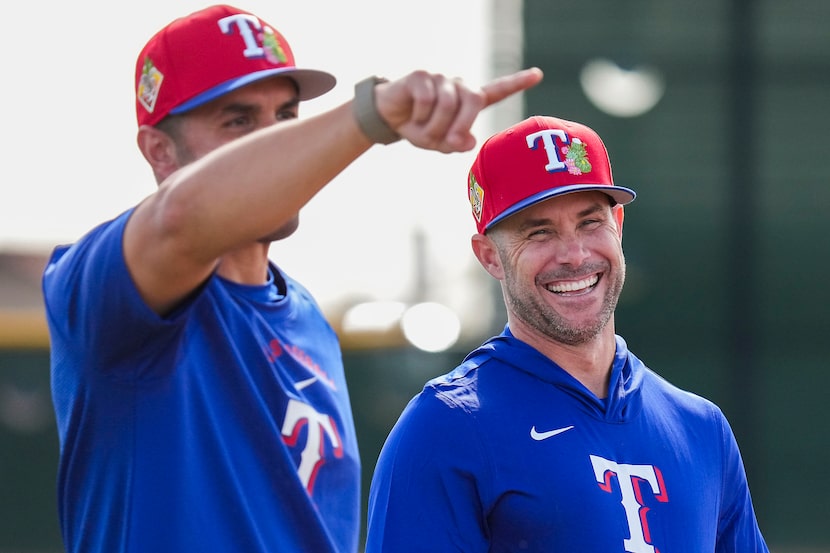
Texas Rangers manager Skip Schumaker (right) laughs with bench coach Luis Urueta during a spring training workout at the team’s training facility on Tuesday, Feb. 10, 2026, in Surprise, Ariz.
Smiley N. Pool / Staff Photographer
Schumaker had already communicated — to his coaches in an early morning meeting somewhere between 5 a.m. physicals and meeting the team. In that coaches meeting, he stressed to the group, two of whom had been on his staff for two years in Miami, the importance of creating a welcoming environment for players to approach them, rather than always being the other way around.
He’d thought about this during the six-hour drive to Surprise from his home in Orange County, Calif. That he began well before dawn on Monday. The time in the car gave him opportunity to grieve missing his high school senior Brody and daughter Presley for most of the next four months, but also to consider exactly how he wanted to get his message across to everyone in the organization. He wants the doors to be open for communication, but more importantly he wants players comfortable enough to walk over the threshold to his office, or to the coaches’ room or to a staffer.
The first step may be the hardest, but it’s also the most important.

Texas Rangers manager Skip Schumaker heads for the clubhouse after a spring training workout at the team’s training facility on Tuesday, Feb. 10, 2026, in Surprise, Ariz.
Smiley N. Pool / Staff Photographer
“I wanted to make sure our staff understands where I’m coming from,” Schumaker said. “I know culture has been a big topic and relationships started months ago or in some cases before that, but when you are in the room together from 5:30 in the morning until after five at night, that’s when it can be a separator.“
And then he launched into a better, more passionate explanation.
“I want [the coaches] to remember how important or how impactful it was for a player to come in and have a coach grabbing them and saying, ‘Hey, I got something for you today,’” he said. “Every player is still evolving and learning and I don’t want anybody here just for a job and checking a box. That’s not who I hired. That’s not who I wanted as a coach.
“I remember Mark McGwire as my hitting coach and Jose Oquendo was the fielding guy and they’d grab me at 6:30 in the morning and told me something right when I walked in the door. That told me something. I was on their mind all night. They were grinding, looking at me, trying to help me get better. And I was like the 25th guy on the roster. So if we can have that kind of impact throughout this camp, I think we’re going to be great.”
So in the pitchers meeting, he largely stayed in the background. When they threw their first bullpens of the spring, he was watching, from Nathan Eovaldi down to Gavin Collyer. But it was often hard to spot him. He was unobtrusive, leaving the instructing to the instructors and making himself available if anybody wanted to talk. He had a few conversations, but mostly let players do their thing.
At the end of the week, when the full camp arrives, he will address the whole camp. He will think about that talk. He will be intentional. And he will be welcoming. The first steps toward a culture course correction are to create an opportunity in which everybody feels comfortable communicating with each other. Because you can say all you want, but words have little meaning if nobody is listening.
On Tuesday, Schumaker made listening his first priority with his team.
All smiles in Surprise: See photos from Texas Rangers’ first day of spring training
 View GalleryBraves add catching depth by signing ex-Rangers All-Star Jonah HeimMissed chance to play for Team USA in WBC leaves Rangers pitcher Jack Leiter ‘frustrated’
Find more Rangers coverage from The Dallas Morning News here.