
The 2026 college baseball season begins Friday. And that means it’s time for The Athletic’s annual coaches forum.
In part one, we asked our panel about the best position players and pitchers they have ever seen in college baseball, which teams might surprise in 2026 and what stats are important to them when evaluating a prospect. Today, the coaches share some recruiting memories. Who was the biggest recruiting find of their career? What about the one who got away? In Part 3, on Thursday, the coaches discuss revenue sharing, the transfer portal and the postseason format.
Here are the coaches:
J.D. Arteaga, Miami
Mike Bianco, Ole Miss
Jordan Bischel, Cincinnati
Dan Fitzgerald, Kansas
Scott Forbes, North Carolina
Pat Hallmark, UTSA
Wes Johnson, Georgia
Skylar Meade, Troy
Eddie Smith, Washington
Who is the biggest recruiting find of your career?
J.D. Arteaga (Miami): I would say (pitcher) Carlos Gutierrez. And unfortunately, he got hurt in the minor leagues and never made it (to the majors), but he was a kid that was a preferred walk-on, and he ended up being a first-round pick for the Minnesota Twins in 2008.
Really had no other offers. Nobody else was recruiting him. From Christopher Columbus High School (in Miami). His mom actually worked at the university. The University of Miami and most private institutions have what’s called tuition remission. So to be completely honest, if he wasn’t a free guy, we probably wouldn’t have taken him. But because he was free, we took a chance on him, and he ended up being a first-round draft pick.
Mike Bianco (Ole Miss): I’d probably say Chris Coghlan. We had just lost a recruit in the draft, I think it was 2003. I came to my office, it was back when landlines were a thing and the message light was blinking, and I checked the message and it was a guy from the Tampa Bay area that left a long message talking about how there was a player down here that was going to go to a junior college, and he thought he was a really good player. And so I called his high school coach, who was, ironically a high school coach when I was playing (in the area) about 20 years prior. And he said, “Hey, Mike, I think he’s one of the best players that ever came out of Pinellas County,” which is Clearwater-St. Pete. It’s a giant baseball hotbed. And I was like, “Wow, that’s a pretty big compliment.”
Flew down there two days later and watched him take batting practice for the American Legion team and play. He got two at-bats, but walked both times, and then I offered him a scholarship. And, you know, Chris played for us in ’04, ’05, ’06, was a first-rounder and was a Rookie of the Year in 2009. And the recruiting process was all about a week, and it was just because somebody called and left a message.
Jordan Bischel (Cincinnati): I’ll go back to Andrew Taylor at Central Michigan (2020-22). Ended up being a second-round draft pick. He was a fall birthday who turned 17 in the fall of his senior year, and he was 6-5 and gangly. And July of his junior year was still kind of 85-87 (mph) without a ton of command. He really popped late. He was a kid we signed pretty far into … maybe October of his senior year, and he turned into an All-American for us. We didn’t see that coming.
The other interesting story with a find that I screwed up is Mario Camilletti, who’s now in AAA for the White Sox and was an All-American for us at CMU. I actually didn’t recruit him all that hard when I was at Northwood, a Division II school. We kind of let him walk away. And then three years later in the portal, we kind of begged him to come to Central Michigan (from Oakland University), and he turned into an All-American for us. I didn’t see that guy as a good enough D2 player, and he ended up being a D1 All-American.
Dan Fitzgerald (Kansas): Scott Schebler played in the big leagues with the Reds. He was a shortstop at Cedar Rapids Prairie High School (in 2009). I think he played six sports in high school. He played baseball, football, basketball, golf, soccer and ran track. High school baseball in Iowa is in the summer, and going in his junior summer, I went to a game, and he was playing shortstop, and he was not a shortstop. Very clearly, he was going to play center field because he could fly. He was mega physical, but baseball really wasn’t his sport at that point. He was way more of a football guy and soccer and everything else. I saw him take two swings that day. It was honestly one of those where it sounds like you’re making it up when you tell the story — first swing he took was a massive bomb to right, and the second swing he took was a massive bomb to left. And I remember saying, “That’s the best left-handed hitting high school player I’ve ever seen in my life.”
We recruited him and had to fend off a bunch of other junior colleges in Iowa, but he didn’t have any Division I offers until late — Iowa and Maryland. But anyway, we were able to keep him, and he had a great one year at Des Moines Area Community College for us, and he was a 26th-rounder and made it to the big leagues and had a nice career. It was a random field, a random Tuesday night in Iowa, and I found a big leaguer.
Scott Forbes (North Carolina): Colin Moran. We had Brian Moran (on the roster), but coach (Scott) Jackson kept watching Colin Moran. He wasn’t very highly recruited (in the Class of 2010), and I just felt like he ended up being one of the best college hitters over a three-year span. … He went in the top eight picks (of the 2013 MLB Draft). It would probably be Colin Moran, or a sneaky pick for me personally would probably be (outfielder) Angel Zarate (2018-22). Not many people recruited him, and he ended up being a great hitter for us.
Pat Hallmark (UTSA): I don’t know if the name will jump off the charts to a lot of people, but there’s a kid named Jon Duplantier, who was a football player out of Katy, basically Houston (in the Class of 2014). He’s pitched in the big leagues. He came out of nowhere. Complete transparency, he kind of recruited himself. I did have to go watch him, but I didn’t find him. He found us. Really smart kid. Nobody was on him. Nobody knew him. And we ended up getting him at Rice. It was just a really cool story for me personally, because you get told a lot, “Hey, you need to go look at this guy or this guy.” As I watched him, I’m like, “He’s checking a lot of boxes.”
But he was a quarterback out of a big Texas high school. And when you’re a quarterback at a big Texas high school, and you’re a big, good-looking athlete, everybody thinks of you as a football player and that you are going to play college football. And him and his dad had, I think, planned the baseball route. But it took a little longer for the recruiters and everybody to find him. But Jon was a great find.
Wes Johnson (Georgia): I’d probably have to go back to my time at Dallas Baptist. Drew Smith was at Crowley (Texas) High School (Class of 2012), throwing 88 miles an hour and left throwing a hundred. He pitched some in the big leagues, for the Mets out of their pen.
Skylar Meade (Troy): No one will find this as exciting as I did, but right when I started, one of my first recruits I really dove in on, followed for a year, was a kid out of Jacksonville, Illinois, named Caleb Howell. He ended up being a career (.376) hitter, the all-time hits leader at Eastern Illinois (2012-15). Was like a 6.35 runner. I’ve been fortunate enough to coach big leaguers and things of that nature, but Caleb Howell was just a heck of a player from the jump when I got to coach him. And I worked really hard. We got him over some good schools, and that was hard to do at Eastern Illinois.
Eddie Smith (Washington): I’d say Danny Dickinson. He was a senior playing in the (Washington high school) state tournament, and I watched him and had no idea who he was going into the tournament. It was June. He’d already graduated from high school before he came and visited us at Utah Valley a couple weeks later, and he went on to be a Freshman All-American for us and then just went in the sixth round last year (after transferring to LSU).
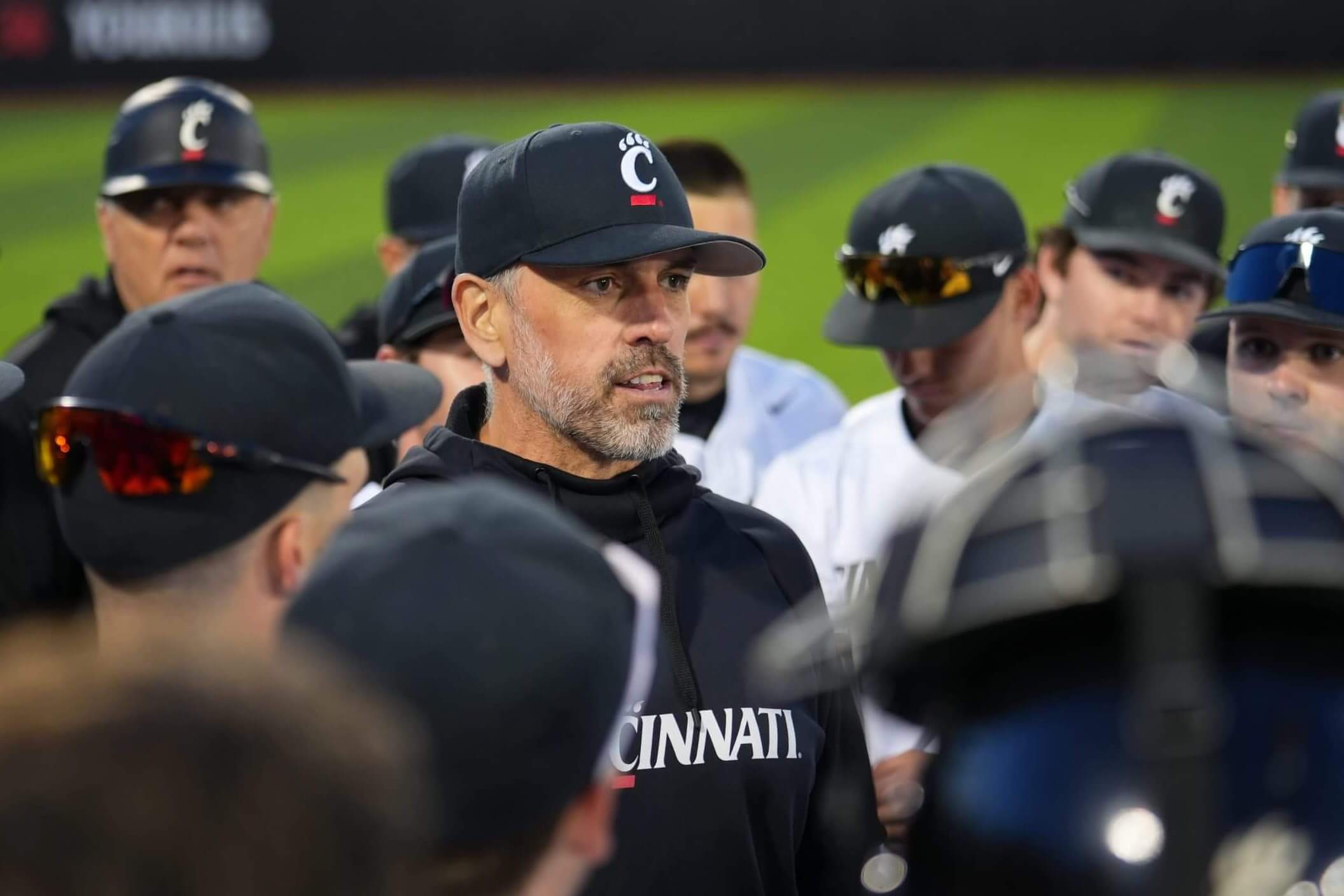
Jordan Bischel went to the NCAA Tournament three times in four full seasons at Central Michigan and has been once in two seasons at Cincinnati. (University of Cincinnati)
Who is the one recruit who got away?
J.D. Arteaga (Miami): We felt pretty good about getting (Pete Alonso), and he ended up going to Florida. And of course, he did some damage against us, like he did against everybody else.
Mike Bianco (Ole Miss): There’s a lot. You lose more than you get. But I would say there’s an in-state catcher named Ed Easley that we ended up not really recruiting because we had other catchers in our program at the time. And Ed went to our arch-rival, Mississippi State, and was a superstar there (2005-07).
It’s one of those where you sit there and scratch your head and go, “Man, you know, we did what we did.” And I understand it because you can’t always recruit that position … only one catcher can play at a time. And we had good ones, but he was one of the best to play in the state. So that one, I don’t know if it stung, but we had to live with it, and he was really good.
Jordan Bischel (Cincinnati): When I got here (after the 2023 season), I don’t know if he really got away because I don’t know if we ever really had a shot at him, but Ryan Nicholson had had a great year here the year before, and was in the portal. We tried to get him to come back, and he was open to it. I like Ryan a lot. I’ve gotten to know him. But he ended up transferring to Kentucky, had a great year there, played in the College World Series and is in pro ball. Now, we replaced him with Josh Kross, who ended up doing the same things here, so it didn’t hurt us too badly.
Dan Fitzgerald (Kansas): When I was at (Division II) Flagler College in St. Augustine, Florida, I thought we had a shot to get Mat Gamel. He ended up having a nice big-league career, but that was one at Flagler that I thought would have been a massive steal. He was at Chipola (junior college) at the time, and I remember we really liked him and tried to get him. He ended up being a fourth-rounder (in 2005) and played in the big leagues, and I remember thinking that would have been the greatest steal of all time. He might not even remember, but I thought we had a shot at him.
Scott Forbes (North Carolina): A lot got away. You don’t get them all, but one that still haunts me to this day is Carson Fulmer. He went to Vanderbilt (2013-15). I felt like he was such a leader. I felt like wherever he ended up, they were going to win a national championship. That’s how strongly I felt. That’s a credit to Carson. He had that much ability. He had the “it” factor for sure.
Wes Johnson (Georgia): That list is long. Way back to my time at Central Arkansas. I thought we snuck a young man named Jalen Beeks out (of Crowder College in 2012). I thought we had him. Man, we were right there, but he blew up, and Arkansas came in and got him. And that young man had a tremendous career at Arkansas and then went on to have a really good career in major league baseball.
Pat Hallmark (UTSA): I don’t know that we ever thought we had him and I was recruiting him, but (Rice head coach) David Pierce was doing most of it, but (Alex) Bregman (LSU, 2013-15) came on a visit. Again, you know, when you’re at Rice and the places I’ve been, you’re never really people’s top, top choice. But still, like, we knew Bregman was really good, and we didn’t get him, and then he’s done everything he’s done. But that’s one that got away.
Skylar Meade (Troy): I loved R.J. Austin. I knew R.J. since he was 14. I will admit that, as much as I loved him and was the one bringing him to the table (at South Carolina), I don’t think I pounded the table hard enough and understood what he would be as a position player because he also pitched when he was young. I don’t think I absolutely … I was convicted, but I didn’t fight for it. Then you see R.J. obviously do what he did at Vanderbilt (2023-25).
I got to be on the coaching staff with Team USA when he was there. The work ethic that you saw, the dynamic nature of what he could do day in, day out at every position on the field. I think I knew this, but why did I even hesitate for a millisecond on that?
Eddie Smith (Washington): Jackie Bradley Jr. was a guy who I remember really early on in my coaching career. He came on a visit (to Virginia). This was kind of when early recruiting was first starting, where I think it was maybe his sophomore year of high school, which felt really early at that time in that era, and he committed to South Carolina (2009-11) and was like, “Wait a second, I kind of liked that guy.” Obviously, he had an incredible career in college and in the big leagues.
The rules changed a few years ago — you can’t contact recruits until the summer before the junior year of high school. Has that been a good change?
J.D. Arteaga (Miami): Absolutely. I think it gives you the chance to really get to know some of these kids, right? And watch them play. And there was a time there where you watched a 15-year-old or 14-year-old kid pitch, and if he touched 90, by the time you got to your car, he had seven offers from other schools, and you had no choice but to make him an offer — not knowing the kid and the character, his background, his family and everything like that. So it’s kind of slowed things down. You make less mistakes.
Mike Bianco (Ole Miss): Awesome. And it would just be so crazy if we were still talking to 14-year-olds and then you get to June and July and you’re talking to 23-year-olds, fifth-year seniors trying to transfer them in. You have a (high school) freshman recruiting class, sophomore recruiting class, junior recruiting class, senior recruiting class and you recruit the portal. Not to mention your own team. Yeah, it’s just overwhelming. So that’s a win-win for everybody. I don’t think anybody, or at least I don’t know of anybody that thought that was a great system. But you can’t sit there and say, we’re going to be holier than thou and not recruit a ninth- or 10th-grader when the rest of your league is, right? These are the rules. And so, you’ve got to do your best to be able to compete. And so I think most people are excited.
Jordan Bischel (Cincinnati): I do. I think it is really, really valuable to let these kids be kids. … There’s one change I would love to see. It would be that we can put offers in writing. Right now, you can’t put an offer in writing until August of a kid’s senior year. Obviously, there is a broad, broad strata of what’s available to kids. Under the 11.7 (scholarships) with no NIL, there wasn’t that much room to wiggle, but the gap between a low offer and a big offer now is so substantial. When you talk to a kid and you’re trying to explain outside NIL, revenue share, scholarships, academic awards, it’s really confusing to kids. There can be a lot of misleading stuff.
Some of it is unintentional. We just had a commit the other day, and I’m trying to explain all of this. He said, “Can you just email that to me?” I said, “Nope. I’ll send it to you next August.” It’s not really fair to the kids. I guess the answer is to wait until August 1st to make a decision, but we all know that’s not realistic. To me, if we can tell a kid we want them, we should be able to write down what we’re going to give them. That would be a lot more fair to the kid.
Scott Forbes (North Carolina): I think it’s fabulous. I think it helps us all. It gives us a chance to see the kids — the older and the more mature they are, the better chances we’re going to get the evaluation correct. It prevents everybody from just committing to these kids when they’re 14 years old, 15 years old, and just basically keeping them and seeing how good they get. If they get good enough, they keep them. If they didn’t, back in the day, they would let them go. That’s not what anybody wants. I think it helps tremendously. Honestly, I would be for it even later, but it’s helped. I like it a lot.
Skylar Meade (Troy): I do think it’s a good change. … If you were to really dig back in my career, I was on the forefront of recruiting those young kids. When I was at South Carolina, I remember that 2025 class, I was recruiting those kids in 2018-2019 when they were 13-14 years old. We had three of the first four commits in the country that year. You get a little ridiculed from it, but the reality is, when I was at South Carolina recruiting those kids, they had offers from everybody else. You name a big school, they had it. North Carolina, Mississippi State, LSU. It didn’t matter. I don’t think that’s a great thing for the state of the game. I do think that for these kids, being able to just go play and compete and to be quite frank, maybe do other sports, not worry about being at their apex as a freshman in high school. This is baseball, this is a long play. Be really good as you get older.
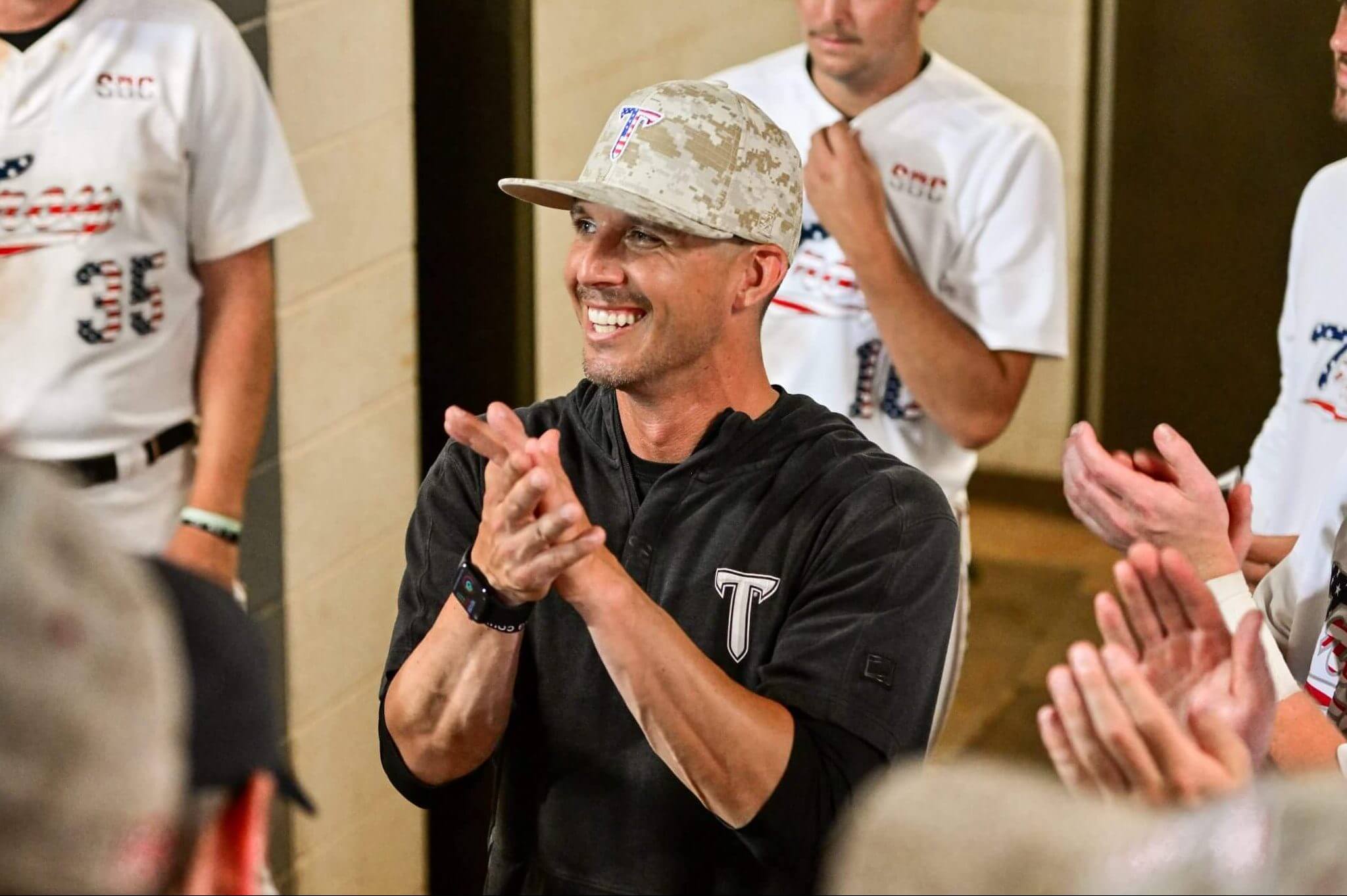
Skylar Meade is 148-89 in four seasons at Troy. (Troy Athletics)
Do you find there is less emphasis or less pressure on high school recruiting because of the portal?
J.D. Arteaga (Miami): I think that we’re still trying to figure that out. And what is the line, right? Seven high school guys and seven portal guys? Is it 15? Every program is run differently. I think that we have to leave room for the portal guys. You don’t know what your needs are going to be and whether it’s guys have a good season and get drafted and leave after the junior year or guys that you think are going to be part of your future and they’re not happy because they don’t play enough right away and now you’ve got to plug that hole.
So I think that’s very fluid right now. Everyone’s trying to figure that out and what is the balance and what is your vision and what recruiting should be. Personally, I think that the portal should be something to just fill in gaps here and there. … But it takes patience from both sides, right? I mean, as a coaching staff, you got to be patient while you develop these guys, and the players have to be patient and, not really waiting their turn, but developing and getting better until they can come in and win games at a high level.
Jordan Bischel (Cincinnati): I think there is something to that. I think if you ask me why have we been pretty successful, I believe our culture and player development have been really high level and our desire to not lean on the portal to be really good.
I think in some ways, if you’re in a position to really crush the portal, you’re probably right (that high school recruiting isn’t as important). If you’re in a position where you’re trying to beat those teams that have that ability to crush the portal, in some ways, it adds importance because that’s our path. If we want to go to the Knoxville Regional and beat Tennessee, it’s probably not because we kicked their butt in the portal. It’s probably because we had great young guys that developed into top-end players that were really bought in. In some ways, we know to beat those elite programs that are going to land All-American-type kids in the portal, we’ve got to do it a different way. So we better get it right.
Scott Forbes (North Carolina): Yeah, I think the old recruiting class rankings are a little bit overrated. You still want to have the best high school players in the country. The biggest risk with that is you get the best high school players committed, they can sign professionally, and a lot of them are going to sign professionally, so you have to have a little bit of luck there.
I wouldn’t say less emphasis. I would say less numbers. You have to leave yourself room to fill some voids in the portal.
Pat Hallmark (UTSA): It’s slowing it down for sure. I find us at UTSA the last year or two, we’re getting a tick better high school recruit because I think it’s slowing down at the top places. They’re going almost strictly portal. So, yeah, I do think the college coach, in general, feels less pressure to get the high school recruit right … because you just go in the portal and fill some gaps that way.
Skylar Meade (Troy): You are certainly right (that you can use the portal to cover up recruiting misses). I don’t know if that’s good or bad or whatever, but being older certainly can help you be better. I think we’ve seen that in a million sports.
I think for us, we’ve stayed very consistent. Just to speak to our program and our ideals, we’ve tried to get six or seven high school kids (a year). We might lose one in the draft, which has happened a couple times, but the reality is we picked the ones that we feel like we landed that were dynamite. … We believe in them, their makeup’s off the chart, they have good families, they’re invested in us and our program, but you also say, I don’t think we can get 15 of those. Therefore, with this cycle and the nature of it, we’re going to have to sprinkle in our juco, and then we’re going to have to be dynamic in the portal. And fortunately, we’ve been very dynamic in both of those areas over the last three years, in particular with the type of player in which we’ve brought in. So I don’t think it’s totally changed for us, but I think for a lot of others it has.
Eddie Smith (Washington): I think that’s a really, really true general statement. I think our path at UW is still a very traditional model with where we are in the NIL space and scholarship space. We aren’t able to go out and bid on the open market for top-tier transfers. So we got to get people that are excited about Washington and grow them through our program. So for us, I think we’re still pretty active at that high school level.