
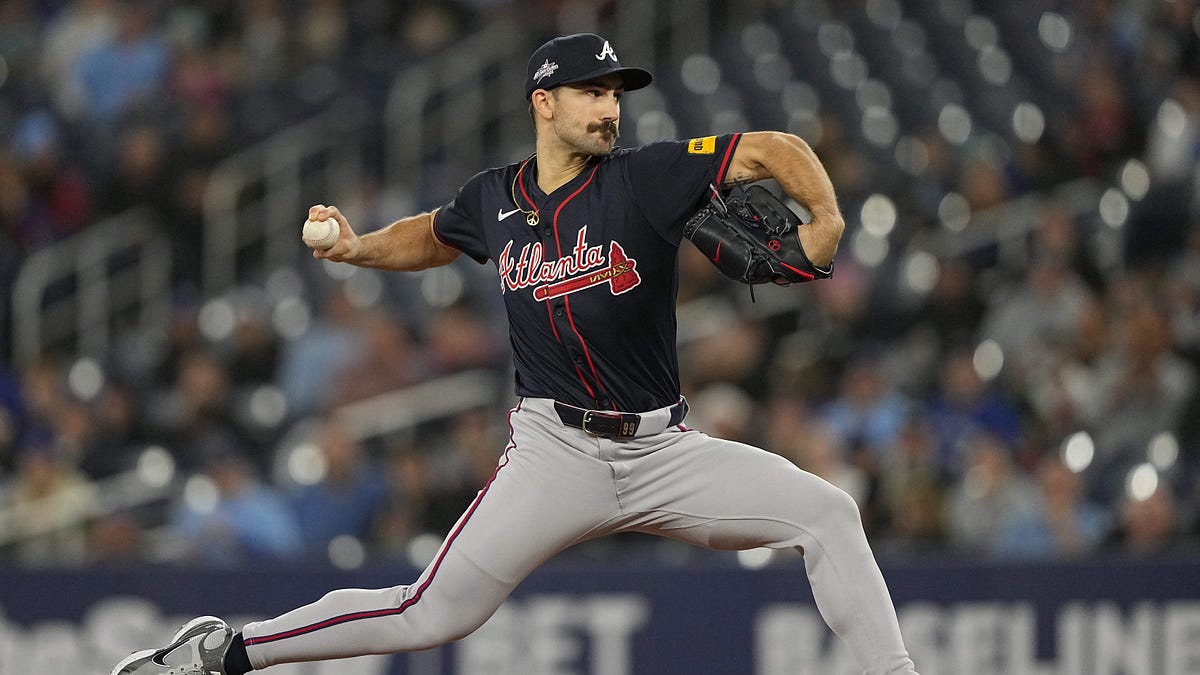
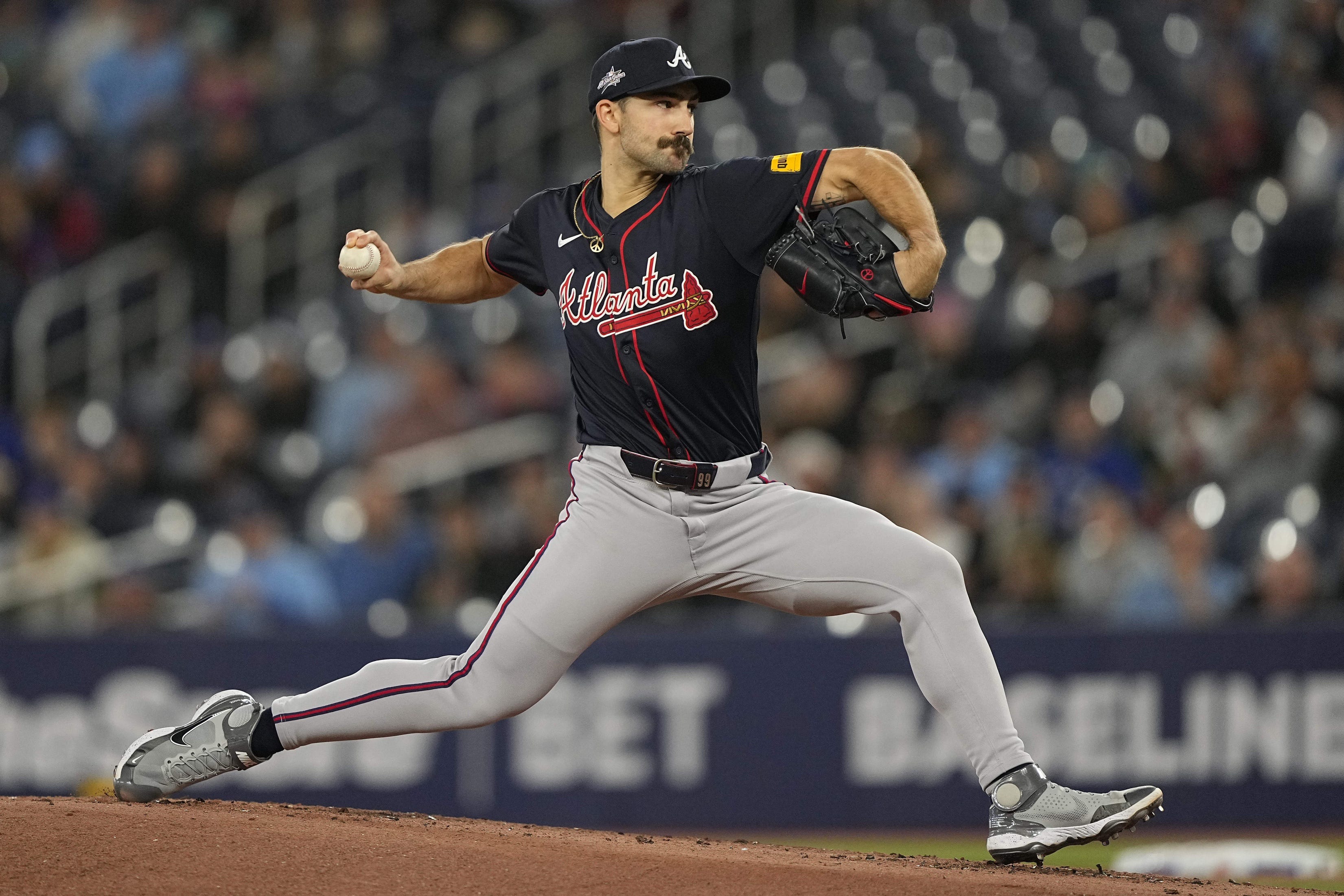
 © Imagn Images
Spencer Schwellenbach’s unfortunate 60-day IL stint for “elbow inflammation”, believed to be brought on by bone spurs, means that the Atlanta Braves are once again dealing with significant losses to their rotation. Schwellenbach is down until at least late May and might not return this season, depending on how his bone spurs react to non-surgical rehab.
It’s a development that has a lot of Braves Country deep in their feelings. Atlanta is hoping it also has Spencer Strider deep in his bag. Let’s talk about it.
On its surface, yes.
Strider went 7-14 with a 4.45 ERA/4.53 FIP, striking out 131 in his 125.1 innings (24.3% K rate) with 51 walks (9.5%) and 20 homers allowed (3.7%). Averaging ‘only’ 95.5 mph on his four-seam fastball, he picked up a pedestrian 15.3% whiff rate on the heater, which impacted his still devastating slider’s effectiveness.
By comparison, here’s the change from his Cy Young finalist season of 2023:
K%: DOWN 12.5%
HR%: UP 0.8% (2.9% to 3.7%)
BB%: UP 1.9%
4S Velo: DOWN 1.7 mph
4S Whiff: DOWN 13.4%
SL Whiff: DOWN 7%
To a lot of baseball, Strider went from baseball’s preeminent strikeout king to just another guy. Bryce Elder – yes, Bryce Elder – finished within five percentage points of Strider’s strikeout rate last season.
But the surface stats from the entire season are a bit misleading, as Strider’s season can be divided into three distinct sections. And what went wrong can be seen rather clearly from a distance:
April – July: 3.71 ERA (77.2 innings)
Aug 6 – Aug 18: 15.43 ERA (11.2 innings)
Aug 25 – September 27: 2.50 ERA (36 innings)
Let’s talk about that three-game stretch in the middle – what went wrong for Strider, and how he fixed it.
Here are Strider’s three pitching lines from that 15.43 ERA stretch last summer.
vs MIL: 4.2IP, 11H (2HR), 5ER, 1BB/6Ks on 94 pitches (61 strikes)
@ NYM: 4IP, 8H (3HR), 8ER, 2BB/2Ks on 82 pitches (54 strikes)
vs CHW: 3IP, 10H (2HR), 7ER, 1BB/2Ks on 68 pitches (41 strikes)
There are a few simple observations to be made from the lines:
Walks weren’t the problem – four total in 65 batters faced, a 4.6% rate.
Homers were a problem – seven of his 20 on the year came in this span. We’re getting to that.
29 hits and four walks is good for a 2.946 WHIP, which is…not good.
But why was it so bad?
Against Milwaukee on the sixth, only two of their hits came in a pitcher’s count – Joey Ortiz’s 0-1 double in the top of the 4th and Christian Yelich’s 0-2 double in the top of the fifth. Everything else was either an even count or when Strider was behind and forced to bring his stuff into the zone. The two-run homer in the top of the 5th by Blake Perkins? A full-count slider that Strider hung middle-middle. The first hit of that inning was a 2-0 Isaac Collins single on a zoned fastball, while he also gave up 2-1 singles (fastball), a 3-2 single (fastball), and a 1-1 homer on a slider that does NOT belong as high in the zone as it was to Andrew Vaughn.
As I alluded to with that Vaughn homer, Strider also left too many pitches up in the zone for his own good. Across the three games, Strider threw four breaking balls in the upper third of the zone and both of them put into play were hits.
If you expand this to the middle or upper third of the zone, which again is not really where you want to throw a slider, Strider gave up a .700 batting average with two homers, three doubles, two singles, and three fielding outs.
I’m fine getting beat on a slider that you executed in the bottom of the zone; it’s baseball, and sometimes a good hit is just a good hit and there’s really nothing you could have done differently. But when you leave it middle-middle or hang it, it’s your own fault.
Against the White Sox in game three, Strider allowed a .556 average on balls put into play against an expected of ‘only’ .296. Several of these were just bad beats, including a 74.7 mph flare single to left that fell right in front of Jurickson Profar and a 65.7 mph grounder to short that Nick Allen couldn’t convert into an out.
The Brewers’ matchup, game one, was a similar ‘bad luck’ outing where Strider gave up an actual .478 average against an expected .315. For the three-game span, Atlanta’s opponents overperformed their expected batting average by .129 points.
The causes were clear: poor count leverage, elevated breaking balls, and some bad batted-ball fortune. The more important question is what happened next.
Fun fact, we actually wrote about Strider’s problematic fastball after that third game, highlighting what the Chicago White Sox did to make his outing a nightmare.
 Thoughts On Spencer Strider’s Struggles
You could tell that the struggles were weighing on Spencer, with the righty telling the media after the game that “I can’t compete in the strike zone, and that’s it.”
He elaborated that it wasn’t the fastball’s velocity, but rather the movement profile that was the problem. “So, my fastball just isn’t getting outs. It’s not a contact pitch, and it’s not moving the way that I need it to move.” His once elite 18.4 inches of induced vertical break was down to a league-average 16.3 inches, reducing the ability of the pitch to miss bats.
The result of losing the fastball as an in-zone early at-bat weapon meant that his entire sequencing was off. Let’s have Spencer explain:
“When I can’t throw my fastball in the strike zone, obviously that gives the hitters a leg up. Then, my slider is an effective pitch, but not if I’m behind in counts or not making guys swing. Then inevitably, if I throw it in the zone, it’s getting crushed.”
But Strider was given some additional time after this three-game span before his next start, and after a trip to Atlanta-based Maven Baseball Lab, he emerged a week later with seven innings of one run, three-hit ball against Miami.
The fastball movement was back, with Strider returning to above-average IVB numbers of roughly 17.3 inches – not his elite 18+, but better than the league average movement he was getting prior. He also sequenced better, throwing 15% curveballs (a season high) and 6% changeups, along with almost equal usage of the slider and heater.
(We wrote about it one start later, after we knew that the changes were there for good)
 The Braves Just Saw a Glimpse of the Old Spencer Strider
Strider’s full-season ERA finished roughly a full run higher than it likely would have been without those three outings. If Strider puts up a 3.34 ERA instead of his actual 4.45, are we nearly as concerned about his 2026 season? I don’t think we are.
Or at least, we wouldn’t have been. With the news that Spencer Schwellenbach will miss somewhere between two months and two seasons of his career with bone spurs in his elbow, Strider making like Stella and getting his groove back feels like it’s more important than ever.
Working against Strider is a great point made by my friend Nick Pollack, founder of Pitcher List, from when he previewed Atlanta’s starting rotation: history.
“Can you remember a pitcher who had an elite four-seamer, underwent elbow surgery, returned with a worse four-seamer, and regained his elite four-seamer the next year? I know it’s a lot of variables, but the answer is simple. There isn’t one.”
Put simply, no one’s attempted to do what Spencer Strider is trying to do.
But at the same time…can you really bet against Spencer Strider? The man is famously as cerebral as they come, devoted to understanding the exact way his body moves and looking for every single edge to become the best pitcher he can be.
And pitching coach Jeremy Hefner identified some adjustments back in December to help him get there, too.
But with the loss of Spencer Schwellenbach, Spencer Strider needs to resume his role as MLB’s resident strikeout king if the Braves want any chance of returning to October, never mind advancing once they get there.
Atlanta doesn’t need Strider to be good – they need him to be elite again.
I’m confident he get back there.