
Despite his failure to thrive as one in 2025, the Chicago Cubs still see Ben Brown as a starting pitcher heading into 2026. That was the most important insight offered by pitching coach Tommy Hottovy when he appeared Saturday on 670 The Score’s “Inside the Clubhouse” and was asked about the 26-year-old righthander.
“I mean, Ben Brown should be an established big-league starter,” Hottovy said. “In my mind, he’s got the stuff there to be able to do it.”
Brown has, indeed, flashed plus stuff in the 40 games and 162 innings he’s pitched in the majors. Since the Cubs acquired him from the Phillies in exchange for David Robertson in 2022, he’s flashed huge upside, powered by a fastball that reaches the upper 90s and a sharp breaking ball. He struck out 25.6% of opposing batters in 2025 and walked just 6.8%.
However, Brown’s heater flattens out and becomes exceptionally hittable any time it sags below 97 miles per hour, because of the combination of its shape and his high arm slot. Working as a starter, he’s struggled to keep his velocity that high, and has thus been hit hard. He had a 5.92 ERA last year, despite the strong strikeout and walk numbers. For most of his career, he’s also utterly lacked a functional third pitch. He has a reliever’s arsenal, and a reliever’s need for sheer velocity.
Hottovy’s optimism about him in a starting role stems in large part from what he’s seeing in the club’s efforts to help Brown expand that arsenal.
“Our goal is to get him stretched out, continue to develop the changeup, working on a few other pitches, and continue to build out his repertoire and let him go be a dominant pitcher for us,” he said Saturday.
Therein lies the upside, if he’s to stay in the rotation. Brown must tap into a changeup that works, and/or widen his arsenal to include a sinker or a slider with more lateral movement. His efforts to do that over the last two seasons have yielded mixed results, but late last year, there was a breakthrough.
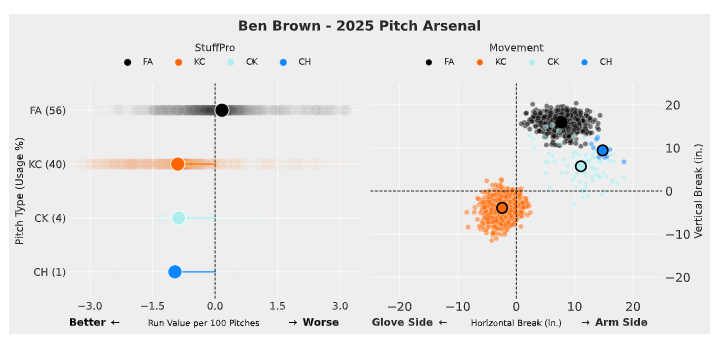
That pale green offering is a kick-change, the same pitch that unlocked things for Jameson Taillon last spring. It’s a pitch with a better chance to be consistently effective for Brown than his old changeup had, because he’s more likely to be able to command it—not in terms of location, but in terms of execution and movement. Whether hitters will ever chase the pitch out of the zone often enough for it to play as well as it grades is an open question, but one that probably hinges more on his command of his other two offerings than on that one.
Though he’s coming up on two years of service time, Brown still has one minor-league option year remaining. The Cubs could choose to stash him in Iowa this spring and keep him stretched out as an emergency starter. That, however, feels like a waste of a high-powered, high-upside arm. To get the most out of Brown, the team needs to either help him turn the corner and become a useful big-league starter now; convert him to a relief role, where he could be a stellar setup man; or trade him.
Hottovy’s faith in Brown is admirable, but he hasn’t yet earned that faith. The talent is there, but it also has limits of which we should take note. The fastball shape is a constraint on his upside. So is the lack of a breaking ball with more side-to-side movement. Most of all, he needs a changeup he trusts, so he can force hitters (especially lefties) to respect that pitch more. As pitchers and catchers officially report to camp, Brown might be the most interesting Cub on site. He could be hugely helpful to the team this year, either as a trade chip or by directly contributing to their pursuit of a division title. If he doesn’t take a big step forward this year, though, he’s unlikely ever to do so.