
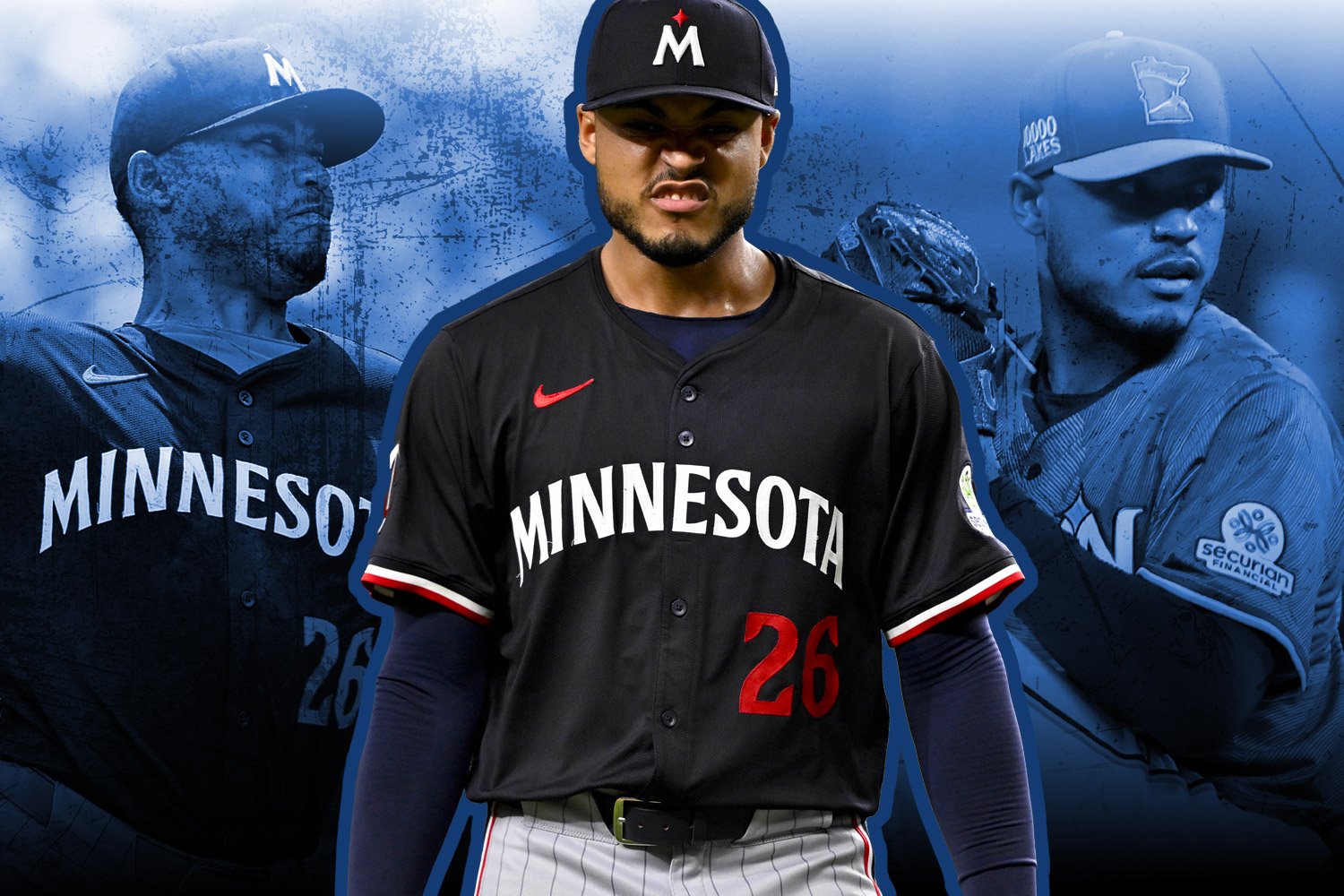
Taj Bradley might have been the best-known name acquired by the Minnesota Twins during the 2025 trade deadline fire sale. A former top 100 prospect, Bradley’s performance plateaued during his third season with the Tampa Bay Rays, who shipped him to the Twins in exchange for the highly coveted Griffin Jax.
Bradley’s first run with the Twins was mediocre. He finished the 2025 campaign with a 5.05 ERA in a career-high 142 ⅔ innings, though, as has been consistent throughout his young career, his 4.37 xFIP suggested that he got a little unlucky.
Entering his first full season with the Twins, the question of whether or not Bradley would be more effective as a reliever has been swirling through many minds. However, unlike my analysis of Zebby Matthews, I think there is sufficient data to suggest that Bradley’s role as a starter is clearer, at least in the short term.
Read Previous Entries:
Taj Bradley’s Stuff and Pitch Arsenal
Bradley’s arsenal primarily consists of four pitches—a four-seamer, cutter, splitter, and curveball—though he occasionally throws a sinker (or at least some of his four-seamers get labeled as such). Like most pitchers, his offerings vary depending on the handedness of the hitter; in 2025, he primarily deployed his fastball, cutter, and curve against righties (515, 347, and 146 pitches, respectively) and his fastball, splitter, and curve against lefties (565, 246, and 189). (Of note: Baseball Savant labeled 192 of Bradley’s fastballs against righties in 2025 as sinkers compared to only 10 against lefties. This suggests that Bradley will alter his grip on occasion against same-handed hitters to induce more horizontal run into the batter.)
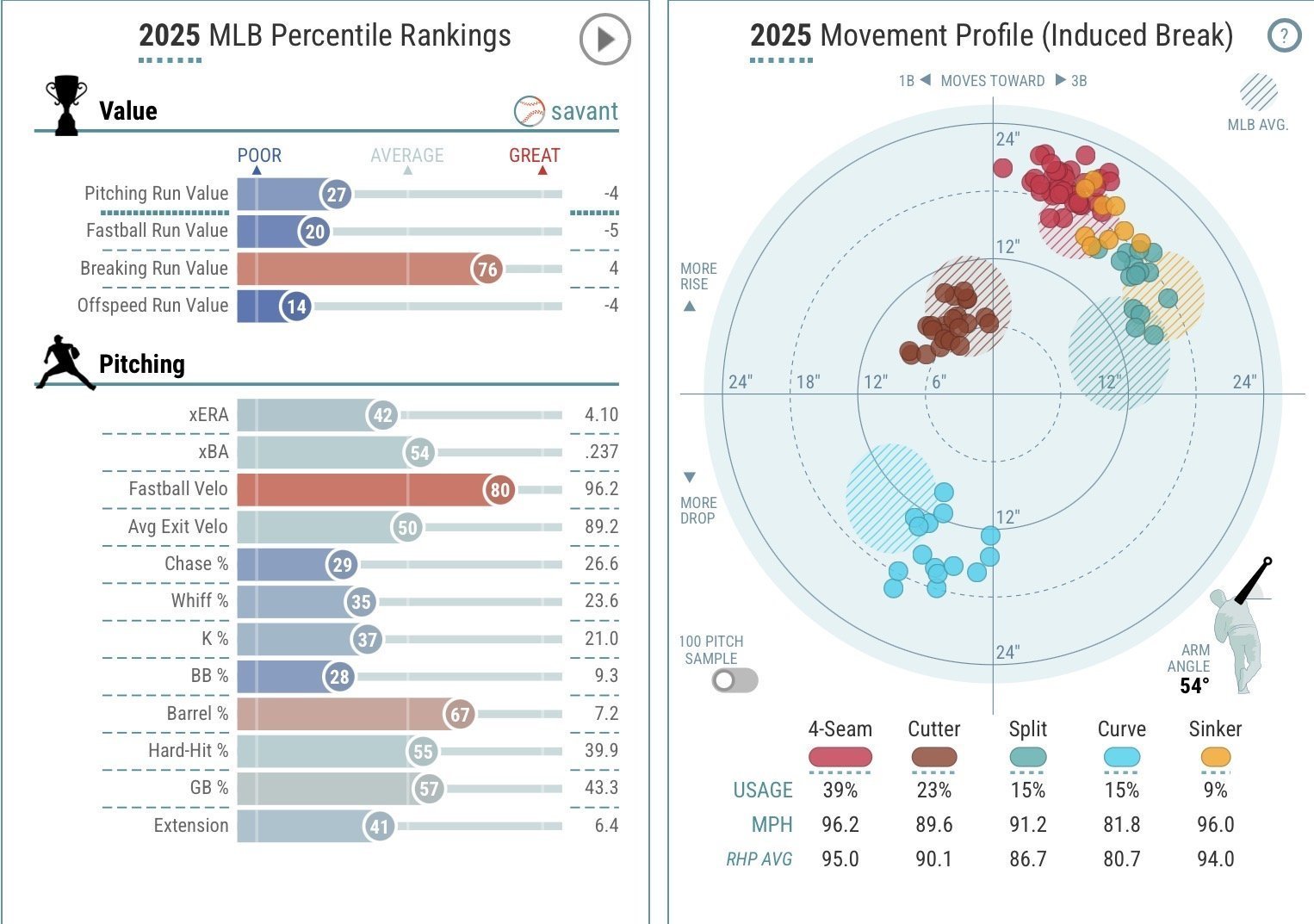
On paper, Bradley’s fastball should play well. It sits in the mid-90s and can touch near 100 mph on occasion with 18.5 inches of induced vertical break (IVB) and 6.2 inches of horizontal break. His fastballs, categorized as sinkers, feature a similar velocity profile, though with 15.4 inches of IVB and 10.5 inches of arm-side run. His four-seamer’s IVB is well-above average, meaning it should fare well at the top of the zone, where its ability to create a rising illusion should cause it to induce whiffs.
Notice how many “shoulds” are in the previous paragraph. In practice, Bradley’s fastball is arguably his worst pitch. In nearly 3,000 offerings across 385 ⅓ major league innings, the fastball has produced an .896 OPS. According to FanGraphs, since making his MLB debut in mid-April 2023, Bradley’s fastball ranks 371st out of 419 in OPS against, while throwing it with the 29th-highest volume (minimum of 500 pitches). (His sinker provides much too small a sample size to make any grand conclusions, but Pitch Info Solutions, which provides its pitch data to Savant, has Bradley producing a .756 OPS across 192 pitches.)
What should—there’s that word again—be heartening to Twins fans, though, is that the rest of Bradley’s repertoire has performed quite well. Nearly 1,500 cutters have produced a .711 OPS (14th volume, 27th OPS, out of 103); his splitter has produced a .597 OPS (10th volume, 26th OPS, out of 171; 1,216 offerings); and his curveball, undeniably his best pitch, has produced a miniscule .454 OPS (39th volume, 6th OPS, out of 100; 844 offerings).
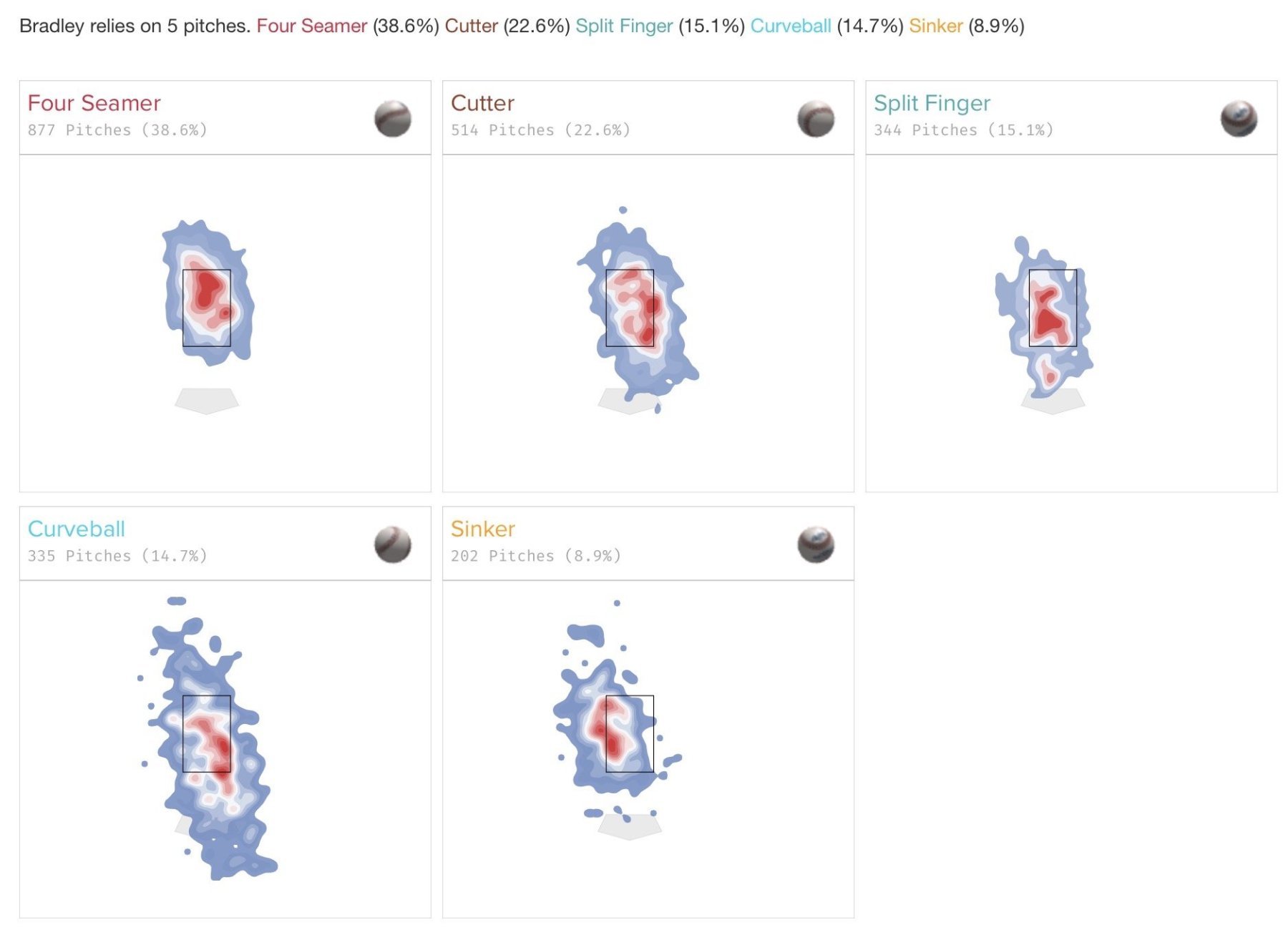
Seemingly, the easiest fix to make Bradley a more effective pitcher is to alter his pitch mix, namely, throwing many more curveballs. Bradley’s curve features a significant vertical break (55.8 inches with gravity, four inches more than average) at 82 mph on average. It’s truly one of the best curves in the game and plays well off his high velocity, high IVB fastball. He’d also do well to throw more cutters. It features below average velo (89.6 mph) and a relatively poor movement profile (4.0 inches of glove side break is good but 5.6 inches of IVB is quite poor), but a .711 OPS is much better than a .896; even if it were to perform worse at higher volume (and it almost undoubtedly would based on its movement profile), it almost couldn’t perform worse than the fastball.
Year
Pitch Type
#
# RHB
# LHB
%
MPH
PA
AB
H
1B
2B
3B
HR
SO
BBE
BA
XBA
SLG
XSLG
WOBA
XWOBA
EV
LA
Spin
Ext.
Whiff%
PutAway%
2025
Sweeper
34
17
17
33.3
82.0
10
8
0
0
0
0
0
2
6
.000
.078
.000
.087
.138
.197
86.1
14
2416
6.7
40.0
18.2
2025
Four Seamer
27
22
5
26.5
93.2
6
6
1
1
0
0
0
2
4
.167
.093
.167
.123
.147
.093
90.2
52
2247
6.8
27.3
22.2
2025
Sinker
27
8
19
26.5
92.9
9
6
2
2
0
0
0
1
5
.333
.277
.333
.455
.430
.442
85.2
32
2040
6.7
10.0
20.0
2025
Changeup
11
11
0
10.8
88.9
2
2
1
0
1
0
0
0
2
.500
.448
1.000
.633
.626
.456
98.1
5
1891
6.8
0.0
0.0
2025
Cutter
3
3
0
2.9
89.4
2
1
1
0
0
0
0
1
1
1.000
.889
4.000
3.536
1.380
1.257
107.1
29
2393
6.7
0.0
0.0
2024
Sweeper
128
95
33
32.1
80.6
25
21
4
3
0
0
1
8
15
.190
.135
.333
.232
.245
.190
86.0
21
2497
6.7
34.5
19.0
2024
Sinker
97
79
18
24.3
92.5
27
27
6
6
0
0
0
2
25
.222
.268
.222
.318
.196
.262
87.1
6
2043
6.7
17.6
11.8
2024
Four Seamer
80
70
10
20.1
93.3
35
33
7
7
0
0
0
4
29
.212
.250
.212
.298
.217
.268
83.1
20
2183
6.7
14.6
10.8
2024
Changeup
57
56
1
14.3
87.9
16
15
5
4
1
0
0
1
15
.333
.299
.400
.419
.319
.321
82.2
2
1985
6.7
17.2
20.0
2024
Cutter
37
32
5
9.3
88.4
11
10
6
5
0
0
0
1
10
.600
.379
.900
.607
.587
.411
93.3
17
2430
6.7
20.0
11.1
What Should Taj Bradley’s Role Be In 2026?
From an aresenal standpoint, Bradley has enough juice to remain a starting pitcher. He possesses three pitches—the cutter, splitter, and curve—that have performed at an above-average to well-above-average clip throughout his three years in the bigs. Altering his pitch mix to feature fewer four-seamers and more curveballs and cutters against righties would be prudent (and would likely improve his rather poor career 15.2% K-BB% and .754 OPS against same-handed batters; for reference, lefties, who should be much better against the right-handed Bradley, have produced a 17.4% K-BB% and .730 OPS. That’s weird.)
However, at a certain point, the results speak for themselves. Bradley has largely been an underwhelming starting pitcher, especially when you take into account his hype as a prospect. He has seen his strikeout rate drop from 28.0% as a rookie to 21.0% in 2025, while his walk rate has increased, from 8.5% (an already high number) to 9.3%. It’s possible that 2026 marks his last run at a starting pitching role, unless he improves his ability to miss bats and avoid freely placing runners on base.