
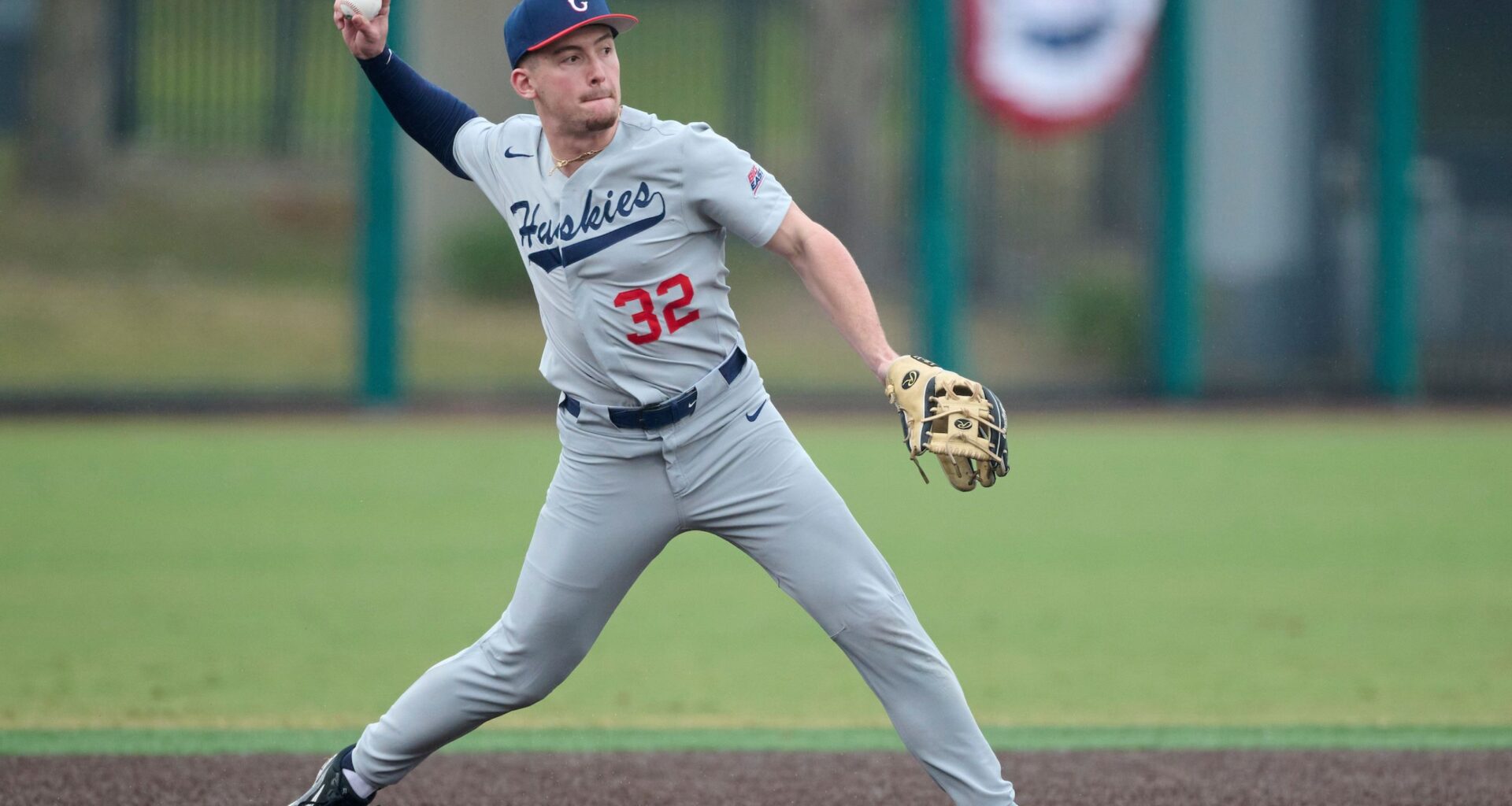
Connecticut, Creighton and Xavier once again headline the Big East race, while the broader conversation centers on whether the league can translate top-heavy strength into meaningful NCAA Tournament representation.
The conference continues to produce legitimate draft talent and disciplined, veteran rosters, but selection leverage has proven difficult to secure in recent seasons. With UConn carrying the sting of last year’s omission and multiple challengers capable of testing the margins, the Big East shapes up as a league defined by urgency as much as ability.
Baseball America subscribers can find our complete 2026 Big East preview below, featuring projected order of finish, top 2026 MLB Draft prospects and conference award picks.
Projected Big East Standings
Note: Listed records are from 2025
Connecticut (38-21; 17-4 Big East)
Creighton (43-16; 17-4)
Xavier (32-27; 14-7)
St. John’s (29-24; 13-8)
Seton Hall (24-30; 10-11)
Georgetown (16-40; 3-18)
Villanova (22-28; 6-15)
Butler (15-39; 4-17)
Top 10 Big East Draft Prospects For 2026
Tyler Minick, OF, Connecticut
Jon Legrande, OF, St. John’s
Clay Burdette, OF, Xavier
Ryan Piech, RHP, Xavier
Sean Finn, RHP, Connecticut
Isaac Wachsmann, OF, Creighton
Ryan Reich, RHP, Seton Hall
JT Raab, RHP, Georgetown
Spencer Seid, LHP, Georgetown
Rob Rispoli, SS, Connecticut
Big East Team to Beat: Connecticut
UConn coach Jim Penders doesn’t hide his belief that the Huskies belonged in the 2025 NCAA Tournament field. He points to strength of schedule, resume context and the program’s sustained track record as reasons UConn was left out. The sting of the omission has lingered well beyond Selection Monday. And that frustration has become fuel. Penders has made it clear that the miss should not be forgotten, using it as a daily reminder that margin matters. That edge accompanies a roster built for season-long consistency, positioning UConn as the preseason favorite in the Big East. The offseason emphasis centered on refinement rather than overhaul, with a deliberate focus on strike-throwing and sharper baserunning. Penders believes fundamentals will determine whether the program corrects course in May. Creighton and Xavier loom as legitimate threats to the conference crown, with St. John’s close behind, but UConn enters the year intent on ensuring last season’s exclusion becomes a catalyst rather than a scar.
Preseason Big East Player of the Year
Tyler Minick, OF, Connecticut
Minick authored one of the most complete offensive seasons in the country last spring, hitting .350/.433/.729 with 22 home runs, 11 doubles and 15 stolen bases as the centerpiece of UConn’s lineup. Though contact frequency can waver, his swing decisions were strong, as he paired a 46% overall swing rate with a manageable 25.4% chase rate. Minick’s ability to elevate and pull the baseball supports the notion that he has plus game power. If he carries that profile into 2026 while handling center field duties, his offensive foundation comfortably fits early-round draft conversations.
Preseason Big East Pitcher of the Year
Wilson Magers, RHP, Creighton
Magers drew serious Freshman All-America consideration in 2025 after posting a 3.47 ERA with 55 strikeouts over 72.2 innings at Creighton en route to earning Big East freshman of the year honors. He returns to Omaha as the likely staff leader and a central figure in the Bluejays’ rotation. The next step in his progression centers on sharpening his strike-throwing, which will determine how much further he can elevate his profile as a sophomore.
Preseason Big East Freshman of the Year
Cam Righi, UTIL, Connecticut
Penders was bullish on Righi throughout the fall, pointing to the 6-foot-4 lefthanded hitter’s unusual defensive versatility as a separator. Righi has shown the ability to handle the outfield, first base and even catcher, giving UConn valuable lineup flexibility. He logged 31 games in the Futures Collegiate League over the summer, hitting .245/.384/.398 with three home runs, four doubles, a triple and 13 stolen bases. That blend of athleticism, positional range and physicality positions him for early at-bats, and he stands as a clear example of what Penders described as “keeping the best in Connecticut home.”
Notable Big East Storylines
The defining question in the Big East entering 2026 is tournament access. League officials believed three bids would have been a fair outcome last year, noting that Connecticut and Xavier finished 41st and 42nd in RPI, respectively, marking the highest rankings among teams left out of the field. Xavier’s omission, in particular, reignited debate over scheduling value after the Musketeers played the nation’s No. 37 strength of schedule, including the fifth-most difficult non-conference slate. With the league’s top teams again scheduling aggressively and projecting as competitive as ever, the central question becomes how many bids the conference can realistically secure. Baseball America projected just one bid based on last year’s outcome, but the expectation internally is to push that number higher.
The committee also pointed to conference depth as a concern, arguing that strength outside the top tier did not measure up. The historical record offers some support for that argument. Since Seton Hall won the Big East Tournament in 2011, only Xavier, Connecticut, Creighton and St. John’s have claimed the league’s automatic bid, with Creighton doing so just twice in that span and St. John’s only once in the last six seasons. Those same four programs are again projected to contend in 2026. Can anyone else disrupt that established hierarchy in 2026?