
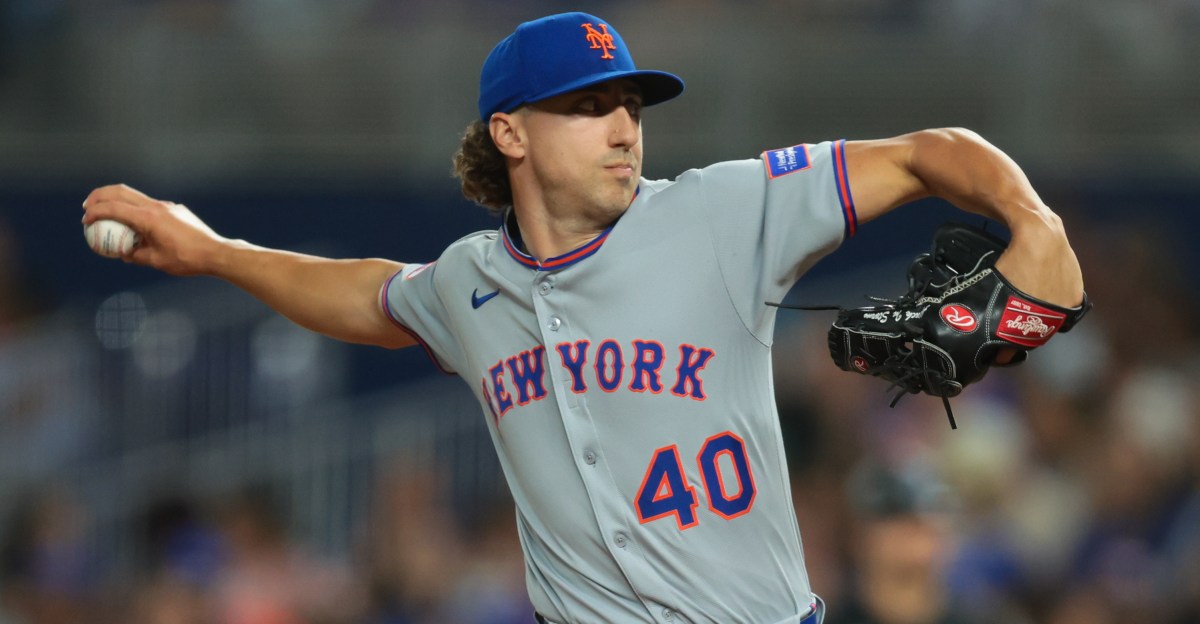
Milwaukee’s pitching development staff has a reputation around the league as a “pitching lab.” As an organization, the Brewers have done a great job of developing pitchers with talent who were either unheralded or underperformed previously. In 2024, Tobias Myers turned into arguably the Brewers’ best starting pitcher. In 2025, Quinn Priester didn’t lose a game for literal months on end.
In 2026, I think recent acquisition Brandon Sproat is the best bet to follow this pattern.
Coming out of the University of Florida, Sproat was regarded — per Baseball America — “as an athletic righthander with arm speed who emphasized his fastball and changeup,” although his “shaky control induced reliever risk.” Despite the “risk,” he was drafted in the second round of the 2024 draft by the Mets and initially looked to be an amazing find. Sproat breezed through the lower minors and arrived in Triple-A before the end of his first professional season.
Unfortunately, he hit a wall there. The right-hander started seven games in 2024 for the Syracuse Mets, posting a 7.53 ERA. His peripherals weren’t great, either. Sproat allowed 2.2 home runs and 11.3 hits per nine innings, both more than double his average in Double-A. He allowed an opponent slugging percentage of .574. Sproat struck out 11 batters per nine innings in both High-A and Double-A, but that number dipped all the way down to 6.59 in Triple-A. Through his first 22 starts with Syracuse (seven in 2024 and 15 in 2025), Sproat sported a pretty brutal 6.45 ERA.
And then, just like that, he figured things out. Starting in July 2025, Sproat started shoving like he had been in the lower minors. Through his last 11 starts in 2025, he recorded a 2.44 ERA while striking out batters a whopping 30% of the time.
Sproat was rewarded for his efforts with a September call-up, making his major-league debut just before his 25th birthday. He didn’t pitch incredibly well during his four appearances with the Mets but didn’t embarrass himself either. I’m inclined to agree with Baseball America, which said in their scouting report on Sproat that he “has all the ingredients to be a No. 4 starter or better, and he’s ready to assume that role in 2026.” He has talent to spare, with four pitches (a mid-80s sweeper, a high-70s curveball, a slider, and a 94-96 mph sinker) that all have the potential to be plus pitches at the major league level.
So, how can the Brewers’ pitching lab get the most out of Sproat?
Sproat has always been talented, but his success down the stretch came as a result of developing a more effective pitch mix. Milwaukee has had a ton of success with modifying and developing pitch selection, and Sproat has as much to work with as any pitcher the Brewers have had in recent years.
Sproat has used a combination of six different pitches — a sweeper, curveball, changeup, slider, fastball, and sinker — since becoming a member of the Mets organization. Below is his pitch chart over his first four career starts. As shown below, Sproat threw his sinker nearly twice as often as any other pitch. He deployed his sweeper, curveball, fastball, and changeup at roughly equal rates while barely using his slider. It’s an extremely limited sample size, but it does show us what the Mets thought an ideal pitch mix would be for Sproat.

His sinker was hit harder than any other pitch during his four starts in New York, even after accounting for higher volume. Sproat gave up a hit on nine of the 99, or 9.1%, of the sinkers that he threw, with three of those hits going for extra bases. His changeup (43 pitches, two hits) and sweeper (55 pitches, one hit) were each used less frequently than his sinker but proved very effective when utilized. Brewer Fanatic’s Jake McKibbin showed that the sinker and sweeper were ineffective against lefties, describing them as pretty much “neutralized.”
Sproat was only throwing his fastball 32% of the time, even in July. He gets solid velocity on his fastball, which can occasionally touch triple digits, but due to below-average shape (a lack of induced vertical break) his fastball hasn’t exactly been a put-out pitch thus far. Baseball America called it “pedestrian.”
The weird thing is that Sproat’s pitch chart with the Mets is almost the exact opposite of what it had been a year prior. Per a 2024 scouting report, Sproat’s best pitches were his fastball and his slider, the two pitches he threw the least as a Met. The fact that he only threw his four seamer 14% of the time in the big leagues probably doesn’t even mean it’s not a good pitch — it just means that without a good shape, it can’t be heavily featured without giving up hard contact. His fastball numbers were good as a Met, which may have because Sproat was reportedly able to slightly alter its shape sometime around… July.
Maybe the fastball is best as an ancillary offering, but I think Milwaukee sees a legitimate plus fastball waiting to be unlocked. Here’s former Brewer Josh Hader on the team’s pitching lab:
“With (pitching coaches) digging more into the lab, they’re starting to learn how pitches should spin to get optimal drop or movement. That’s one of the things we’ve been looking into with TrackMan, seeing how your ball rotates.”
Pretty much every scouting report on Sproat mentions that his fastball has a lot of potential but could use some work to induce further vertical break. That is exactly what the Brewers do. I’d bet that the Brewers will play with Sproat’s fastball until they find the right shape. Trevor Megill and Nick Mears both got hit around before arriving in Milwaukee, but both thrived once they leaned on their fastballs.
In a world where the Brewers are able to unlock his fastball, his ceiling seems to suddenly raise. Even if he doesn’t throw his fastball more than 30-35% of the time, he also has a few other pitches that are worth utilizing.
One of the reasons Sproat improved in July, per Baseball America, was that he began to throw changeups a lot more. His changeup recorded a 26% swinging-strike rate and a 71% groundball rate, with Baseball America noting that the pitch was “paramount” to his recent success. After his fastball, his changeup was his second-most used pitch against left-handed hitters in Triple-A. His curveball — which had a 41% whiff rate and a 32% chase rate in July — was the third-most frequently used.
For the sake of argument, let’s say the Brewers can’t get the sweeper and sinker — a pitch the Mets clearly believed in — to play better against left-handed hitters. If the Brewers can unlock his fastball, he’d have four pitches (fastball, curveball, slider, and changeup) that should all play well against lefties.
Can Sproat be the next Brewers pitching success story? Answer that for yourself. Sproat is an extremely talented prospect, but he’s still figuring out how to pitch to his strengths and fully harness his stuff. He couldn’t have come to a better organization.