
In preparation for the update to our Top 500 dynasty prospect list published last week, we dug deep into advanced Statcast data, scouting notes and industry rankings. That final part is key, as it helps inform us about how certain players are being valued, which, in turn, allows us to more deliberately target players we believe in and bet against those we’re suspicious of.
Today, we’ll be discussing 15 fantasy prospects we’re higher on than the industry consensus—in some cases, a good bit higher—heading into the 2026 season. We’ll discuss reasonings for our aggressive rankings and why we believe these players are prime candidates to target in your acquisition windows leading up to Opening Day.
Devin Fitz-Gerald, 2B/SS, Nationals
We’ve previously covered why Fitz-Gerald is a primary target of mine entering 2026. The infielder debuted in the Arizona Complex League last spring and impressed, earning a promotion to Low-A Hickory after the first month. A shoulder injury stripped Fitz-Gerald of the remainder of his season, but when healthy, he showed a nice blend of skills.
Fitz-Gerald combines plus contact, excellent swing decisions, above-average exit velocity data and good angles. It’s a robust offensive profile that should make him a better fantasy player than real-life prospect. While there are some concerns around his long-term defensive home, there are plenty of consensus top 100 fantasy prospects—I’m looking at you, Michael Arroyo—who fit into that bucket.
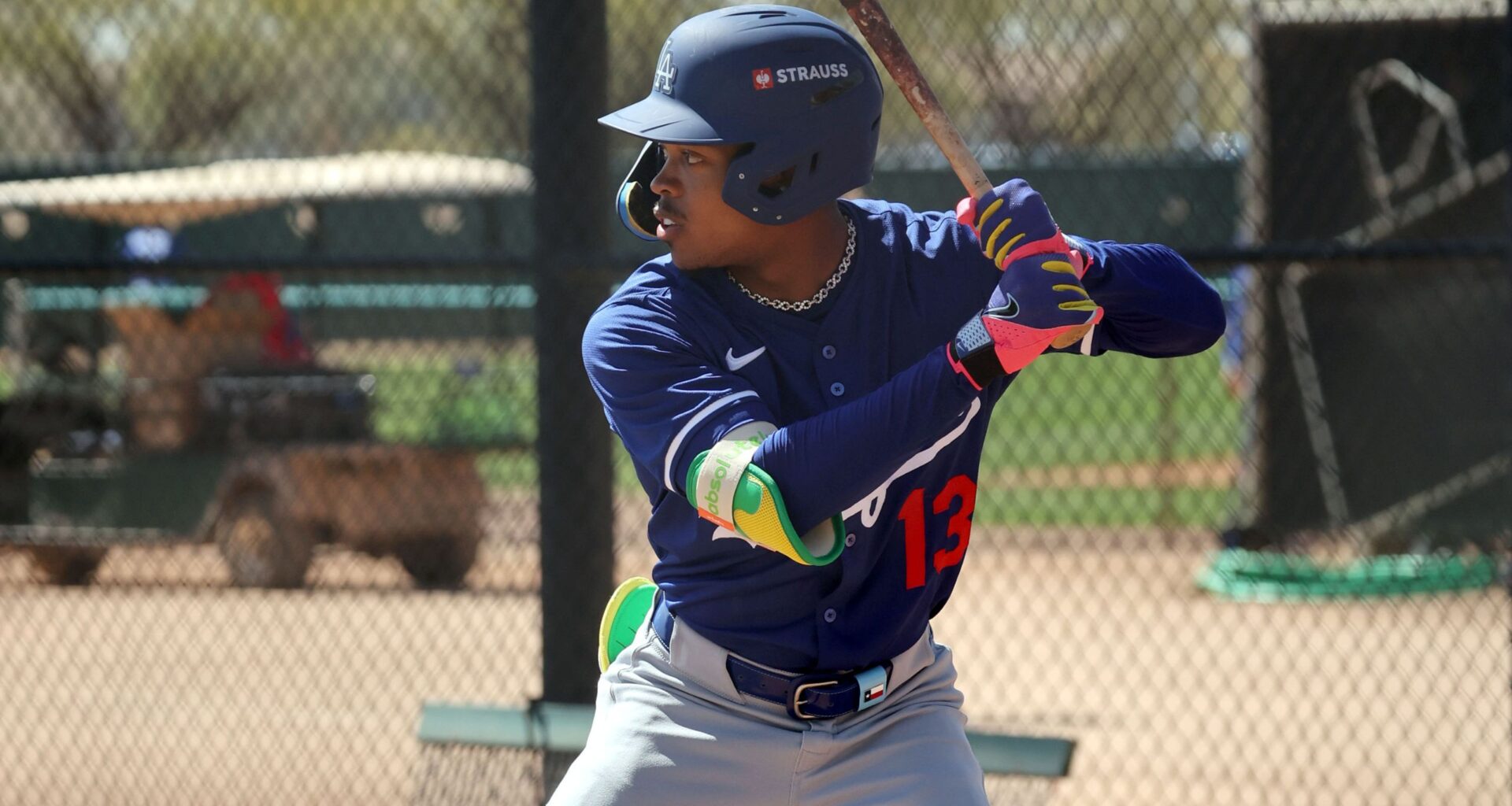
Kendall George, OF, Dodgers
As long as batting average and stolen bases are categories in fantasy, there will be a place for speed- and contact-based hitting profiles.
George isn’t ranked too far behind the Orioles’ Enrique Bradfield Jr. and offers a similar skill set at a discount. He hit .295/.409/.370 with 100 stolen bases in 2025 with High-A Great Lakes. George is one of the few prospects with a true 80-grade tool, and he uses that elite speed and baserunning acumen to generate outlandish stolen base totals. On the other side of the coin, George has true 20-grade power. As such, his game is predicated on putting the ball in play, getting on-base—something he does at a very high rate—and making plays with his legs.
It’s unlikely George is ever a full-time player with the Dodgers, but he’s a prime trade candidate in the coming years. While it’s always tough to bet on contact/speed center fielders, George could be the best version of this archetype.
Brock Wilken, 3B, Brewers
There are few players in the game today who have experienced worse luck than Wilken over the last two years. He missed a large chunk of 2024 after a grotesque hit by pitch and then sat out the second half of 2025 due to a dislocated knee cap suffered during a clubhouse celebration.
Prior to the knee injury, Wilken was arguably playing the best baseball of his career. While he dealt with bad batted-ball luck in the notoriously difficult Southern League (.267 BABIP), Wilken did impress with excellent production across 79 games. He hit .226/.387/.489 with a 20.1% walk rate that was good enough for a line 58% better than the average Southern League hitter. Wilken showed excellent power and on-base skills with enough contact to consistently get to his plus-plus power. Perhaps most impressively, Wilken posted those numbers in one of the hardest run environments in the minor leagues.
Wilken will likely be added to the 40-man roster next winter. After a full season in Double-A, he will likely begin 2026 in Triple-A.
Jake Bennett, LHP, Red Sox
Coming out of 2025, fantasy owners likely could have acquired Bennett for a song. But now, after a trade to the Red Sox and further analysis of his stuff and release traits, there has been a groundswell of his dynasty stock.
In his return from Tommy John surgery in 2025, Bennett pitched well between High-A and Double-A, posting a 2.27 ERA over 75.1 innings. While Bennett didn’t miss many bats, he did drive a high rate of ground balls.
Going from the pitching development program under the Nationals’ previous regime to the Red Sox should be a major development for Bennett’s future outlook. He has a five-pitch mix with only average power, but his seven-plus feet of extension give him some untapped potential if he can get to a few more mph on his fastball.
Bennett is on Boston’s 40-man roster entering the season and could see starts at some point in 2026.
Brandon Clarke, LHP, Cardinals
Over the first few months of last season, Clarke saw his dynasty stock explode. He came out of spring training throwing upper-90s sinkers and mid-to-high-80s sweepers, making for some of the loudest stuff in the game almost immediately upon toeing a professional mound. Blister issues sidelined Clarke, however, and led to command issues when he was active. He was later moved to the Cardinals in the Sonny Gray trade.
Clarke carries plenty of relief risk, but the overreaction on both ends of Clarke’s injury has created a good buying opportunity. He has the sort of high-end upside that’s worth a roster spot in dynasty.
Seaver King, SS, Nationals
King’s 2025 went about as poorly as it could go. His hyper-aggressive, swing-happy approach led to lots of swing-and-miss and more poor contact than was acceptable.
With the Nationals’ new front office in place, there’s some thought that adjustments could be made to King’s approach. Behind his .244/.294/.337 line, King did show good in-zone contact (17.4%) and power (104.8 mph 90th percentile EV) numbers, but he was sunk by his 37.1% chase rate.
King’s dynasty stock has bottomed out, but he’s a legitimate buy-low candidate as he heads into year two.
Aidan West, SS, Dodgers
West is one of my top targets in first-year player drafts this offseason, as I’m buying into his athleticism and strong combination of power and speed.
The Dodgers have a checkered history with prep hitters, but West provides an opportunity to buy into a high-upside lottery ticket later on in drafts this offseason. Scanning our dynasty list, you’ll notice we have a heavy bias toward speed, particularly for players with 20-home run and 20-steal upside. West fits into that bucket of players.
Jake Bloss, RHP, Blue Jays
When it comes to pitchers coming back from Tommy John surgery, there’s typically a stretch when their fantasy value is at its lowest. It’s not immediately after the surgery, but somewhere in the middle of that 15-month period typical for TJ recovery.
Bloss is a good example of this phenomenon. Heading into last season, he was showing improved stuff from his MLB debut and looked like a potential option for the Blue Jays’ rotation at some point. Instead, he injured his elbow, had Tommy John surgery and is now a forgotten name in dynasty this offseason.
Likely to return in the second half of 2026, Bloss could be a player who sees his stock climb heading into 2027 if he returns successfully. He’s nearly free in dynasty at the moment but worth a look in deeper leagues.
Rhett Lowder, RHP, Reds
When Lowder was an amateur, I viewed him as a low-upside, back-of-the-rotation arm likely to pitch in the major leagues for a decade. That’s still my perspective on Lowder, but over the last two years, his price has dropped dramatically.
After missing most of 2025 with forearm and oblique injuries, Lowder has become an afterthought in dynasty. He doesn’t have a rotation spot at present, but these things have a way of working themselves out. Lowder can provide solid innings and ratios in deeper dynasty leagues long term, making him an excellent flip candidate in fantasy—add Lowder now on the cheap and flip him in the next 12 months for twice the return.
Stharlin Torres, RHP, Reds
I previously wrote about why Torres is underrated in dynasty and will reiterate it now: Few pitchers in the lower minors have a better combination of stuff and strikes than the 19-year-old Reds righthander.
Our Stuff+ metric graded Torres’ arsenal at 110, and he throws strikes at a rate of 71.5%. He has almost no peers in the complex levels or Low-A with comparable strikes and stuff. Torres creates ride in his four-seam fastball with projectable low-to-mid-90s velocity and the makings of a plus changeup.
Torres is still cheap, but a strong full season of starts at a full-season level could see his price climb dramatically.
Braylon Payne, OF, Brewers
The hyperathletic Payne spent all of 2025 on one of the most talented teams in the minors. He played 77 games with Low-A Carolina, sharing the field with super prospect duo of Jesús Made and Luis Peña. This allowed Payne to slide a little under the radar. Furthermore, the Carolina League’s extreme run-suppressing environments made his .240/.354/.382 slash line look worse than it actually was (114 wRC+).
Payne has plus speed, defensive value, plus raw power (105.1 mph 90th percentile EV) and good swing decisions. The contact is a problem, but we’ve seen players like this climb up rankings after refining their plate skills. This is a gamble on Payne’s power and speed.
Aroon Escobar, 2B, Phillies
Coming out of spring training last year, Escobar was a hot name. The diminutive second baseman was showing real impact, hitting with a “hair on fire” approach to the game. He slashed .285/.377/.452 over 69 games with Low-A Clearwater and then made the jump to High-A Jersey Shore. Escobar’s numbers ticked down a little in High-A, but he still produced a line that was 16% better than league average as a 20-year-old.
Under the hood, Escobar shows power with a 104.7 mph 90th percentile EV, strong contact with a 16.2% in-zone whiff rate and excellent swing decisions.
Escobar is a truly underrated dynasty prospect who should be a target for savvy managers this offseason.
Ixan Henderson, LHP, Cardinals
While Henderson is a pitchability lefty who will eat innings—not the most exciting fantasy archetype—he has shown enough stuff (103 Stuff+) to make his profile work in the big leagues.
Henderson made 25 starts at Double-A Springfield last year, totaling 132 innings. This came on the heels of a 2024 campaign in which he threw 104 innings in his first full professional season. He posted a 2.59 ERA in 2025, striking out 25.2% of batters and walking 9.6%.
Henderson is a sum-of-his-parts pitcher but changes shapes, moves the ball in and out of the zone and knows how to generate outs in a variety of fashions.
Demetrio Crisantes, 2B, Diamondbacks
Injuries have robbed us of watching one of the best young hitters in the minors in Crisantes.
Make no mistake—I’m not arguing that Crisantes isn’t a very flawed player. He’s dealt with significant injuries and has major questions around what his future defensive home may be. But that said, prior to tearing his labrum, Crisantes was showing elite contact with some power in High-A as a 20-year-old.
The talent is there, as Crisantes’ 9.2% in-zone whiff rate in 2025 was arguably 80-grade. He’s rarely beaten in the zone and shows at least average long-term power projection. Of course, any Crisantes projections are pending a healthy return from injury.
Braden Nett, RHP, Athletics
Acquired from the Padres at the 2025 trade deadline, Nett is a better pitching prospect than the current dynasty community consensus gives him credit for.
Added to the 40-man roster this offseason, Nett spent all of 2025 in the Double-A Texas League and performed admirably despite the heightened run environments. He pitched to a 3.77 ERA that was supported by his ERA estimators to go with a 24.8% strikeout rate and 45.6% groundball rate. He ranks well in Stuff+ with a score of 105, mixing a deep arsenal with the ability to miss bats with multiple pitches.
Nett seems like a sneaky bet to break into a big league rotation in 2026.