
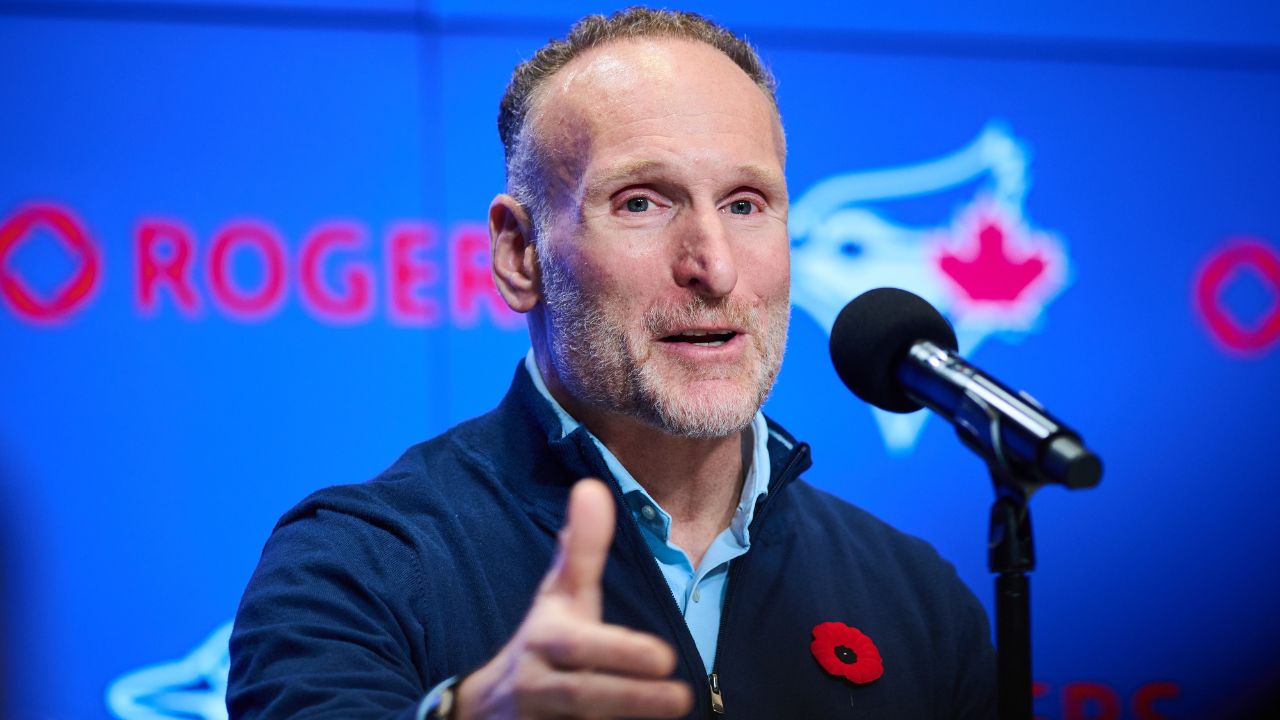
The morning after the crushing Game 7 loss to the Los Angeles Dodgers that ended the Toronto Blue Jays’ inspired run to the 2025 World Series, Mark Shapiro’s phone rang.
Team owner Edward Rogers, like so many others caught up in the frenzy as October’s drama spilled into November, sought to make sense of the dizzying finale and its aftermath.
“‘I feel like I’ve lost a family member. It’s been such a ride. How do you move forward from this point?’” Shapiro recalled him saying during a fireside chat last week hosted by the Empire Club of Canada, which gave the Blue Jays its 2025 Nation Builder Award.
“I told Edward, and I meant it, ‘There’s only one way I know to move forward and that’s to get back to the pursuit, get back to the process.’ … We wanted to get back to work for our fans, for each other, because, frankly, it was the only way to find solace.”
How much solace the Blue Jays have found since is an open question, as games as wild as that 5-4, 11-inning classic can linger. But after committing $353 million to augment the roster, they certainly did get back to the pursuit. Over the past three months, they watched Shane Bieber exercise his player option, signed Dylan Cease, Cody Ponce and Tyler Rogers to bolster the pitching staff, added Kazuma Okamoto to boost the lineup, swung big at Kyle Tucker, who opted for a short-term monster deal from the Dodgers, and saw star shortstop Bo Bichette leave for a similarly creative deal with the New York Mets.
Factor in an extension for Shapiro as president and CEO, a few coaching changes and several signings to fortify the club’s upper-level farm system depth and it was one of the most consequential winters in team history, with the potential to reverberate for years ahead. As the test of their work begins Wednesday with the spring’s first official workout for pitchers and catchers, here’s a look back at how it played out.
The baseball calendar offers no respite, so barely 12 hours after the Dodgers celebrated their second consecutive title, six Blue Jays were among the 137 players to declare free agency. None of that was a surprise, of course, as behind the scenes throughout the playoffs, GM Ross Atkins and other senior executives did double duty, helping the club’s baseball operations department chip away at plans for the upcoming market.
With Chris Bassitt, Max Scherzer and, possibly, Bieber, set to leave the rotation, Seranthony Dominguez no longer in the bullpen and enough position-player depth to backfill if Bichette didn’t return, the organization knew pitching had to be the focal point. After all, even with Trey Yesavage’s remarkable emergence, the rotation needed work, as did a bullpen that really missed Yimi Garcia after he underwent season-ending elbow surgery, despite Louis Varland’s addition at the deadline last summer. The market for arms, both starters and relievers, ran deep, with options across all tiers, although there was a clear delineation between the very top starters — free agents Cease and Framber Valdez and trade candidate Sonny Gray (at that point it wasn’t clear if the Milwaukee Brewers would trade Freddy Peralta, which they did late last month to the Mets) — and the rest of the class. They were intent on landing someone in the top group.
Easier said than done and before those pursuits even picked up, the first domino of their winter fell when Bieber exercised his player option on Nov. 4. The Blue Jays had expected him to be no more than a deadline rental when they acquired him from Cleveland for pitching prospect Khal Stephen and the right-hander, returning from Tommy John surgery, gave them value for that, posting a 3.57 ERA in 40.1 innings across seven starts before adding 18.2 more frames in five playoff outings. It was a strong platform upon which to return to the market, but he took the option instead, leading to industry speculation about whether a health issue factored into his call long before word of his right forearm fatigue emerged Tuesday.
Regardless, Bieber gave the Blue Jays a complementary piece to the puzzle they hoped to assemble over the winter and a positive springboard into the General Managers’ Meetings, where the momentum from their post-season run was evident.
As the industry began gathering at the Cosmopolitan of Las Vegas on Nov. 10, the chattering classes were abuzz about the Blue Jays’ plans. One influential agent described them as “hungry” and “acting like the big boys,” while another predicted their post-season run would help them get more players this winter. The rumour mill, as usual, had them in on everything. That they had money to spend fuelled the chatter, too.
Behind closed doors, the Blue Jays worked hard to separate fact from fiction. As free agency opened, they made calls to their pitching targets, including a full array of late-game relievers, and had three fateful meetings. One was with Scott Boras, the powerful player attorney who once again held significant control over the free-agent market with his roster of players, including Cease, Okamoto, Alex Bregman, Pete Alonso and Cody Bellinger among them. Another was with Excel, whose players included Ponce, the righty high on the Blue Jays’ target list after dominating the Korean Baseball Organization last year, and Tucker. The last one was with Bichette’s representatives, Greg Genske and Joe Mizzo of Vayner Sports. Those initial discussions left two impressions on the Blue Jays — the pitching market was likely to move before the position-player market; and the competition for Tucker and Bichette would be fierce, perhaps beyond their comfort zone.
Groundwork laid, by mid-November momentum began to build with Cease, who came away from a Zoom call impressed by the club’s vision for how to help him reach his peak. The Blue Jays had followed Cease closely for years, trying to trade for him when the Chicago White Sox sent him to San Diego in March 2024 and again last spring, when they targeted the righty and contact master Luis Arraez. This time, they quickly sensed the interest was mutual and that Boras was ready to move early, something he did the previous off-season, when he got Blake Snell done with the Dodgers in late November. Talks progressed and by the time the Boston Red Sox acquired Gray from St. Louis for three prospects on Nov. 25 — the Blue Jays were involved but the price had moved beyond their walkaway point — they had real traction with Cease. Word of his $210-million, seven-year agreement, the largest free-agent deal in franchise history, leaked Nov. 26, giving them the front-of-the-rotation-calibre arm they had sought.
Landing Cease quickly rewrote the perennial runner-up narrative that hounded the Blue Jays in the free-agent market, amplifying the momentum created by their World Series exposure. Suddenly, they weren’t the team spurned by Shohei Ohtani and Juan Soto and Corbin Burnes, but rather a legitimate player, one that rather than deciding between Tucker or Bichette, was able to do Tucker AND Bichette.
As some imaginations ran wild, the Blue Jays remained focused on landing yet more pitching, even with Bieber and Cease in the fold. To that end, they began to lock in on Ponce, who reinvented himself in the KBO and had checked all the Blue Jays’ scouting boxes in terms of their pitch tools evaluation, projection system and makeup assessment while dominating with Hanwha. And though they envisioned him as a starter, his versatility to work out of the bullpen if needed made him all the more attractive.
The Blue Jays were also involved on Michael King at the time, but made the decision to make a push on Ponce in the hopes of getting something done quickly. It worked and a $30-million, three-year deal was agreed to Dec. 2, Ponce accepting the exact number his wife Emma had envisioned back in June.
“There wasn’t really much else that I could have asked for,” said Ponce. “We were like, we manifested this, let’s rock and roll with it.”
The Blue Jays were rocking and rolling at that point, too, with Tucker visiting their Player Development Complex in Dunedin, Fla., the next day. As a resident of nearby Tampa, the star outfielder didn’t have to travel far, so there was reason to not read too much into the trip. But at the same time, that’s also when the Blue Jays began to feel like they might actually be in play for him. Still, Tucker and most of the position-player market was still at the 50-yard line as the Winter Meetings in Orlando approached, while the reliever market was moving fast.
Raisel Iglesias, Ryan Helsley and Emilio Pagan had all reached agreements leading into baseball’s annual swap meet and things were picking up around Edwin Diaz, as well. To varying degrees, the Blue Jays pursued each of them before they signed elsewhere, Diaz joining the Dodgers on a massive $69-million, three-year deal. Once he signed, the last remaining closer of pedigree remaining was Robert Suarez, whom the Blue Jays had pursued before he joined the Padres. As all that played out, one agent predicted they would land either him or Tyler Rogers.
Meanwhile, some big business that will help shape the contours of this season got done in Orlando, as the Philadelphia Phillies re-signed Kyle Schwarber for $150 million over five years and the Baltimore Orioles, who’d first pursued the slugger, shifted gears and landed Pete Alonso for $155 million for five years. Two key signals there — first, the Mets were going to have money to spend and motivation to do it after both Diaz and Alonso signed elsewhere; and second, the Orioles, after a tepid off-season push last year, were serious about climbing back atop the AL East after 2025 came off the rails for them.
Mike Elias, Baltimore’s GM, said the landscape of the division is “certainly something you keep an eye on throughout the winter and at times it can influence some of the decision-making as I think every team’s looking at their projected standings.”
“This is, once again, a historically strong division and in the AL East people make big moves,” Elias continued. “There are big swings and impact players being added to the division every winter. It’s just life in this division. I think we made several ourselves. I think we’re right in the thick of things. I think this division up and down is going to be really tough as it always is. But, we enjoy it.”
Suarez agreed to a $45-million, three-year deal with Atlanta on Dec. 11, the day after the Winter Meetings ended, and at that point the Blue Jays moved to lock down Rogers. They had been open to adding a closer-type, but more than anything, they wanted a reliever who dominated righties, a weakness they felt was exposed by Garcia’s absence.
Rogers fit the bill, having held righty batters to a .229/.232/.288 line last year, and as a submariner he also gave the bullpen a different look, a bonus the Blue Jays value. They closed on a a $37-million, three-year deal the next day — hours after Shapiro’s five-year extension was announced and right as they completed a trade with Detroit for another side-armer, righty Chase Lee.
“When the American League champs give you a phone call,” said Rogers, “you kind of perk up and get excited about that.”
Having added four pitchers to the major-league roster, succeeding at the very top of their off-season wish list, the Blue Jays shifted gears to their offence. All along, they felt like they would be fine if they didn’t add a position player and they weren’t going to force the issue.
When Okamoto’s market moved toward resolution as 2025 gave way to 2026, they felt like the price really made sense for them on a number of fronts. The 29-year-old from Gojo, Japan, has legit power, with 277 career homers for the Japanese league’s Yomiuri Giants, plays both infield corners and is still in his peak years. At $60 million over four years, he came at a palatable cost and with the Tucker and Bichette markets still a couple weeks from maturing, there was an element of bird-in-hand at play, too. At that point, the Blue Jays maybe had a 30 per cent chance of landing one of the premier two, but could 100 per cent land Okamoto. And rather than risk getting no one, they pulled the trigger Jan. 3, believing he will provide competent defence at third and thump at the plate.
The payroll implications were significant, as Okamoto’s deal pushed the Blue Jays to a competitive-balance tax payroll of roughly $295 million, as calculated by Spotrac, well beyond the third luxury-tax threshold of $284 million. They’re also facing a projected tax bill of roughly $23 million, meaning they’d essentially hit their spending limit.
Yet before the Blue Jays signed Okamoto, they checked with ownership to make sure that if they could get Tucker or Bichette, they’d have the approval. Provided the numbers were right, they would.
That only meant something if other teams weren’t prepared to go all out for them, a scenario that became likely as events progressed. So, as Bregman signed with the Cubs for $175 million over five years Jan. 14 — the Blue Jays were interested, but not at that level — Tucker’s process was also coming to an end. They stayed engaged all along and with a long-term offer of $350 million for 10 years on the table, felt their chances of landing him were in the 50-50 range.
But as the Blue Jays speculated, the Mets entered the fray with a shorter-term, high annual-average value offer right near the finish line. The Dodgers, lurking in the background the whole time as well, also jumped in, and their offer of $240 million over four years proved too tempting to pass up, the sides reaching agreement Jan. 15.
Spurned and in need of a major move in what to that point had been a disappointing winter, the Mets essentially copied and pasted the Dodgers’ approach on Tucker to Bichette, landing him with a $126-million, three-year deal that includes opt-outs after the first and second seasons.
To that point, Bichette had been sitting on a long-term offer from the Phillies and the industry speculation was that he would end up there, but he had wanted the Mets and they found a way to make it happen. Like Tucker, whose deal includes opt-outs after years two and three, the high average-annual value and flexibility to re-enter the market tipped the scales.
“For a player like Bo, a team’s interest in longer-term and shorter-term — and he had both options on the table from multiple teams — it really is more of a statement about where that team is with respect to their existing payroll, their future commitments and CBT,” said Genske. “That seemed to me to be the biggest factor in whether a team was really pushing us for a 10-year contract or the shorter-term variety.”
Those deals kept what on paper looks like a home-run off-season for the Blue Jays from turning into a grand-slam winter. Still, pulling off what they did — shopping successfully at the top of the pitching market and still adding on the position-player side, too — isn’t easy to accomplish. Every team draws up its ideal scenario for the off-season and few come as close to that vision as the Blue Jays did.
Still, winning the winter guarantees nothing, and their glitzy buildup before the 2013 season offers a good reminder of that. But carrying a projected luxury-tax payroll of roughly $295 million, fifth highest in the majors, the Blue Jays are operating on a plane they haven’t been on before, part of what Edward Rogers described as “an evolution versus any kind of radical change,” during a December interview.
The wider plan is to “continue to invest in a team that can be competitive every season,” he added.
“Sports, as you know, are extremely hard. There are a lot of amazing teams and we’re in a division with some great teams. It’s great to see them, but they’re pretty tough. Our vision is to let our fans know at the beginning of the season that we have a chance every single year, and we’re going to be contenders and viable. There are many things that happen throughout the season that help you or hurt you, but we don’t want to go from highs to lows and we’ll continue to invest to be as viable as we can.”
As spring training opens, the test of that viability is off and running.