
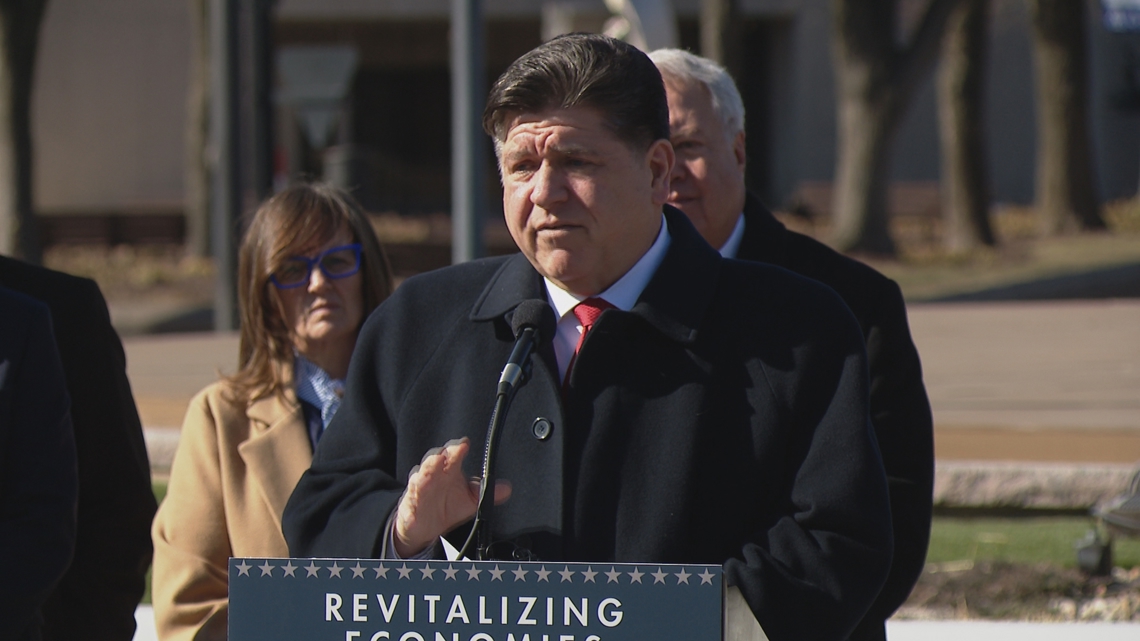
Illinois Gov. JB Pritzker is expanding a financing scheme near the Missouri border and promises to compete for sports teams “in every world.”
BELLEVILLE, Illinois — Gov. J.B. Pritzker on Monday promoted an expansion of Illinois’ STAR bond program and said he is open to using economic incentives to retain or attract professional sports franchises, including potentially the St. Louis Cardinals.
Speaking at an event near the Missouri border, Pritzker highlighted STAR bonds—Sales Tax and Revenue bonds—as a mechanism for spurring economic growth by allowing future sales tax revenue to fund large-scale development projects.
“STAR bonds can generate truly transformational levels of economic growth,” Pritzker said.
Pritzker referenced recent feedback from a national site-selection firm, saying they told him Illinois hasn’t seen “this much dynamism in the opportunity to do business in the state” since Gov. Jim Thompson. Thompson, a Republican who served from 1977 to 1991, successfully negotiated to keep the Chicago White Sox in Illinois in 1988 by approving public financing for a new stadium.
Asked by 5 On Your Side political editor Mark Maxwell whether Illinois would follow Kansas’ example—Kansas recently used STAR bonds to attract the NFL’s Kansas City Chiefs away from Missouri—Pritzker initially distanced himself from that particular model.
“This was not written for the Bears,” Pritzker said, referring to the Chicago Bears, who have explored relocation options including a site in Indiana.
Illinois law currently prohibits the use of STAR bonds for new professional sports stadiums. The statute explicitly bars any STAR bond project plan that includes “the development of any facility, stadium, arena, or other structure if the purpose of the facility, stadium, arena, or other structure is the holding of professional sports contests.” Professional sports is defined in the law as major league baseball, basketball, football, or ice hockey.
However, when asked whether professional sports teams should view the current STAR bonds legislation as Illinois’ final offer, Pritzker said no, leaving open the possibility that the law could be amended.
“We’re not going to do anything that’s bad for the taxpayers here. I mean, I am not… we’re not throwing money at building a stadium. For anybody,” Pritzker said.
The governor has said he’s open to help build out public infrastructure around stadiums. In short, Pritzker’s recent pitch to the Bears has been, ‘Illinois won’t buy you a stadium, but it might help pave the road to one.’
But when pressed on whether the Bears might be bluffing about leaving Illinois, Pritzker did not dismiss the threat.
“I never take anything as if it’s a bluff,” Pritzker said. “I mean, I’m always concerned about making sure that we’re attracting businesses or keeping businesses in the state of Illinois.”
Maxwell also asked if there was any world where Illinois would attempt to lure the St. Louis Cardinals baseball team across state lines, noting that team ownership has expressed concerns about the age of Busch Stadium.
“I am trying to attract businesses, yeah,” Pritzker replied. “You said ‘any world?’ Yeah, like every world in which we are trying to attract businesses—and that includes teams—but businesses to the state of Illinois.”
Bill DeWitt III, president of the Cardinals, told 5 On Your Side Sports Director Frank Cusumano that Illinois is not under consideration.
“We are working on plans for a major renovation to Busch III as well as taking steps to map out a possible phase 3 at Ballpark Village,” DeWitt said. “So no, Illinois is not on our radar.”
The expansion, signed into law in 2025, allows local governments to issue bonds backed by future sales tax revenue for major tourism, entertainment, and retail projects. The program had been largely dormant since its creation in 2010.
Under the expanded program, projects must create at least 300 jobs and generate $30 million in investment. Larger “NOVA district” projects require $500 million in investment and 1,500 jobs.
Representative Jay Hoffman, D-Swansea, who helped craft the legislation, said the Metro East region qualifies for up to three STAR bond projects, though officials were not able to name any projects already in motion.
“A STAR bond is an economic development tool that many other states have had and have used to great success,” Hoffman said.
Kyle Anderson, executive director of the Leadership Council of Southwestern Illinois, said approximately $3 billion in Illinois consumer spending flows to Missouri annually, including spending at St. Louis sporting events and entertainment venues.
“I wouldn’t mind seeing some concerts in my backyard,” Anderson said.
Eric Oller, executive secretary-treasurer of the Southwestern Illinois Building and Construction Trades Council, noted that STAR bond projects include prevailing wage requirements and project labor agreements.
“Star bonds simply are made for job creation and community investment,” Oller said.
The Bears have not committed to a new stadium location. Team officials have explored sites in Chicago, Arlington Heights and northwest Indiana. Pritzker said his administration has been in “consistent conversation” with the Bears for approximately 1.5 to 2 years.
“I think there’s a real possibility that many of the things that we put on the table to work with the Bears on are things that they’re willing to do to stay in the state of Illinois,” Pritzker said.