
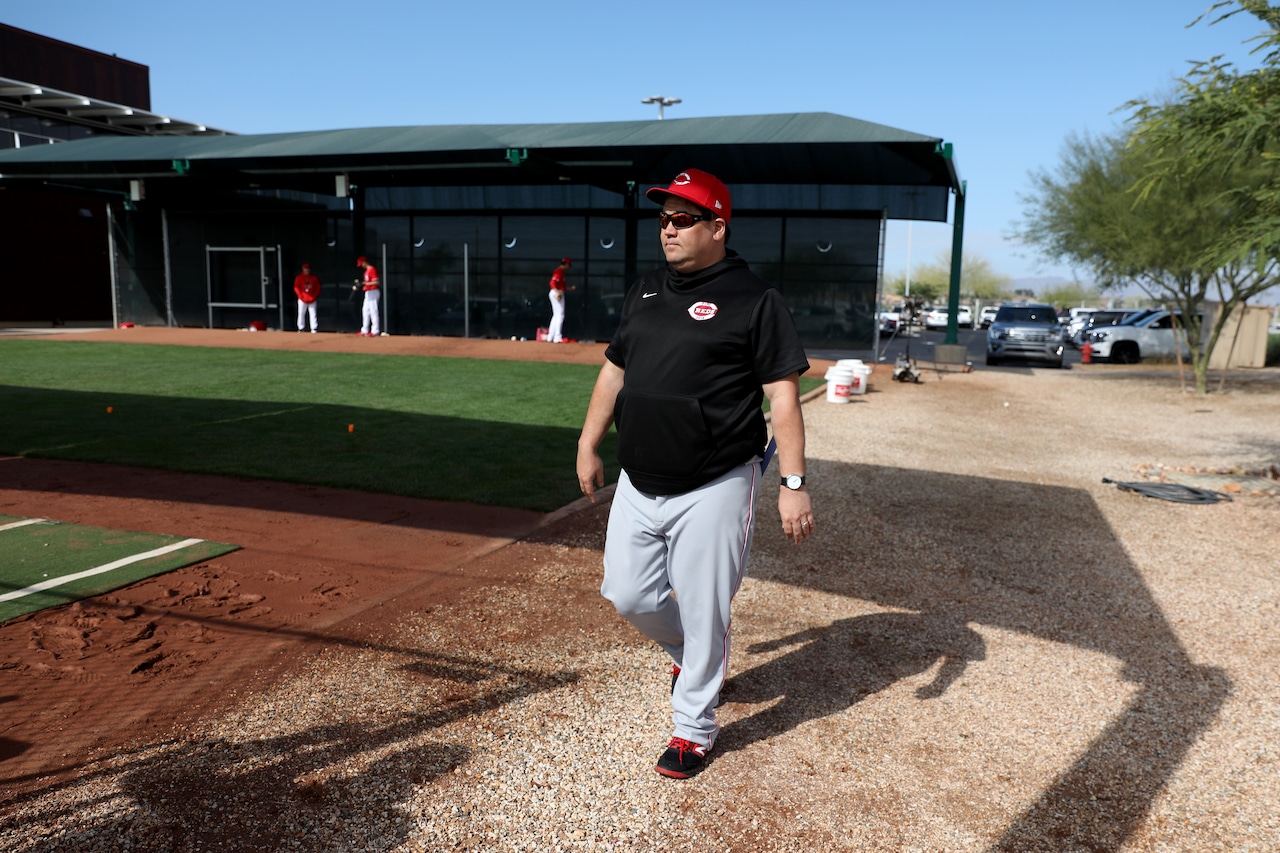
Kyle Boddy lives approximately 3,000 miles from Boston on the other side of the country in Washington.
But the Driveline Baseball founder and special advisor to Red Sox chief baseball officer Craig Breslow has become a polarizing figure in Boston sports.
Is Driveline’s influence making the Red Sox a better and more efficient organization? Or is it making Boston too dependent on analytics and science?
Boddy isn’t in the business of trying to fix the game, although he admits that baseball itself could use some adjustments and rule changes to be more appealing to viewers.
Driveline is about making players better within the game’s current structure. The Red Sox, meanwhile, believe strongly in Driveline’s methods. They are going to continue to use these methods to try to get the most out of their players to win as many games as possible.
The influence Driveline has on the Red Sox isn’t going away. It’s growing under Breslow’s leadership. The Red Sox hired four more former Driveline employees this offseason and promoted hitting coordinator John Soteropulos to Alex Cora’s major league coaching staff. Soteropulos, who worked at Driveline from April 2019 to January 2023, is serving as an assistant hitting coach.
Boddy understands the charges leveled at him and sabermetricians by talk radio hosts, fans and other baseball traditionalists. The nerds, a group he counts himself among, have contributed, in some degree, to making baseball less entertaining. It’s just not their problem to solve. Their focus is on getting their teams to score and prevent as many runs as possible, whether it’s using data to put together defensive shifts to turn balls hit with high expected batting averages into outs or using advanced metrics to calculate the value of players.
“From an entertainment product perspective, we do need to do a better job,” Boddy said. “But that’s not the club’s job. That’s the league’s job. The club’s job is to win. And so we’re going to make decisions that we feel lead to the most winning.”
The way the game is played these days, velocity and power-hitting lead to wins. That’s why the nerd group is focused so heavily on those two areas. The scrutinized Red Sox’ offensive approach aligns with the Driveline methods and what Ted Williams once preached: pulling the ball in the air. Meanwhile, the Red Sox also have used Driveline’s methods to increase fastball velocity.
“It’s a power-on-power game these days, and maybe I actually agree with talk radio hosts that I don’t think that leads to a very entertaining product, in my opinion,” Boddy said.
Former Driveline employees hired by Red Sox this offseasonPosition Elijah BoyerDouble-A Portland assistant hitting coachCody GraccoHigh-A Greenville assistant hitting coachIvan QuackenbushLow-A Salem assistant hitting coachBrent HokenessAssistant baseball scientist
Red Sox fans tend to turn to social media to blame the Driveline methods when Boston’s offense has a bad game.
In October 2025, NESN analyst Lou Merloni responded simply on X to a fan who questioned whether Red Sox hitting coach Pete Fatse should return in 2026:
“I think Pete has done a good job. People mischaracterize him a ‘Driveline guy’. He’s not, no matter how many people tell you he is. Most people don’t even know what ‘Driveline’ is.”
There is a misunderstanding about what Driveline does and who in the Red Sox organization works or worked for the company.
With Driveline’s influence only increasing within the organization, it’s worth understanding what the company does.
Boddy said he doesn’t think anyone is being malicious when they criticize Driveline or assume incorrect information about it. He also doesn’t expect radio hosts to learn everything about his company.
“Why is it on a radio host?” Boddy said. “Why should I have these expectations like, ‘Oh, well, you should do a lot of research and read Wikipedia and read Kyle’s book.’ Why should they do that? They’ve got a million things they got to do, so it doesn’t bother me. I’m honored, honestly, that Driveline is that relevant to them.”
Driveline doesn’t have a one-size-fits-all approach. It’s not aiming for every pitcher to throw 100 mph or every hitter to pull the ball in the air and develop 30-home run power.
“There’s this big perception of Driveline as like this end all, be all,” former Red Sox pitcher Walker Buehler said. “At the end of the day, they’re trying to physically improve the average outcome.”
Buehler described it as Driveline “building engines that are more efficient.”
“Whether that be a swing or a throw, if you can operate more efficiently, then your bad ones aren’t as bad,” Buehler said. “And I think they’re kind of doing the upside and the downside, raising both of them, or the ceiling and floor, however you want to look at it. If you get more efficient, both of those are going to rise.”
Driveline’s biomechanics lab gives individual assessments and reports on how each client’s body moves. From there, they devise training plans for deliveries, swings, etc.
“You want to have all the skills required to be a necessary hitter,” said Soteropulos, Boston’s new assistant hitting coach who previously worked as a business associate and then a hitting trainer at Driveline. “You’ve got to make contact. You want to hit the ball hard. You want to do all those things that comprise successful hitting. And you also want to make sure that you lean into your strengths. Lean into your strengths and then also address any weaknesses, too.”
Soteropulos joining the staff doesn’t mean the Red Sox are going all-in on launch angle and power to the pull side or doubling down on one specific approach.
In fact, the 2025 AL champion Blue Jays hit the most balls in play and posted the lowest strikeout rate (17.8%) of any team under hitting coach David Popkins, a former Driveline client, and Toronto senior hitting biomechanist Ben Jones, a former Driveline employee.
This 2026 Red Sox want a balanced lineup with power and contact, but they are lacking power on paper. Breslow, however, sees certain players emerging. He said a fully healthy season out of Roman Anthony should help. He also pointed to trade addition Willson Contreras and right fielder Wilyer Abreu being important sources of power.
“I think there’s going to be a slug and power that emerges from this group, but I also think we have a pretty balanced lineup,” Breslow said.
The Red Sox are making a conscious effort to make more contact this year, especially with a runner at third base and fewer than two outs. They improved in that area late last season. During the final two months, they had the eighth-fewest whiffs (905) in MLB after posting the third-most (2,143) in the first four months.
The Red Sox’ hitting approach begins in the minors and almost identically aligns with what Driveline teaches to its clients. Driveline focuses on bat speed, swing decisions and batted ball quality. The Red Sox practice four core areas, additionally focusing on swing characteristics.
The Red Sox loved Kristian Campbell’s elite contact rate at Georgia Tech but saw opportunities for the 6-foot-3 infielder/outfielder to hit for more power. They made adjustments to his swing to increase his power, though it meant trading some contact ability in the process.
“Someone like Roman, who didn’t go to college, probably has to make slightly different approaches where it’s like his power is crazy where it’s maybe bat-to-ball skills need to improve,” Boddy said. “And that’s where the big core four are.”
Soteropulos said biomechanics is “definitely an important piece that needs to be monitored, tracked and evaluated” but it’s just one of many pillars that get the most out of a player’s on-field performance. Hitting coaches also see a lot of things with their own eyes, he added.
He also said that while right-handed hitters can benefit from pulling the ball in the air at Fenway, that’s certainly not the only approach.
“The modern game demands a lot of hitters, and you have to have multiple clubs in the bag, and you can’t be one-dimensional,” Soteropulos said. “There’s too many pitch shapes. Pitchers have advanced a lot in the last five to 10 years, and for hitters to have success and be successful, they need to be able to hit the ball to all parts of the field and hit pitches in every part of the zone and also hit a lot of different pitch shapes.
“So while Fenway is uniquely shaped, I think like the base approach of our hitters, it varies from guy to guy, for sure,” Soteropulos added. “But just be dynamic. Have our hitters be dynamic and be able to be successful against a lot of different pitch shapes and a lot of different pitch velocities.”
Boddy said the best teams make contact and he welcomes the league to make changes to increase balls in play and make it a faster-paced game.
“Fans want to see balls in play. They want to see a faster game,” Boddy said. “They want to see more players involved. And that’s on the league to make changes, and they have been.”
Boddy noted that there’s a lot of experimenting with rule changes in the minor leagues. Those have already led to some rule changes in the majors, which have led to an increase in stolen bases to make the product more entertaining.
“Baseball has the longest tradition of any of the sports, so it can be hard to make rule changes,” he said.