
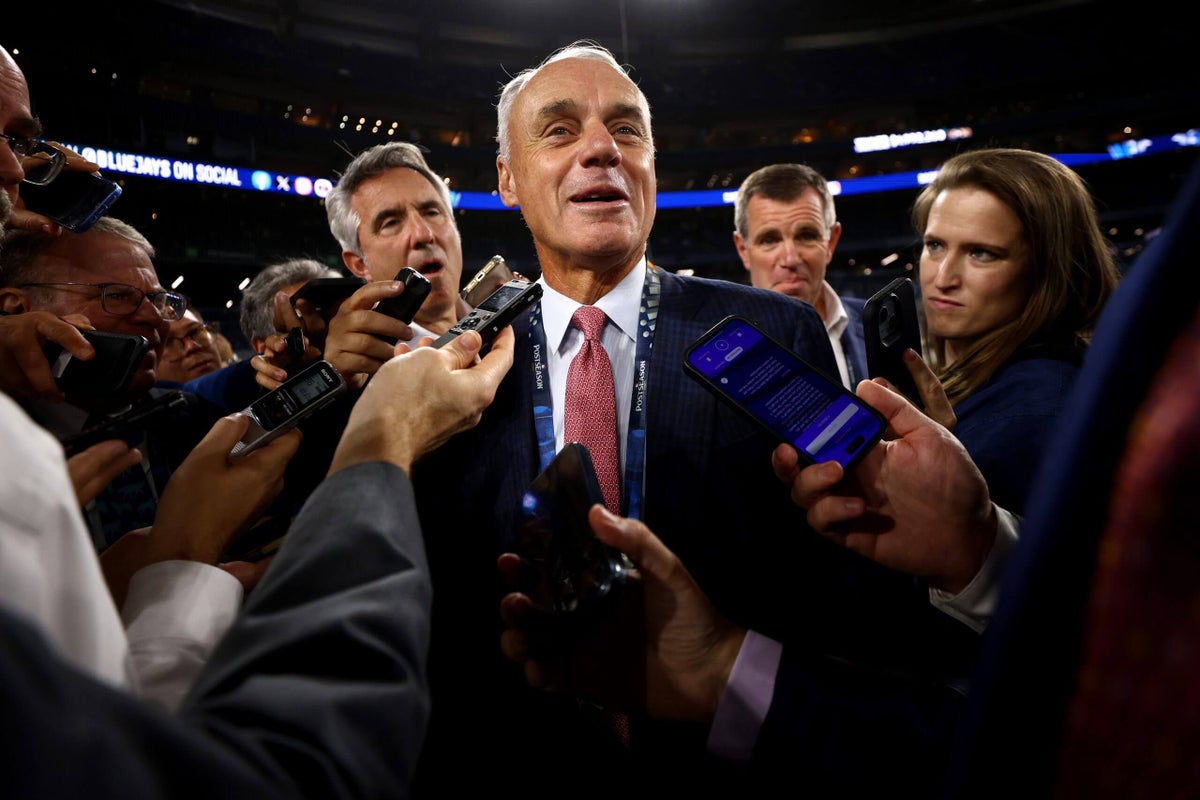
PALM BEACH, Fla. — A salary cap would be a seismic shift for Major League Baseball, changing far more than how much teams can spend.
Team and league officials describe a cap as an egalitarian reset, a leveling of the playing field that would allow teams in all markets to more fairly compete. To the Players Association, such competitive balance arguments are age-old red herrings, distractions from the owners’ ultimate goal of increasing their franchise values and lining their own pockets.
But the effects of a cap would be so broad that any single talking point is liable to undersell the impact. Entrenched systems of free agency and salary arbitration would likely be radically revised. Revenue sharing — how clubs divide money between themselves — would change too. Player pay would likely wind up in escrow, and the list goes on.
“Every day we hear from fans across the country who believe their team doesn’t have a fair opportunity to compete,” league spokesperson Glen Caplin said in a statement. “Our message to those fans is that we hear your concerns, and are committed to a solution that levels the playing field. While no proposals have been finalized, we look forward to discussing solutions with the MLBPA in the months to come so that fans in all of our markets, regardless of size, can feel that their team has a chance to consistently compete.”
The union has opposed the concept for decades.
“Salary caps in the other sports have not led to competitive balance,” said Bruce Meyer, the deputy director of the union, in an interview with The Athletic. “In fact — baseball, which is the only one of the four major sports that does not have a salary cap — actually has better competitive balance than the other sports. A salary cap punishes competition, punishes clubs that want to go out and acquire the best players and put the most exciting product on the field for the fans. It gives owners who prefer not to compete an all-purpose excuse not to do so.”
As spring training began this week, league owners continued to discuss their labor strategy in Florida during meetings that wrap today. Formal negotiations between owners and players over the next collective bargaining agreement are expected to begin early in the regular season.
Talks are not expected to move quickly, and another December lockout is widely expected. The big question is whether it costs the sport regular-season games in 2027. The NBA, NFL and NHL all have caps, but none were agreed to eagerly by their players.
“You never see salary caps that would pay players more than the aggregate fair-market value — there’s no point to it from the owners’ standpoint,” said Don Fehr, former head of the baseball and hockey unions.
What follows is an explanation of how a salary cap could change baseball, and the dueling views of what that world would look like. Many specifics of how a cap would work depend on what MLB ultimately proposes. The league declined an interview request for this story.
It’s not just a cap. It’s a floor, too
Any reference to a “cap” system really means a “cap-and-floor” system. One wouldn’t arrive without the other.
Before bringing a cap proposal to players, owners have to sift through their own internal politics to choose limits they’re comfortable with. The task is complicated mostly because small-market teams will want to keep payroll as low as possible.
Whatever the owners first propose probably is not where they’d be willing to end up. A reasonable goal from an ownership perspective might be $240 million at the top and $160 million at the bottom, one source briefed on management thinking who was not authorized to speak publicly said.
A ceiling won’t be a hard sell for the richest owners. Teams like the Los Angeles Dodgers, who have a league-high $402 million payroll, the New York Mets and New York Yankees would actually benefit from a limit on their spending.
“The biggest beneficiaries are going to be the biggest markets, and the biggest losers will be the small markets,” said the management source. “They’ll have to spend money in order to be a part of this. And the big markets will do well because there will be no pressure from fans to go to $300-400 million payrolls and so forth.”
The cap and floor would not take full effect immediately. A phase-in period would be needed over a number of years where teams would have grace periods to comply, raising or lowering payroll.
Industry sources said it was unlikely owners would ask to alter existing player contracts: long-term deals reached agreed to in the current system would be honored. The union would oppose clawbacks in any system.
The league and the players would formally split baseball’s money
The single most important change in a cap system might be the creation of a formal revenue split from which everything else would flow.
MLB and the players would negotiate what percentage of the industry’s revenue goes to each side. For 2024, MLB estimated the total haul to be about $12.1 billion. Caplin said he could not provide a 2025 figure because it is not yet final.
The league office and the union can calculate how much of that money goes to the players and how much to the owners, and the percentages change, at least a little, every year. Last summer, commissioner Rob Manfred said the players’ share was about 47 percent.
Meyer countered Wednesday that, “if you include all the compensation paid pursuant to the current major league CBA, the players’ share is comfortably over 50 percent.”
A cap system eliminates year-to-year variability. The sides would negotiate the percentages they receive in advance. Importantly, the league could offer players a larger share than they receive now if they agree to a cap.
“My first deal where I was the chief negotiator in 2002, we were spending 63 percent of our revenue on players,” Manfred said.
Manfred has told players in meetings across the league that had they long ago adopted a system where they shared revenue equally with owners, players would have made billions more.
The union has several objections to Manfred’s claim.
“We don’t know what proposal Rob is referring to, but first of all, it doesn’t make sense on the most basic level,” Meyer said. “If they’re saying, ‘Oh, we’re willing to pay you more,’ then why do they want the system? It’s obviously worth even more than that to them.”
The players’ split would also likely go down over time, Meyer warned.
“Whatever the special introductory offer is, the history has shown that doesn’t last,” Meyer said. “Once they get you in that system, you never get out, and they drive that percentage down by repeated lockouts. In fact, in the salary-cap sports since 1994, they’ve had way more work stoppages, way more lockouts, way more missed games than in our sport.”
But how the split is calculated — revenue definition — would also be contested. It is even today without a cap.
Many team owners have real-estate developments and other ancillary business that owners would fight to exclude, and players to include. The union thinks the current system accounts for some of that value.
“Talking about share in the abstract really doesn’t tell you anything,” Meyer said.
Say goodbye to the free agent megadeal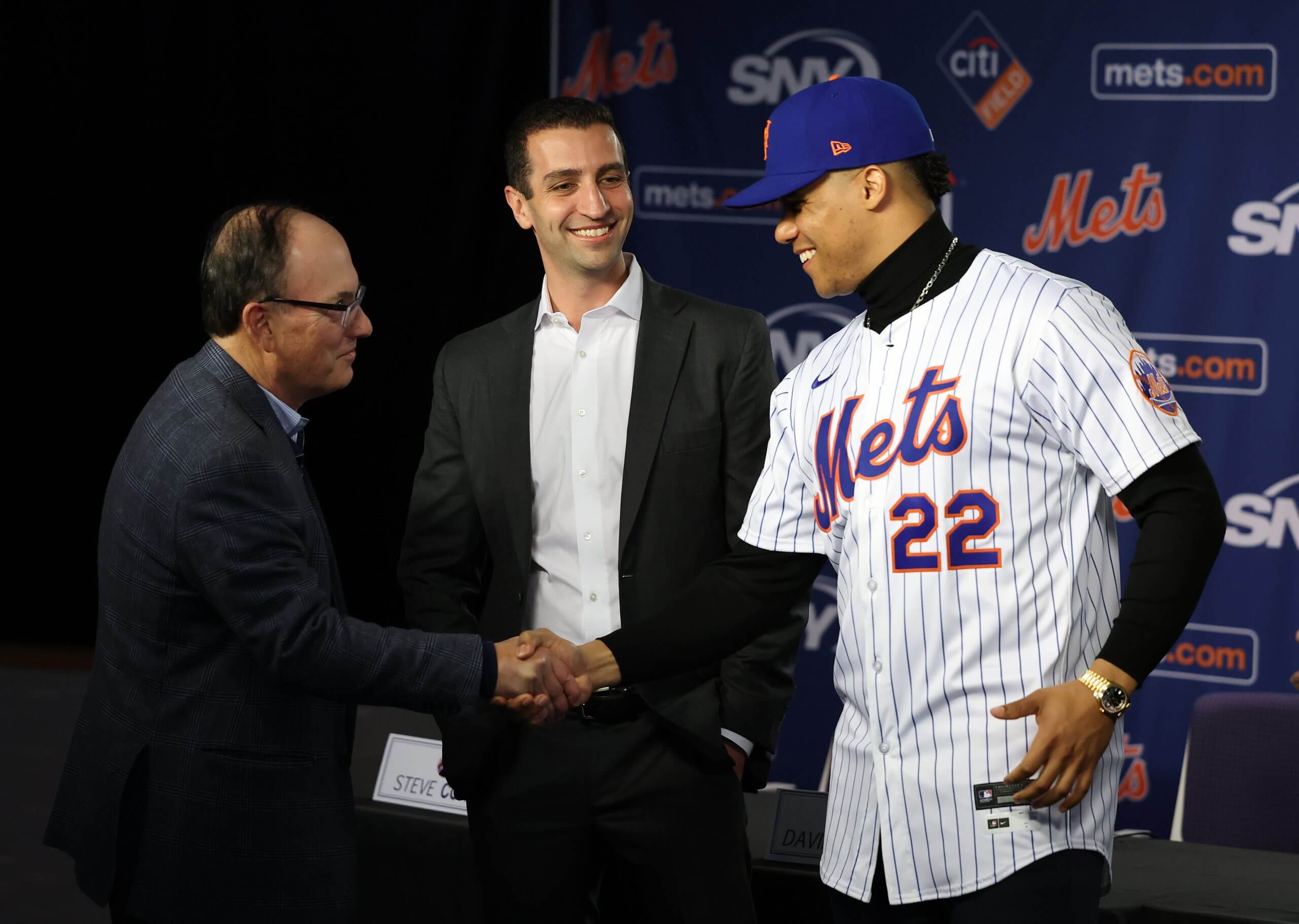
Massive contracts like Juan Soto’s deal with the Mets would likely come to an end under the cap. (Al Bello / Getty Images)
If MLB gets its way, contracts like the 15-year, $765 million deal Juan Soto signed with the New York Mets could never be given out again.
MLB is eyeing a NHL-style “hard cap,” a source said, which would create firm limits in three areas: club payroll, individual contract length and individual player salary.
But caps can take different forms. MLB could initially propose a max number of years for individual contracts and then relent, for example.
The NBA has what is referred to as a “soft cap,” where the limit on team payroll has some flexibility — but when the dust settles, everything still falls in line with the overall split.
The free agency and arbitration processes would also change. In the current system, it would be almost unthinkable for owners to let players become free agents sooner than the current wait time of six years, or to hit arbitration earlier than the current standard of three years. But a cap could reduce those wait times.
A big bump in the minimum salary, which is $780,000 this year, would likely be on the table as well, one larger than the league would otherwise propose.
“I think it’s going to be very persuasive for a lot of the players,” a management source said. “You’re seeing a lot of players now see the NBA, NFL and NHL, nobody’s in the poor house. There’s a lot of money going around to a lot more people.”
A cap makes those changes much easier, but in some ways, less meaningful. When the amount of money going to both sides is predetermined, the issues are distributional.
Manfred has positioned the current economic system as a “great deal” for baseball’s elite, but not the rest of the players. A key contested matter is whether a cap would improve other players’ earnings and opportunities.
“The salary cap is bad for players at all levels, because it converts the system into a zero-sum game, which is to say a system where every time a player gets paid a dollar, that dollar has to come from another player’s pocket,” Meyer said. “The middle-class players get squeezed because they pay the stars, and everyone else gets basically whatever is left.”
A free-agent signing deadline would likely arrive too. Players and agents today oppose the idea, which the league wants to spur winter action, because it could push players into lesser deals. But the fixed pot of money would dampen that concern.
The end of the guaranteed contract?
The revenue split means the sides more directly share in year-to-year booms and busts. The league paints this as a positive that better aligns everyone.
But to the union, it means the end of guaranteed contracts. Today, baseball players are entitled to the salary their agreements call for, regardless of how the industry fares in a given year. A cap would require salary adjustments depending on how much money actually comes in.
In some leagues that’s achieved through escrow, putting money aside until the results are in. For the 2024-25 NBA season, players had to effectively give back nearly $500 million amidst declining TV revenues. Sources said MLB will likely propose escrow.
Then there’s roster churn to fit the cap. In the NFL, free agency pushes players who are already under contract out the door.
“Every free-agent period, it’s blood in locker rooms as they cut players,” Meyer said.
MLB players particularly benefited, and the owners suffered, from being outside a cap system a few years ago. When a shortened season was played during the COVID-19 pandemic in 2020, MLB players fared much better than their counterparts in cap leagues, where a drop in revenues meant player salaries sharply declined.
Will teams be worth more?
All clubs, in markets large or small, would ultimately gain in a cap system, because franchise values would jump everywhere.
“The perception around baseball is that without a salary cap, its values will lag behind, at least behind the NFL and the NBA, and that’s been the case,” Steve Greenberg, a banker at Allen & Company who handles franchise sales, said last year. “We’ll see what happens in Rob’s final negotiation.”
MLB teams were worth $2.6 billion on average entering last season, per Forbes.
The union believes that some of that value flows to players in the current system. An owner might be willing to pay a hefty sum on the belief that improving the team will increase the franchise’s stature and sale price.
“The nature of a salary cap is to artificially suppress their labor costs, resulting in teams being more profitable,” Meyer said. “So it makes sense that it would increase their franchise values. That increase in franchise values doesn’t get shared with the players in any of the cap sports.”
Is competitive balance actually broken? And if so, would this actually fix it?
The public arguments always circle back to what fans care about most: what baseball looks like on the field. An already large series of debates, then, turns into two others: whether MLB has a problem with parity, and how to improve it either way.
The sides disagree on both fronts, and have for a long time.
“The only way to fix baseball is to do a salary cap and a floor,” Colorado Rockies owner Dick Monfort, the head of MLB’s labor committee, told The Denver Gazette last year. “Something’s got to happen. The competitive imbalance in baseball has gotten to the point of ludicrosity now. It’s an unregulated industry.”
The optics are poor when the Dodgers have a payroll more than four times larger than teams like the Miami Marlins and Tampa Bay Rays. The league says payroll disparity — the ratio between the top and lowest spending clubs — has never been greater, while the union’s numbers show otherwise.
“We have businesses that are literally not similar in terms of the overall revenue that they’re generating,” Manfred said in 2023.
But these arguments also have been around a long time.
“I’ve been hearing this competitive balance bulls— for 30 years now,” said Gene Orza, a retired MLBPA lawyer. “It’s nonsense. That’s just a ruse, that’s propaganda, that’s not real. The Yankees won three in a row — ‘competitive balance, competitive balance’ — now the Yankees haven’t won in 17 years.
“Why has the value of every franchise gone up, every single one of them?”
Manfred himself said prior to the 2024 World Series, which featured the Dodgers and Yankees, that “our record on competitive balance is darn good.” But more recently, he’s harped on perception, saying smaller market fans worry their teams can’t compete.
Caplin of MLB cited a few statistics: the World Series has been won by a top-10 payroll club for four straight years, and for six out of the last seven. A bottom-15 market, meanwhile, hasn’t won a World Series since the 2015 Kansas City Royals.
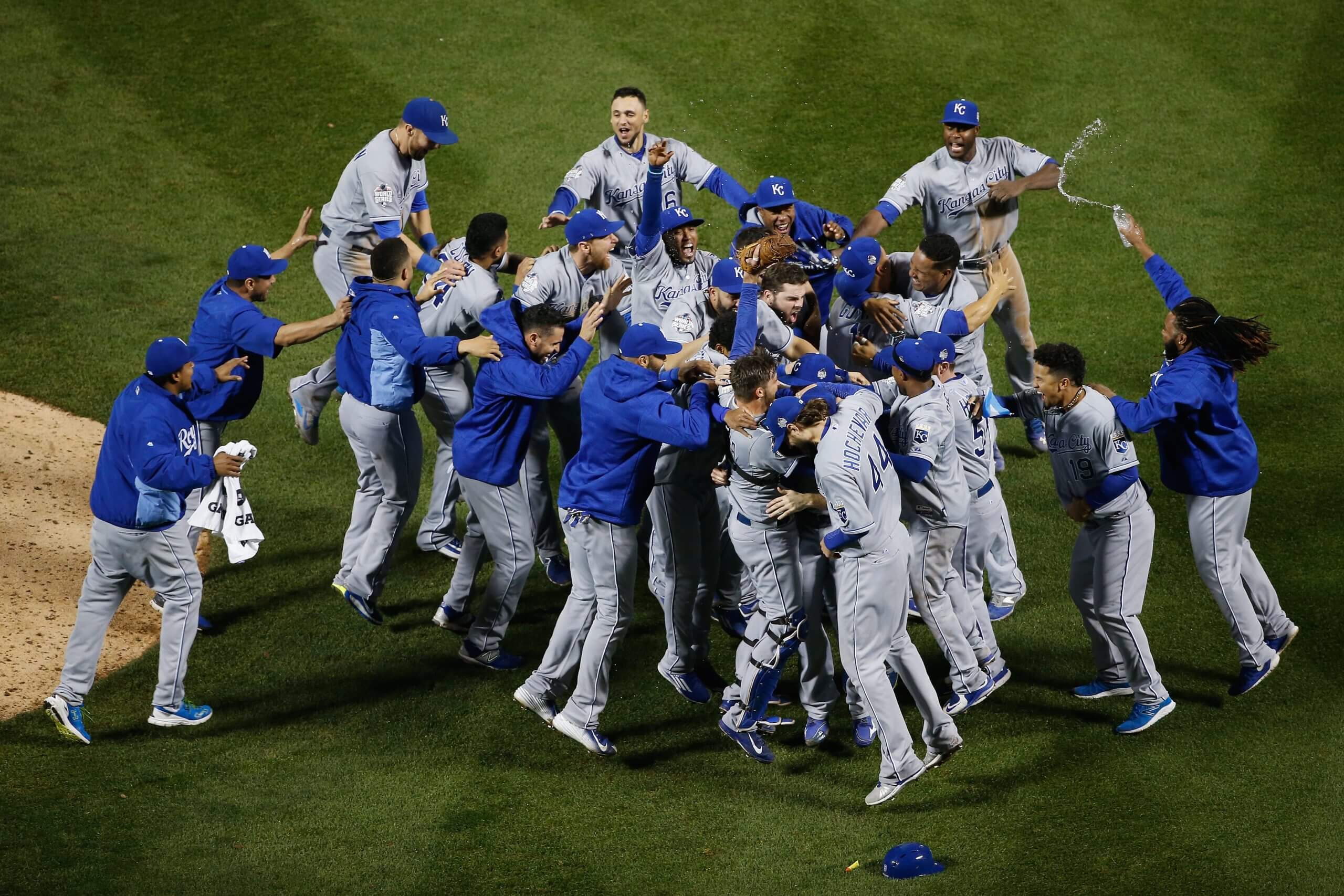
The 2015 Royals were the last bottom-half market to win a World Series. (Tim Bradbury / Getty Images)
“In the last three seasons, we’ve had 22 teams make the playoffs,” Meyer countered. “In the last three seasons, we’ve had 11 different teams make the league championships. We’ve had 18 different teams in the World Series since 2012.”
A distinction could be drawn between small-market teams’ competitiveness for top free agents and their ultimately ability to contend for a championship. The Milwaukee Brewers have won three straight division titles, but they just traded away ace Freddy Peralta to the Mets.
Small-market teams today sometimes sign homegrown players to long-term deals, but a cap could help them more frequently compete for the biggest fish in free agency as well.
The union argues that teams today just don’t want to spend.
“The problem is not with the teams that are spending money to try and make their teams better,” Meyer said. “The problem is with the teams that are willing to go along and not do everything they can to put the best team on the field, even though they can afford to. That affects fans in many markets, and can be addressed without a salary cap.”
Club financials are closely guarded except for those of the Atlanta Braves, a publicly traded company. (The Toronto Blue Jays are owned by a public company but are not a separately reported entity.)
“The league and the clubs make a lot of claims to the public, to fans about their finances, but they don’t open the books to the public,” Meyer said. “So they’re asking the fans to take their word for various things.
“We have certain information that we’re not permitted to share. The small market teams under the current system get massive amounts of revenue sharing, and not just revenue sharing, but luxury-tax proceeds and central revenues.”
A cap would reduce the criticism owners receive for tight purse strings, barbs that irk owners. Whether a cap would really even out competition, though, is a different question.
Would teams such as the Pittsburgh Pirates, with perennially low payrolls in the current system, still spend toward the floor every year, and the Dodgers the top? If so, how many more playoff appearances would the Pirates net? The delta between the salary ceiling and floor becomes crucial.
The NFL has been dominated by the Kansas City Chiefs and New England Patriots. Those teams’ success is most often attributed to their management, rather than their payrolls, which are typically modest. The field could be more open with a cap, but cap leagues still create consistent winners and losers.
The cap galvanizes both sides
In this negotiation, a cap is not only a potential end, but a means to an end. Amidst dwindling local TV revenues, Manfred wants to change baseball’s media rights structure, and a cap is a lever to do so.
Manfred wants to take more local games national, and ultimately, spread TV money around more evenly between clubs. Revenue sharing is a hotly contested topic, and the big-market teams won’t give up their prized local rights for free. But that’s where a cap comes in: it’s a unifier for owners in making other trade-offs.
The rub, of course, is that a cap has long been a unifier for players as well.
“What would really be bad for the sport and for the media rights,” Meyer said, “would be for the league, coming off a season with all this momentum, to choose to shut it down and miss games to get a restriction that they don’t need.”