
One of the ripples from Monday’s six-player trade between the Boston Red Sox and Milwaukee Brewers, with Caleb Durbin and Kyle Harrison as the principals, was the idea that maybe a path had opened for the Padres to make a late trade for a starting pitcher.
The thinking was this: Milwaukee has pitching depth after acquiring left-handers Harrison and Shane Drohan from Boston, and they no longer have a third baseman after unloading Durbin. David Hamilton, the other player Milwaukee got in the deal, might get the first crack at the job. Could A.J. Preller interest his Brewers counterpart Matt Arnold in, say, Jake Cronenworth to fill that gap?
But then there was another thought: Now is not the time for the Padres to move Cronenworth, even though we posited during the Winter Meetings that trading him might be the club’s easiest path to acquiring pitching.
Here’s an argument, albeit not a full-throated one, for keeping him as spring training begins:
3 reasons for Padres to retain Jake Cronenworth
Cronenworth wouldn’t fetch what other teams have gotten for versatile infielders this month
True, the market for versatile infielders appears robust. The Durbin deal brought Milwaukee back an MLB arm, an MLB-ready arm, and a speedy MLB infielder. Four days earlier, the Arizona Diamondbacks dealt Blaze Alexander to the Baltimore Orioles for hard-throwing right-hander Kade Strowd and two minor leaguers. A couple of days before that, the St. Louis Cardinals bagged a top-100 prospect (Jurrangelo Cijntje), two other minor leaguers and two draft picks from the Seattle Mariners and Tampa Bay Rays for Brendan Donovan.
But each move featured someone who had more overall value than Cronenworth. Durbin will turn 26 this month and is coming off a season in which he finished third in National League Rookie of the Year voting. Alexander is 26, he’s cheap, and he has flashed potential during his brief career. Donovan, 29, is one of the best contact hitters in the game, he’s still arbitration-eligible, and he’s highly versatile.
Cronenworth is 32 and has five years and $60 million-plus remaining on his seven-year, $80 million extension. He can play second, short and first but has just one inning of MLB experience at third base. How much money — and what level of prospect — would Preller need to attach to him for a team to bite?
Cronenworth is the Padres’ best internal option at second base
First, the negative: There’s a lot of blue on his Baseball Savant page. His career-high .367 on-base percentage last year was boosted by a career-high 13.4 walk rate that was three points higher than his previous personal best. Using run values, he could only handle four-seam fastballs last season. Was that a byproduct of the rib fracture that cost him most of April and a bit of May, or was that a sign of age?
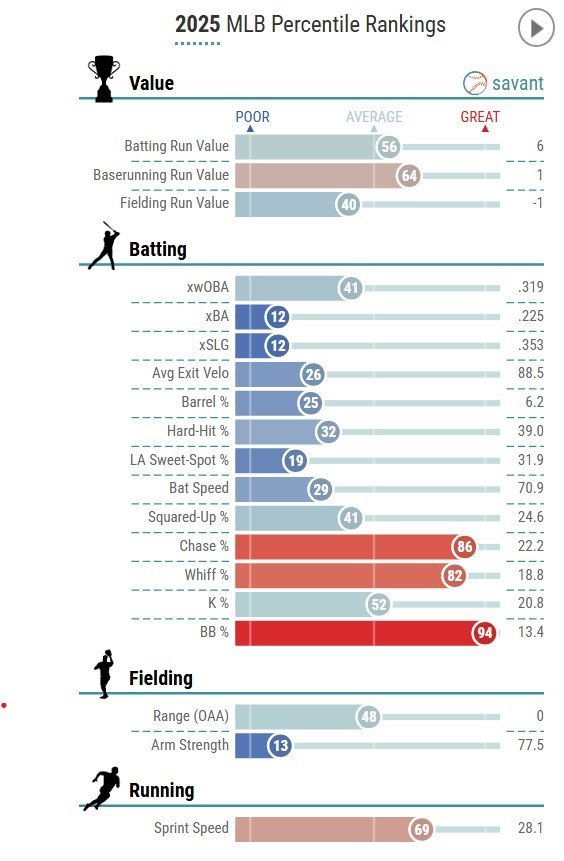
Now, the positive: Cronenworth delivers above-average offensive production (117 wRC+, 108 OPS+ in 2025, in line with his career averages). San Diego’s other options at second base — Mason McCoy, Sung Mun Song and Will Wagner — can’t be counted on to match that.
Song, 29, hit a career-high 26 home runs in the KBO last year, but he has never taken an MLB at-bat and he’s nursing an oblique injury suffered during offseason training. McCoy, 30, has made 84 mostly empty plate appearances over parts of three seasons (.494 OPS). Wagner, 27, has a career 95 wRC+ over roughly a full season of plate appearances. None of that says “everyday player for a contending club.”
Defense is the weakest part of this argument. Cronenworth’s fielding at second last year was average to below average according to advanced metrics. He was eighth among 11 qualified second basemen with minus-8 defensive runs saved. Outs above average rated him better at minus-1, fifth-best in that group. Song, meanwhile, was a Gold Glove third baseman in Korea. McCoy and Wagner have posted middling defensive metrics.
Cronenworth is a part of the Padres’ core, and vibes matter
He has been a regular contributor since making his MLB debut in 2020, the COVID year. San Diego has made the postseason four times in his six seasons. He forms a veteran keystone combination with shortstop Xander Bogaerts. San Diego would be removing a big piece — for a potentially low return — from a team that has championship aspirations.
Think you could write an article like this one? We’re looking for additional contributors, and we pay for all our content! Please click here, fill out the form, and someone will reply with more information.