
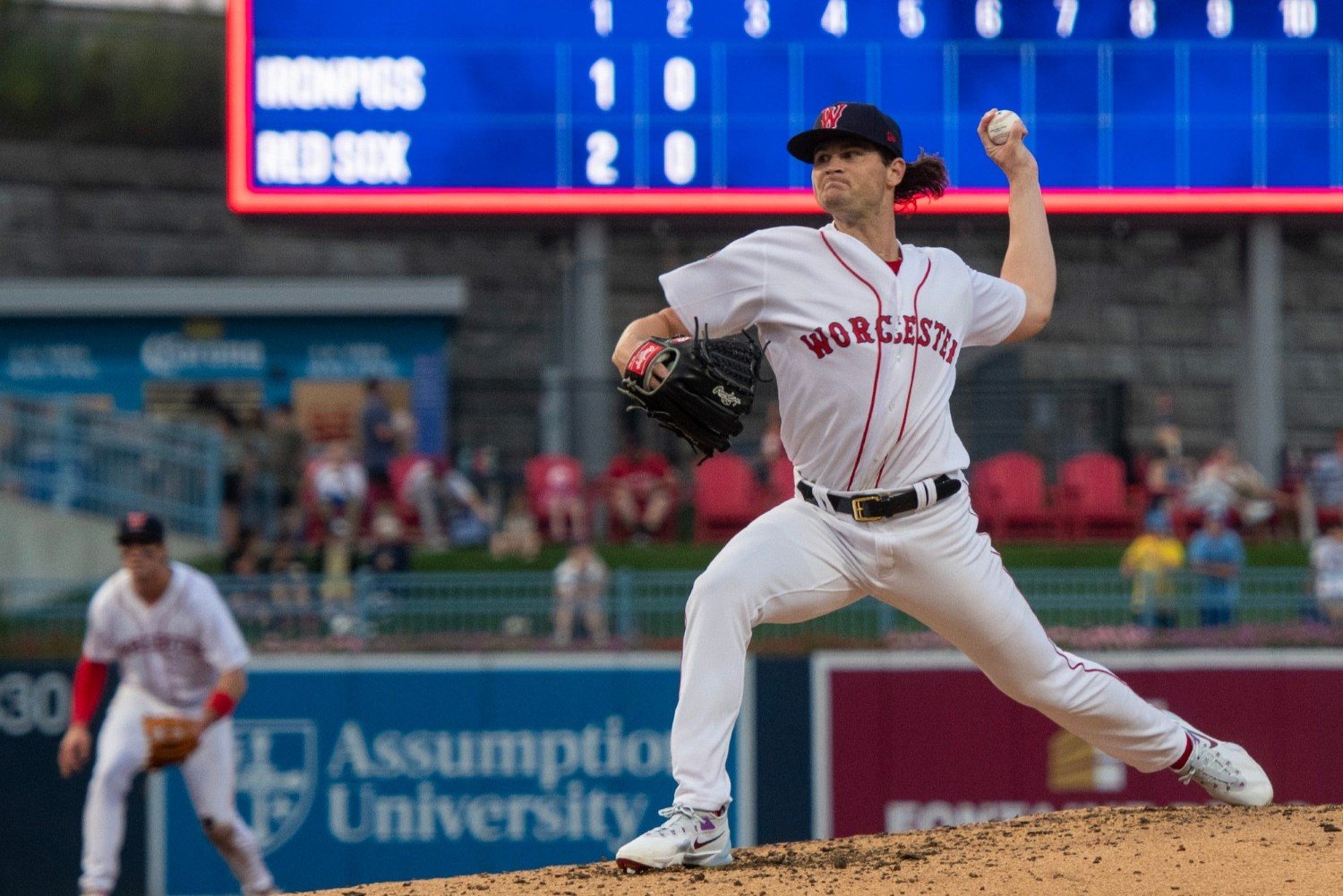
Kyle Harrison is the more recognizable of the two left-handed pitchers the Brewers acquired from the Red Sox in the Caleb Durbin trade earlier this week. However, president of baseball operations Matt Arnold stressed that the club also thinks highly of Shane Drohan, who owns an unassuming 4.29 ERA and 4.52 FIP across five minor-league seasons and has yet to make his big-league debut at age 27.
“Our scouts really, really like this guy,” Arnold said on Monday. “He was a very big part of [the trade] for us as well.”
After Boston made him its fifth-round pick out of Florida State in 2020, Drohan made it to Triple-A Worcester in 2023, but injuries and control issues stalled his progress there. Shoulder surgery wiped out most of his 2024 campaign (which included a brief stay in the Chicago White Sox organization as a Rule 5 pick), and he missed three months last year with forearm inflammation. When healthy, he has walked 11.4% of hitters over his minor-league career.
Drohan’s ability to miss bats, however, has always been apparent. Thanks to a deceptive arsenal delivered from a low arm slot, he owns a career 26.3% strikeout rate as a professional. By cleaning up that five-pitch mix last year, the southpaw elevated his game to new heights, posting a 2.27 ERA, 68 DRA-, and 35.3% strikeout rate in 47 2/3 Triple-A innings.
“He’s kind of flown under the radar a little bit more than Harrison, but this guy dominated in Triple-A last year,” Arnold said, adding that the club has no concerns related to that forearm injury. “I mean, he was very good. Strikes out a lot of guys and has really good stuff.”
Visually, Drohan’s delivery looked more athletic. Here’s a comparison of the southpaw throwing a breaking pitch in his previous healthy season in 2023 and in 2025, both with the bases empty.
Drohan moves quicker in the earlier clip, but his delivery is stiffer. Pitching out of a fuller windup in the 2025 clip, he takes longer to get to his release point, but he gets deeper into his back leg before rotating more explosively toward the plate. The result is a well-located, sharper slider that gets a chase low and away.
With those changes, Drohan added a tick of velocity to each of his pitches, increased the backspin-induced carry of his four-seam fastball, and tightened his cutter and slider into more consistent and distinct shapes. His control also improved, as he cut his walk rate to 8.4% in Triple-A.
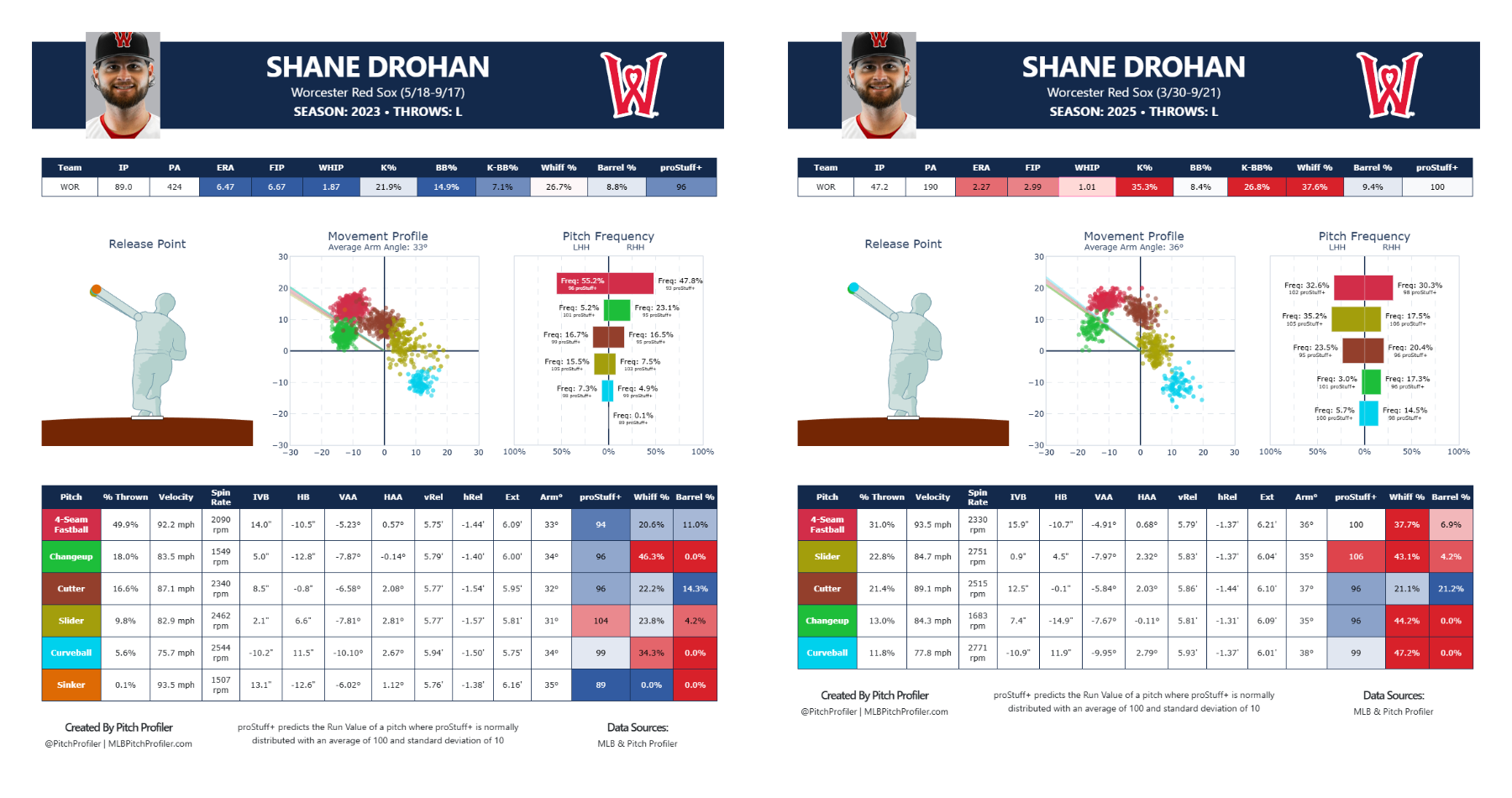
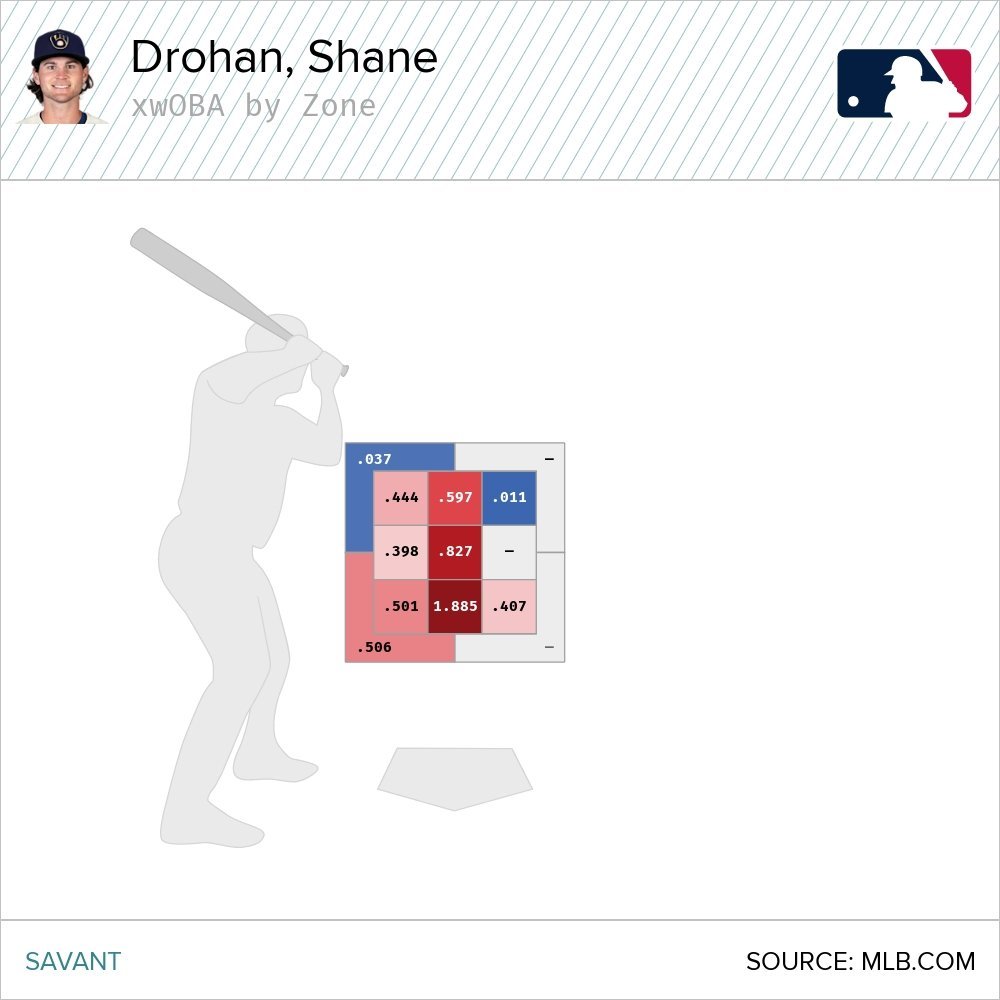
Those developments turned Drohan into one of the top swing-and-miss pitchers in minor-league baseball. He generated whiffs on 37.3% of swings, which ranked in the 99th percentile of Triple-A pitchers. His riding cutter, which opponents tagged for a .504 xwOBA, was the only pitch not to produce a plus whiff rate.
The rest of his arsenal was dominant. Drohan’s improved four-seamer played well at the top of the zone, and his fading changeup baffled hitters, thanks to nearly 10 mph of separation off the heater. His shortened gyro slider remained in the strike zone longer before its late movement took effect, leading to more chases and weak contact. His curveball, regarded by some evaluators as his best pitch before he refined his slider, offers bigger movement when necessary from a similar slot to the rest of his pitches.
Drohan could scrap his cutter in a relief role, where his fastball-slider pairing would be enough to carve through most hitters. If he remains a starter, he and the Brewers must determine the best way to use the pitch. He found the most success when back-dooring it to right-handed hitters, which is how Quinn Priester began using his similarly shaped cutter to lefties throughout last summer.
Drohan’s swing-and-miss upside has never been in question, and with improved control, he’s closer to missing big-league bats. The question is how consistently he’ll tap into that upside, and in what role. He figures to be further down the depth chart than the myriad bona fide starters in camp, but he has the arsenal to start. Don’t be surprised if he’s recording pivotal outs in Milwaukee by season’s end.