
Spring training is about a month away. The air is starting to warm, and the birds are returning. I love spring. It’s a time of renewal, both in life and in baseball.
One of the beauties of baseball is its consistency. Things change slowly in baseball, and that’s okay with me. Speaking of change, has anyone else noticed the Girl Scouts changed Thin Mints? As a bit of a cookie connoisseur, I’m not a fan. They’re not as delectable as the old Thin Mints.
Back to baseball. A pitcher delivers the ball and, 60 feet 6 inches away, a batter tries to hit it. Granted, over the years, the equipment has improved: better bats, balls that we assume are more uniform, even small things like better spikes can make a difference. Even in years when we question the integrity of the baseball, the umpire switches out balls after nearly every pitch. In the old days, a ball might have been used until it was hit into the stands, which meant many batters stood in the box trying to locate a dirty baseball hurtling toward them.
One noticeable change over the years has been hitters wearing all sorts of body armor. I understand it— a 95-mile-per-hour fastball that hits your elbow is going to cause significant pain and possibly a trip to the injured list. This is one change that tilts in favor of the batter, giving them confidence to stand a little closer to the plate even against the hardest throwers. When I was a young teen, I took a fastball off my left thigh from the hardest thrower in town. The next day, I could see the baseball’s stitches imprinted in the bruise. I’d have given anything to be wearing a thigh pad. Do you think I was thinking about that pitch the next time I faced him? You’d better believe it. The lack of body armor gave hard throwers like Don Drysdale and Bob Gibson a significant advantage.
This is the final installment of great hitting seasons, looking at some of the best from the 1990s to the present day, with memories of the jacked-up ’90s. It seemed like everyone was lifting weights in that glorious decade, and many players were supplementing their workouts with illegal substances. Balls were flying out of ballparks faster and farther than any of us had ever seen. It was all an illusion and, at the same time, glorious.
Before we road trip to the ’90s, I want to write about one of my personal favorite hitting seasons: Rusty Staub in 1973. Statistically, it wasn’t anything special: .279/.361/.421 with just 15 home runs and 76 RBI in 152 games. It wasn’t even Staub’s best season, which was probably 1970 in Montreal or maybe 1978 with the Tigers. Staub, adorned with one of the all-time great nicknames in Montreal—Le Grand Orange—was a vastly underrated hitter over his 23-year career.
What made his 1973 season so memorable was the joy it brought to baseball. That was the season an undermanned Mets team made an improbable run to the World Series, primarily on the backs of ace Tom Seaver and Staub’s timely hitting.
Over the final 13 games of the season, the Mets went from two and a half games back to winning the pennant by one and a half games over the St. Louis Cardinals. Staub led the charge by hitting .393 over that stretch, helping lead the Mets to ten wins.
The Mets finished just 82–79, then somehow beat the heavily favored Cincinnati Reds in a thrilling five-game championship series.
Against all odds, they took the powerhouse Oakland A’s to seven games in the World Series, with Staub hitting .423 despite playing with a separated shoulder. Maybe it was just my 12-year-old memories, but it seemed like anytime the Mets needed a big hit late in a game—especially in the Championship Series or the World Series—Staub delivered.
There was no mistaking Staub’s brilliance with the bat. He ended his career with 2,716 hits and is the only player in history to record at least 500 hits with four different franchises. Most years he was a doubles machine, and he had a fantastic eye, drawing over 100 walks twice and finishing with a career .362 OBP.
He was beloved in both Montreal and New York and is a member of both teams’ Halls of Fame. Staub is one of those players who deserves another look from the Veterans Committee of the Baseball Hall of Fame.
Albert Belle. The name conjures a lot of different feelings. He was the son of a football coach and a math teacher. He was a member of the National Honor Society and an Eagle Scout. He had a reputation as a hothead prone to outbursts, but man, could he hit. Despite his virtuosity with the bat, he was only the second-best hitter in history named Albert.
He attended LSU, where he hit .332 with power over his college career. The Indians took him in the second round of the 1987 draft—the same draft in which Ken Griffey Jr. went first overall. The Royals selected Kevin Appier in the first round and Terry Shumpert in the second, six picks before Belle. It’s hard to imagine passing on Belle when you look at his college production, but that’s never stopped the Royals from making questionable draft choices.
Belle made his major league debut in 1989 at age 22 and blossomed into stardom in 1991. At his peak—an eight-year stretch—he was one of the most feared power hitters in the game. His best season likely came in 1995, though a case can be made for others.
The 1995 season was shortened due to a players’ strike, and in 143 games Belle slashed .317/.401/.690 with 50 home runs, 52 doubles, 126 RBI, 121 runs scored, and 377 total bases. He almost certainly would have topped 400 total bases in a full season. As it was, he became the first player in history to hit 50 home runs and 50 doubles in the same season. He led the league in six offensive categories, made the All-Star team, and won the Silver Slugger. In a great injustice, he finished second in the MVP voting behind Boston’s Mo Vaughn. Maybe voters were punishing Belle for his often-surly attitude, but Vaughn was no choir boy. Belle’s offensive output dwarfed Vaughn’s.
Belle was remarkably consistent all summer, rarely going more than two consecutive games without a hit. He had 15-game and 11-game hitting streaks and collected four hits in a game on four occasions. When a guy is swinging the bat like that, it’s hard to pick out his best game. The peak probably came on August 5 against the White Sox, when Belle went 4-for-4 with two home runs and ten total bases in an 11–7 Indians win.
Belle retired after the 2000 season due to degenerative hip osteoarthritis. In a fitting farewell, he homered in his final career at-bat. He was inducted into the Guardians/Indians Hall of Fame in 2016.
One of Belle’s teammates on those powerhouse Cleveland teams was his outfield running mate Manny Ramirez. The Indians took Manny with the 13th pick in the 1991 draft, and by 1993 he was in Cleveland. Ramirez hit his stride in 1995 and had an amazing 13-season peak. Did Manny use steroids? Most likely, as many did. I’m not here to pontificate about the steroid era. Everyone has their own feelings about it.
Ramirez’s best season came in 1999, when over 147 games he hit .333/.442/.663 with 44 home runs, 34 doubles, 96 walks, and 165 RBI. That earned him his third All-Star appearance and his second Silver Slugger. Before his career ended, Manny would make 12 All-Star teams and win nine Silver Sluggers. He won a batting title in 2002 and had 11 seasons with an OBP greater than .400. He was a wizard with the bat.
Ramirez finished third in the 1999 MVP voting, which is probably where he belonged given his defensive shortcomings.
His best game that summer came on August 25, when he lacerated Oakland for four hits, including three home runs. He scored four times and collected 14 total bases in a 12–4 Tribe win.
Manny played through the 2011 season and would probably be in the Hall of Fame if not for the steroid issues. And I’m okay with that.
Ramirez was inducted into the Guardians/Indians Hall of Fame in 2023.
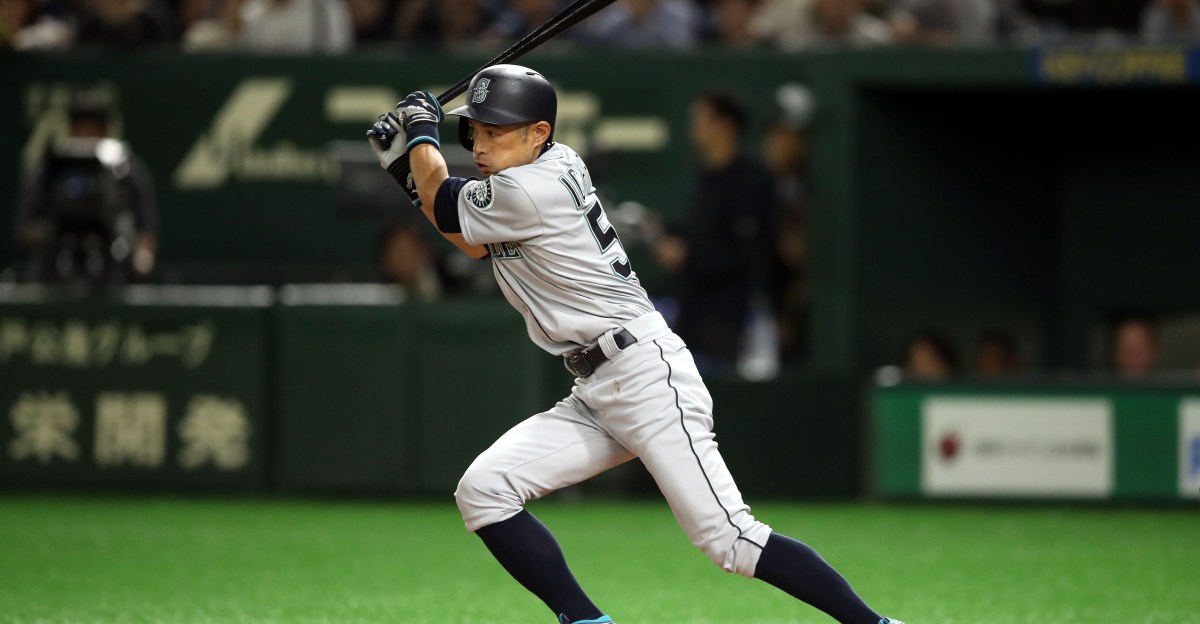
When Ichiro Suzuki signed with the Mariners prior to the 2001 season, no one quite knew what to expect. Ichiro had been a megastar in Japan, but Japanese players had yet to translate that stardom to American baseball. Already 27 at his major league debut, he brought nine years of experience with the Orix BlueWave. He burst out of the gate, collecting a rookie-record 242 hits. That shattered the previous mark of 223 set by Lloyd Waner in 1927 and was the most hits by any player since 1930. Ichiro won his first batting title that year with a .350 average and displayed a cannon arm in right field. He was a runaway winner of both the Rookie of the Year and the American League MVP.
His best season came in 2004, and the numbers are almost cartoonish: .372/.414/.455 with a league-leading 262 hits—a major league record—and 101 runs scored. Ichiro never hit for much power, finishing his 2,653-game career with 117 home runs and just 96 triples in 19 seasons. But he was a consistent 25–30 doubles hitter and a savant at stroking singles.
How do you pick the best game of someone who hits .372? Ichiro had a 21-game hitting streak, collected four hits in six different games, and five hits in four different games. His best game was probably August 17 against the Royals at the K. It was his first game in Kansas City and perhaps the impetus for his famous description of August in Missouri as “hotter than two rats f***ing in a wool sock.” Coming from anyone else, it wouldn’t have been as funny.
The Royals finished 58–104 that year, which felt normal in those days. Ichiro led off and deposited the second pitch he saw into the right-field bullpen. The blast came off Darrell May, who lasted just two innings, allowing nine hits and nine runs. Ichiro singled again in the second before Tony Peña turned to Matt Kinney, a pitcher I have absolutely no memory of. Ichiro greeted him with a bases-loaded single in the third. Three innings, three at-bats, three hits.
He added a fourth hit in the fifth and later drew a walk. Final tally: 4-for-4 with a walk, two runs scored, and five RBI. Ichiro hit .352 against Kansas City in his career, his highest average against any opponent. He was elected to the Baseball Hall of Fame in 2025 with 99.7 percent of the vote.
Looking at great hitters, two things jump out. Nearly every outstanding hitter debuted very young, usually at 19 or 20. Yes, once in a generation a team overlooks a terrific hitter like Bob Johnson or, on a local level, Whit Merrifield. Both debuted at 27, but they are exceptions. Most hitting savants reach the majors early. The second commonality is a long peak—10 to 14 years is not unusual.
Both were true of Miguel Cabrera. Miggy debuted with the Florida Marlins at age 20 and by the next season was a force. His 13-year peak produced a .306 career average, 511 home runs, 1,881 RBI, and 3,174 hits. Those are Hall of Fame numbers, and he will be elected when eligible in 2028.
For our purposes, we’ll look at his 2012 Triple Crown season. Winning the Triple Crown in baseball is about as difficult as winning it in horse racing. There have been only 17 winners in history and just three in my lifetime. The National League hasn’t had one since Joe Medwick in 1937, which still amazes me. Shohei Ohtani may eventually end that drought.
In 2012, Cabrera hit .330/.393/.606 with 44 home runs, 139 RBI, 109 runs scored, and 377 total bases. He clinched the Triple Crown in the final three games of the season, played in Kansas City. Cabrera went 6-for-10 in that series, and the Kansas City crowd rewarded him with a standing ovation when Jim Leyland removed him in the fourth inning of the final game. Cabrera was visibly moved, thanking the fans and saying it “felt like playing at home.” It was one of those moments that made me proud to be a Royals fan.
Cabrera’s longest hitting streak that summer was 14 games, and he recorded four four-hit games. He was mechanically consistent all season, rarely going more than two games without a hit. His peak RBI game was five, which came in the third game of the season.
His best game likely came June 2 against the Yankees, when he went 3-for-4 with two solo home runs and ten total bases. On October 1, he torched the Royals with four hits in five at-bats, including a home run, leading the Tigers to a 6–3 win.
Purely by numbers, he may have been even better in 2011 or 2013, but sometimes it takes a little luck to win a Triple Crown. Cabrera retired after the 2023 season, one of those players you simply felt lucky to watch.