
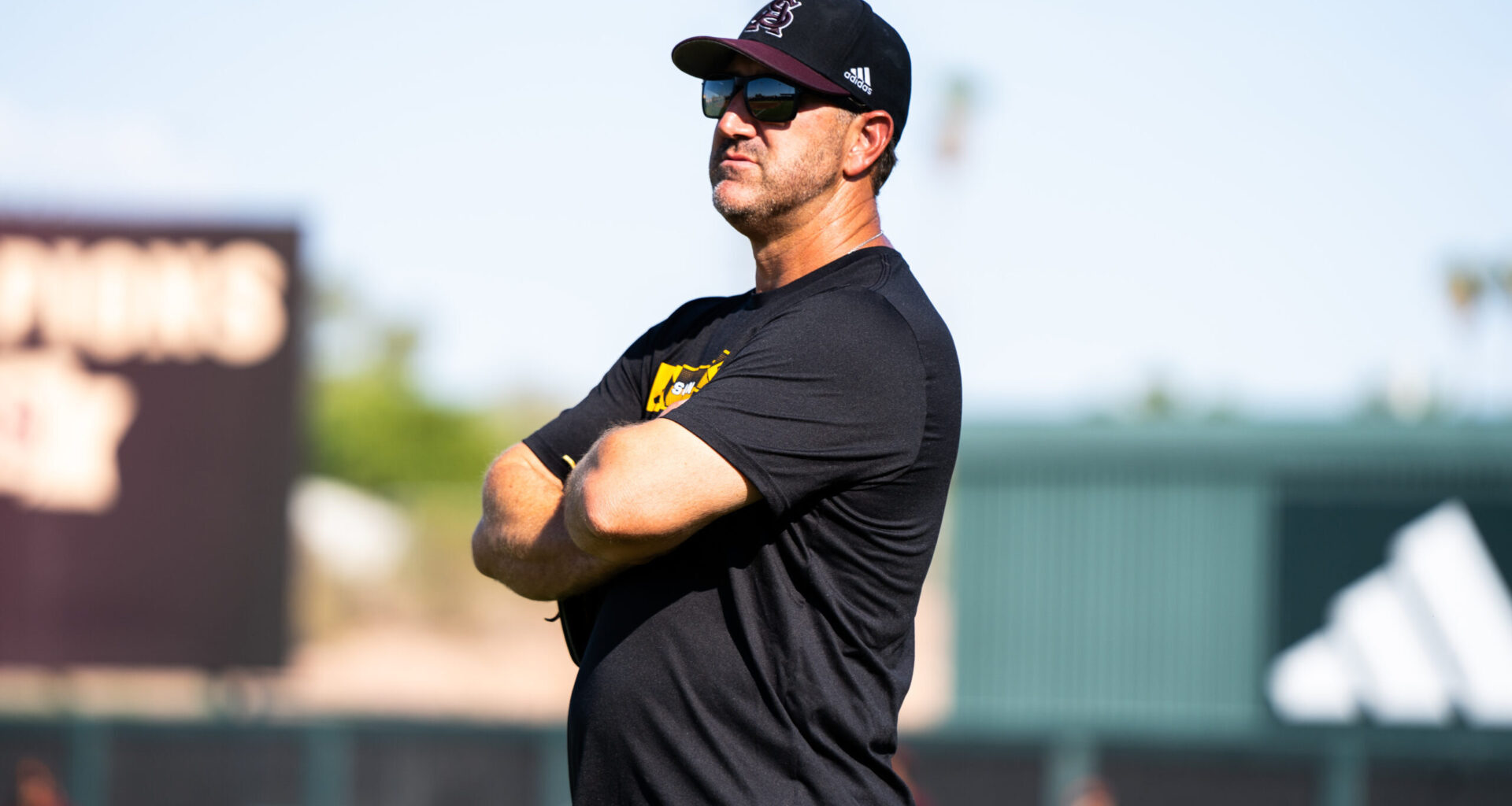
PHOENIX — Arizona State’s baseball team reinvented its identity this offseason, turning its focus to depth and competition after losing 27 of the team’s 41 players from last year.
The Sun Devils lost nine players from last season to the MLB Draft, all within the first 10 rounds. Those exits, paired with departures due to graduation and the transfer portal, constituted a significant exodus of talent. Despite this, the team’s internal confidence remains high.
“I believe we’re in a much better position as a program with depth and talent level,” said ASU coach Willie Bloomquist, whose squad opens the season Friday at home with a three-game series against Omaha. “I think we’re in a much better spot than we were, and we’re going to just continue to grind and build upon that.”
The distribution of talent is markedly different than last year, when the Sun Devils finished 36-24 and 18-12 in the Big 12. While the team can make significant strides and acquisitions between seasons, one offseason is not enough time to replace nine professional-level players, a number that was good for third-most of any college in the MLB Draft.
This does not mean, however, that the team is destined to regress after making the NCAA tournament in 2025 for the first time under Bloomquist. While the top-end quality of players may take a hit, ASU had the opportunity to build a roster with bolstered depth and increased competition for playing time, potentially improving the collective quality of the roster.
“There was a lot of competition,” assistant coach Jason Ellison said, referring to ASU’s preseason roster. “That’s one thing we do have this year, which I thought we lacked a little bit is we have more depth on the bench. There’s guys that are going to be on the bench, [that] could be starting for us, potentially.”
Infielder Jacob Tobias and outfielder Isaiah Jackson were ASU’s only players to appear in all 60 regular season contests last year, meaning that the Sun Devils should require considerable production from their bench to find success this season.
This increased depth not only looks to address that need but also attempts to improve the quality of the starting lineup by forcing players to compete and earn their playing time.
Ellison, a Seattle-area native and fan of the Seattle Seahawks, drew on his experience of listening to Pete Carroll, the accomplished college and NFL coach.
“I think competition’s great for many aspects,” Ellison said. “Being a Seattle guy and hearing Pete Carroll preaching competition amongst their guys always, I’m a big advocate of it, so yeah, it’s good.”
Although competition is a definite vehicle for improvement and player development, simply having a deeper roster and stiffer competition for starting roles and playing time does not guarantee immediate and consistent production at every spot on the diamond.
“There’s going to be bumps and bruises and whatever there may be,” pitching coach Jeremy Accardo said of the battle for spots in the starting rotation. “But if all these guys are focused on what they can control, I think we’re going to be in a good spot.”
That sentiment can apply generally to the entire roster, but more notably, it departs from the coaching staff’s previous optimistic tone. A pragmatic point of view is likely more representative of how the Sun Devils will have to operate this season.
Despite an influx of depth and competition, the reality remains that the roster is likely to be less talented than it was last year. The team will be forced to operate differently to account for this deficit of talent. This starts with emphasizing success on the margins.
“We have to hold the running game better. We have to field our positions better, make the routine plays, turn double plays, be much better at two-strike, hitting-wise,” Bloomquist said. “Those types of things that ultimately, if you’re good at them, those result in wins, right?”
These nuances are necessary for every team to win, but the burden to reach them at a high level becomes greater for a team with less talent. If the formula for winning is simplified to a combination of talent and execution, a Sun Devils team with lesser talent would require better execution.
None of this is to say that ASU is a bad team or lacks talent. The Sun Devils enter the season ranked fourth in the 2026 Big 12 Baseball preseason poll, with three players selected to the preseason Big 12 team in outfielder Landon Hairston, third baseman Austen Roellig and pitcher Cole Carlon. Additionally, outfielder Dean Toigo was selected as the preseason Big 12 Newcomer of the Year.
While ultimately still a talented squad, the impact of the transfer of talent to MLB and other avenues is felt strongest in the pitching staff, where the Sun Devils will need to get creative.
“We might be piggybacking a few guys, too, on Friday, you know; have essentially two starters on Friday and two on Saturday, and see how that shapes out and who has more success and then ultimately, by the time we get to conference, we’ll have a really good idea on who our set Friday, Saturday, Sunday are,” Bloomquist said.
It is difficult to parse whether this decision is based on setting up the entire pitching staff for success, having a lack of top-end weekend talent, or a combination of these factors. It is fair to assume that if ASU had a few arms stand out as clear weekend starters that the coaching staff would give them the reins from day one, so the decision to piggyback could indicate a lack of talent or a degree of uncertainty in some of the pitchers succeeding as a starter.
With a player like Carlon entering the starting rotation after a successful year as a staple in ASU’s bullpen last year, and UNLV transfer Alex Overbay potentially factoring into the rotation after leading the Rebels in saves last year, a cautious approach could prove wise given the difficulty of picking up a starter’s workload. Combine this with the rest of the pitching staff’s lack of starting experience and it becomes clear the decision to piggyback throughout the nonconference schedule could pay dividends.
In the best case scenario, the Sun Devils will be able to determine the staples of their starting rotation before conference play begins in March, and those who do not earn a starting spot enter the bullpen with the ability to go further than three outs while maintaining the flexibility to bounce back to the starting rotation in case of injury. Alternatively, and on the downside, some arms could struggle and be forced to move to the bullpen, and the innings that they pitched could leave the remaining starters underprepared entering conference play.
Despite the difficulties of weathering ASU’s exodus of talent, the coaching staff has built a competitive and deep roster that looks to win in 2026.
“I think it’ll be a little different than last year where I thought there was a little all or nothing to our game at times, where this year, I think we’re a little more dynamic in other ways,” Ellison said.
This <a target=”_blank” href=”https://cronkitenews.azpbs.org/2026/02/12/sun-devils-ncaa-baseball-big-12/”>article</a> first appeared on <a target=”_blank” href=”https://cronkitenews.azpbs.org”>Cronkite News</a> and is republished here under a <a target=”_blank” href=”https://creativecommons.org/licenses/by-nd/4.0/”>Creative Commons Attribution-NoDerivatives 4.0 International License</a>.
<img id=”republication-tracker-tool-source” src=”https://cronkitenews.azpbs.org/?republication-pixel=true&post=99855″ style=”width:1px;height:1px;”><script> PARSELY = { autotrack: false, onload: function() { PARSELY.beacon.trackPageView({ url: “https://cronkitenews.azpbs.org/2026/02/12/sun-devils-ncaa-baseball-big-12/”, urlref: window.location.href }); } } </script> <script id=”parsely-cfg” src=”//cdn.parsely.com/keys/cronkitenews.azpbs.org/p.js”></script>
Canonical Tag:
Copy Tag
Article Content:
Iron sharpens iron: Internal competition key to success for ASU baseball
Tanner Bonheimer, Cronkite News
February 12, 2026
PHOENIX — Arizona State’s baseball team reinvented its identity this offseason, turning its focus to depth and competition after losing 27 of the team’s 41 players from last year.
The Sun Devils lost nine players from last season to the MLB Draft, all within the first 10 rounds. Those exits, paired with departures due to graduation and the transfer portal, constituted a significant exodus of talent. Despite this, the team’s internal confidence remains high.
“I believe we’re in a much better position as a program with depth and talent level,” said ASU coach Willie Bloomquist, whose squad opens the season Friday at home with a three-game series against Omaha. “I think we’re in a much better spot than we were, and we’re going to just continue to grind and build upon that.”
The distribution of talent is markedly different than last year, when the Sun Devils finished 36-24 and 18-12 in the Big 12. While the team can make significant strides and acquisitions between seasons, one offseason is not enough time to replace nine professional-level players, a number that was good for third-most of any college in the MLB Draft.
This does not mean, however, that the team is destined to regress after making the NCAA tournament in 2025 for the first time under Bloomquist. While the top-end quality of players may take a hit, ASU had the opportunity to build a roster with bolstered depth and increased competition for playing time, potentially improving the collective quality of the roster.
“There was a lot of competition,” assistant coach Jason Ellison said, referring to ASU’s preseason roster. “That’s one thing we do have this year, which I thought we lacked a little bit is we have more depth on the bench. There’s guys that are going to be on the bench, [that] could be starting for us, potentially.”
Infielder Jacob Tobias and outfielder Isaiah Jackson were ASU’s only players to appear in all 60 regular season contests last year, meaning that the Sun Devils should require considerable production from their bench to find success this season.
This increased depth not only looks to address that need but also attempts to improve the quality of the starting lineup by forcing players to compete and earn their playing time.
Ellison, a Seattle-area native and fan of the Seattle Seahawks, drew on his experience of listening to Pete Carroll, the accomplished college and NFL coach.
“I think competition’s great for many aspects,” Ellison said. “Being a Seattle guy and hearing Pete Carroll preaching competition amongst their guys always, I’m a big advocate of it, so yeah, it’s good.”
Although competition is a definite vehicle for improvement and player development, simply having a deeper roster and stiffer competition for starting roles and playing time does not guarantee immediate and consistent production at every spot on the diamond.
“There’s going to be bumps and bruises and whatever there may be,” pitching coach Jeremy Accardo said of the battle for spots in the starting rotation. “But if all these guys are focused on what they can control, I think we’re going to be in a good spot.”
That sentiment can apply generally to the entire roster, but more notably, it departs from the coaching staff’s previous optimistic tone. A pragmatic point of view is likely more representative of how the Sun Devils will have to operate this season.
Despite an influx of depth and competition, the reality remains that the roster is likely to be less talented than it was last year. The team will be forced to operate differently to account for this deficit of talent. This starts with emphasizing success on the margins.
“We have to hold the running game better. We have to field our positions better, make the routine plays, turn double plays, be much better at two-strike, hitting-wise,” Bloomquist said. “Those types of things that ultimately, if you’re good at them, those result in wins, right?”
These nuances are necessary for every team to win, but the burden to reach them at a high level becomes greater for a team with less talent. If the formula for winning is simplified to a combination of talent and execution, a Sun Devils team with lesser talent would require better execution.
None of this is to say that ASU is a bad team or lacks talent. The Sun Devils enter the season ranked fourth in the 2026 Big 12 Baseball preseason poll, with three players selected to the preseason Big 12 team in outfielder Landon Hairston, third baseman Austen Roellig and pitcher Cole Carlon. Additionally, outfielder Dean Toigo was selected as the preseason Big 12 Newcomer of the Year.
While ultimately still a talented squad, the impact of the transfer of talent to MLB and other avenues is felt strongest in the pitching staff, where the Sun Devils will need to get creative.
“We might be piggybacking a few guys, too, on Friday, you know; have essentially two starters on Friday and two on Saturday, and see how that shapes out and who has more success and then ultimately, by the time we get to conference, we’ll have a really good idea on who our set Friday, Saturday, Sunday are,” Bloomquist said.
It is difficult to parse whether this decision is based on setting up the entire pitching staff for success, having a lack of top-end weekend talent, or a combination of these factors. It is fair to assume that if ASU had a few arms stand out as clear weekend starters that the coaching staff would give them the reins from day one, so the decision to piggyback could indicate a lack of talent or a degree of uncertainty in some of the pitchers succeeding as a starter.
With a player like Carlon entering the starting rotation after a successful year as a staple in ASU’s bullpen last year, and UNLV transfer Alex Overbay potentially factoring into the rotation after leading the Rebels in saves last year, a cautious approach could prove wise given the difficulty of picking up a starter’s workload. Combine this with the rest of the pitching staff’s lack of starting experience and it becomes clear the decision to piggyback throughout the nonconference schedule could pay dividends.
In the best case scenario, the Sun Devils will be able to determine the staples of their starting rotation before conference play begins in March, and those who do not earn a starting spot enter the bullpen with the ability to go further than three outs while maintaining the flexibility to bounce back to the starting rotation in case of injury. Alternatively, and on the downside, some arms could struggle and be forced to move to the bullpen, and the innings that they pitched could leave the remaining starters underprepared entering conference play.
Despite the difficulties of weathering ASU’s exodus of talent, the coaching staff has built a competitive and deep roster that looks to win in 2026.
“I think it’ll be a little different than last year where I thought there was a little all or nothing to our game at times, where this year, I think we’re a little more dynamic in other ways,” Ellison said.
This article first appeared on Cronkite News and is republished here under a Creative Commons Attribution-NoDerivatives 4.0 International License.
Copy Content
Tracking snippet:
Copy Snippet