
There’s a certain tension between what Cade Horton throws and what he says (or thinks) he throws. Ask Horton, and he’ll tell you he has a four-seam fastball, a changeup, a slider and a curveball, and that he worked in a sinker with some success in 2025. Baseball Savant reflects that. However, Baseball Prospectus has a wider array of potential tags for pitch types, and does a better job of classifying pitches—sometimes even contravening the identifications the hurler themselves assign to their offerings. For them, Horton throws a hard cutter (what he calls the fastball), a sweeper (what he calls his slider), a slider (what he calls his curve), and the changeup and sinker.
Horton is such an extreme natural supinator that even though he doesn’t consciously throw a cutter or a sweeper, those are the shapes his fastball and slider approach. Everything he throws moves to the glove side more than one would expect, based on his three-quarter arm slot. Only a handful of pitchers in the league are more unusual in this way, and most of them throw from lower slots, so Horton gives hitters a unique set of problems to solve.
This should sound familiar. As we’ve discussed before, Horton is very much like fellow Cubs starter Justin Steele, who has thrived as one of the best pitchers in the National League for the last half-decade with a brace of pitches that won’t stop moving toward right-handed batters. He, too, has what he calls a four-seam fastball but what acts like a cutter, and a slider that sweeps so much that Prospectus classifies it that way. There are three key differences, though:
Steele is left-handed; Horton is a righty.
Steele has largely kept his secondary breaking ball, a true curve, in his holster. He’ll throw it, but it’s not a major part of his approach to either right- or left-handed batters. Horton is much more comfortable with that power curve (or slider) than Steele is with his bigger breaker.
Horton’s changeup is a better pitch than any offspeed offering Steele has come up with to date.
The first of those three things works in Steele’s favor, when it comes to the other two. Left-handed batters are less used to facing lefty hurlers than right-handed batters are to facing righties. Thus, the natural platoon split for a southpaw is wider. When Steele starts, opposing managers tend to stack their lineups with right-handed bats. However, even without the platoon advantage, Steele finds an advantage based on handedness.
His stuff profile bullies those hitters, steering everything in on their hands or toward their back knee. It’s a set of pitch shapes a lefty batter would be much more comfortable seeing from a righty pitcher, because they have more reps against righties than even righty batters have against lefties—especially ones who pitch like Steele, A lack of familiarity or comfort makes Steele a tough matchup. Horton is unusual, too, but not in a way that stumps opponents quite as thoroughly as Steele can. Thus, whereas Steele can survive (and even dominate) by attacking hitters with that cutter-sweeper mix, Horton has to do more things well.
Happily, he’s already adjusted to that reality. He throws his curve/slider much more than his slider/sweeper to lefty batters, and he no sooner found this highly effective changeup than made it an important part of his repertoire against them. He has to be more well-rounded and versatile than Steele, but luckily, he’s proving to be. It doesn’t hurt that he throws about 4 miles per hour harder than Steele does.
There’s a question worth asking here, though. Horton has that second breaking ball, with more depth and just as much velocity as the sweepier one. He uses it against righties, because righties would (frankly) wreck the sweeper. But he only threw the curve/slider 18% of the time when facing lefties as a rookie. He threw the changeup a bit more, but that still left him going to the four-seamer/cutter 55% of the time. That might be too much. In his first whirlwind tour of the majors, lefties didn’t really get to him, but they certainly had a better time of things than righties did.
Horton v. RHH: 228 PA, .184/.260/.301, 51 K, 16 BB
Horton v. LHH: 248 PA, .251/.302/.361, 46 K, 17 BB
If he makes no significant adjustment, it seems fair to say that he’s going to experience unpleasant regression against lefty batters in 2026. To avoid it, Horton needs to go to the curve/slider more. There’s a minor problem with that plan, though, which we should also talk about: he needs to better understand his own fastball.
Here, from a good approximation of a lefty batter’s vantage point, are the average trajectories of Horton’s three main pitches against them in 2025.

You’re not a professional hitter, and you’re not seeing what those hitters would actually see, anyway, but you’re seeing an animated representation thereof. You probably see the issue: The curve comes out of a slightly higher release point and then stays higher than the fastball. One thing Horton does not have, because of the slot he employs and the way his arm works within it, is carry on the fastball or that valuable flatness on the heater at the top of the strike zone. Without that, and with the curve/slider popping out high like that, hitters can distinguish the two offerings fairly early.
That works fine if you execute perfectly, and if you’ve outsmarted the batter. If Horton catches a hitter looking for a fastball but throws them a curve/slider, they’re very unlikely to swing. That’s bad news if it’s a strike-to-ball breaker, but if he throws one that’s intended to drop right into the zone and earn a called strike, he’ll succeed. If the opponent is sitting on that breaking ball and spots it out of the hand, it might still work, if Horton has thrown a really good strike-to-ball version of the pitch. That’s how he can get chases and whiffs with that pitch.
However, the fastball’s lack of hop means that if a hitter is looking for that pitch and it’s not in the zone, they can probably still lay off it. If they’re looking for the curve/slider and they get the heater, they’re likely to be late, but this is the other problem with his current mix: the fastball isn’t always in the right location to properly punish a hitter for being late. For that (and, in general, with a heater that moves toward the glove side, at least relative to almost every other similar fastball), you want to attack the first-base side of the plate. The ball should be boring in on a lefty batter, the same way Steele’s hard cutter does. Instead, not quite understanding that he throws a cutter and thinking of it as a four-seamer, Horton mostly keeps the pitch away from lefties.
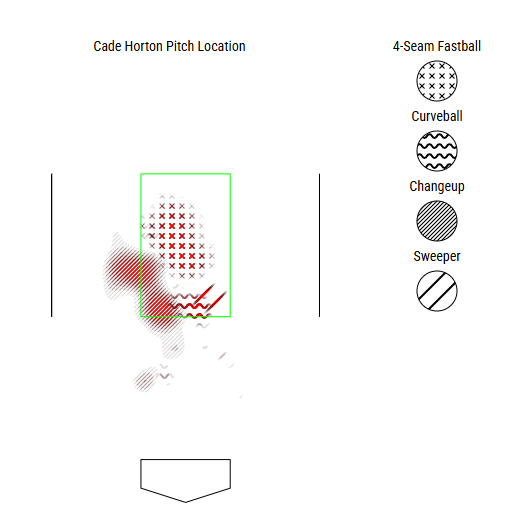
Even without good rising action on the heater, you want to elevate it more than this, to set up the changeup and the vertical breaking ball. You certainly want to attack the inner third with it, at least at times. Horton hasn’t found either the right mechanics or the conviction to do that yet.
More of that power curve or slider will be vital, for Horton to do as well against lefties as he did in 2025. It’ll certainly be necessary, if he wants to improve upon his rookie campaign and prove himself to be the ace of a World Series-caliber team. To properly utilize it, though, he needs to better disguise it out of the hand. That might mean a small amount of specialized mechanical work, but it mostly means practicing attacking the glove side with that glove-side heat, and then having enough confidence to execute a multi-dimensional plan on the mound. He has all the makings of a Cy Young Award contender. If you’re expecting him to scale those heights in 2026, though, spend the spring watching how he mixes and locates his stuff to lefty batters.