
FORT MYERS, Fla. — It’s only mid-February and free agents remain on the market, many now steeply discounted. It’s quite possible, then, that the Red Sox could still add a reliever or two or another depth piece before Opening Day.
But it’s safe to assume that most of the heavy lifting (and spending) is complete. A roster rebuild that began last fall is close to completion.
It can be said that the Red Sox took a circuitous route to get here. In the first week of October, during their post-mortem in the aftermath of a first-round elimination at the hands of the Yankees, the Red Sox identified starting pitching and power as two elements they would look to add.
They went .500 in their efforts.
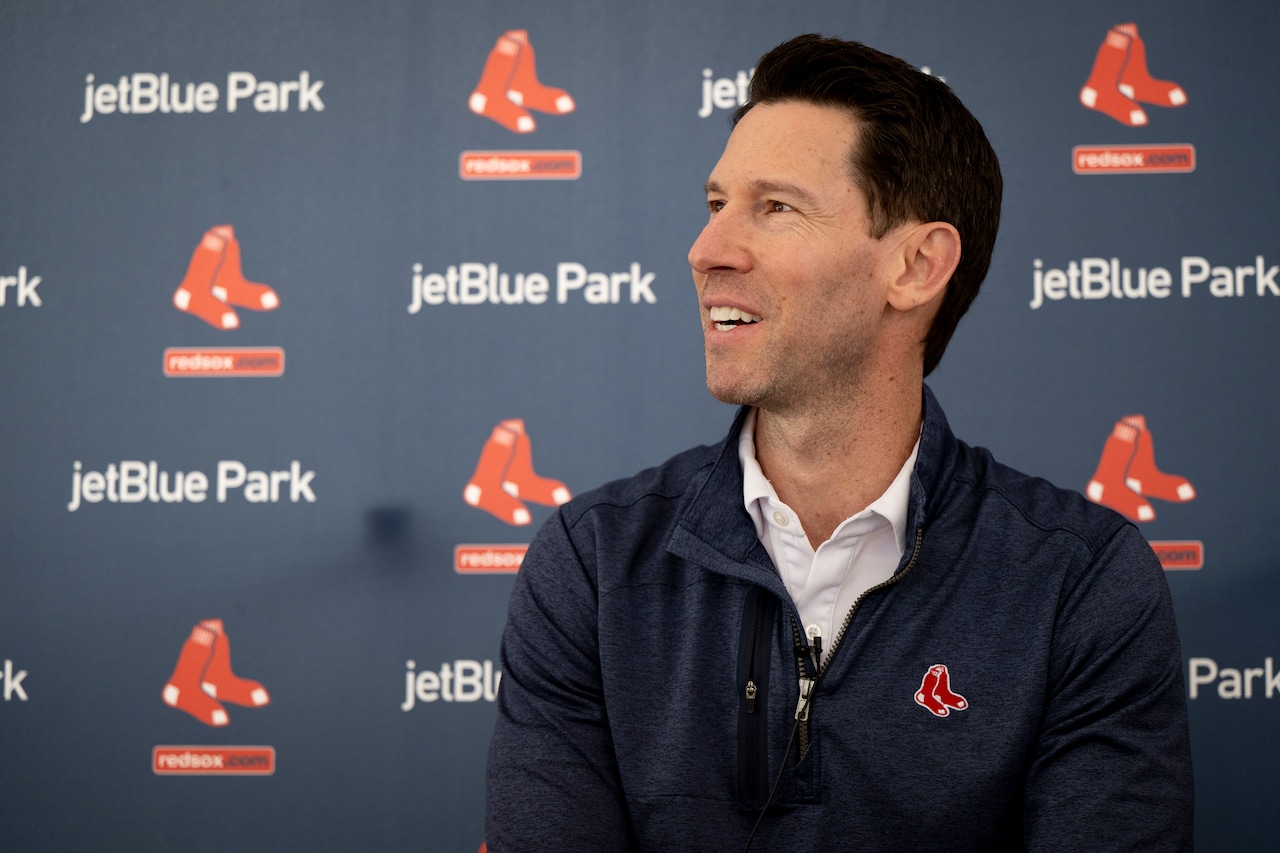
Chief baseball officer Craig Breslow added a total of three starters, something few executives can claim. Sonny Gray and Ranger Suarez, neither of whom can be classified as aces, are nonetheless All-Star-caliber starters. A third pick-up, Johan Oviedo, is, at the very least, a talented arm with remaining upside.
There’s little doubt that the rotation is improved from a year ago, especially with a return to full health for depth optons Kutter Crawford and Patrick Sondoval and the presence of elite prospects Payton Tolle and Connelly Early.
But when it came to addressing their power deficiency, the Red Sox fell far short. First baseman Willson Contreras is a solid offensive presence, but has never hit as many as 25 homers in a season while infielder Caleb Durbin is more of a bat-to-ball weapon.
On a strictly binary basis, the Red Sox lost 27 homers by not retaining Alex Bregman and Rob Refsnyder while importing 31 (20 from Contreras and 11 from Durbin).
That hardly qualifies as an offensive makeover.
Eschewing other power options on the market — the team barely bothered to compete for power sources like Pete Alonso and Kyle Schwarber — the Red Sox shifted gears after losing out on Bregman and, unable to find attractive offensive weapons remaining on the market, instead pursued a strategy that was more focused on run prevention.
Bolstering the rotation was only part of the equation; the Red Sox wisely realized that a better collection of starters wouldn’t be enough to overcome the shoddy infield defense that marked the team’s play for the last handful of seasons.
A year ago, the Red Sox led all of baseball in errors and in the American League, only three teams had a worse defensive efficiency rating (measuring the rate at which batted balls are converted into outs).
In an abrupt about-face, the Red Sox, having already acquired Contreras, a slick-fielding first baseman, moved to land two infielders in the last few weeks to better their defense.
Utility man Isiah Kiner-Falefa grades out above-average at three different infield positions while Caleb Durbin is also a plus defender at third.
That’s quite an improvement to the infield in the span of a few weeks.
“I feel like we have a more complete team than last year,” said manager Alex Cora earlier this week. “What we wanted to accomplish with this pitching staff and the type of position players we have, hopefully we can mesh and we can become the team that we want.”
But the case could be made that it came at a cost. By elevating the defense as a companion piece for boosting run prevention, did the Red Sox ignore their own lack of offensive sock?
In 2025, Boston averaged 4.85 runs per game, good enough for third in the American League. And for all the advancements in analytics, outscoring the opposition remains the most important offensive metric.
But measuring by power, the Red Sox were decidedly below-average. They finished a staggering 88 homers behind the Yankees and were ninth out of 15 teams when it came to home run totals.
One argument is that the Red Sox this season can expect more pop from young players who spent only a portion of 2025 with the big league team. Surely, Roman Anthony will far outstrip his homer total (nine) from a year ago, along with Marcelo Mayer (four).
Should Wilyer Abreu hit lefties well enough to become a more-or-less everyday player, expect his homer totals to spike some, too.
It may well be that the Red Sox’ newfound emphasis on pitching and defense will serve them well over the course fo a six-month season. Pitching and defense isn’t as prone to periodic dips and a well-balanced team can win a lot of games by 3-2 or 4-3.
“With the talent that we have,” said Cora, “we can put it together with the pitching staff and we can grind some wins with just pitching and playing (better) defense.”
The same can’t always be said for October. There’s no quicker nor more efficient offensive strike than the long ball in the postseason, and it’s surely no coincidence that teams that outhomered their opponents last fall went on to post a 29-5 record. In the previous four postseasons combined, applying the same measurement, teams who hit more homers were a combined 95-20.
Given their current makeup, the Red Sox could well be a more formidable regular season team this year and improve on their 89 wins of a year ago. But what will that get them in October, when power is the most determinative factor for playoff success?
Of course, nothing’s stopping the Red Sox from adding additional slug to the lineup at any point during the year, and especially at the trade deadline.
As they’re now constituted, the Sox would seem to be better equipped to win over 162 regular season games than they might be in facing teams with quality pitching in the postseason.
For now, they can worry about that later.
“We’re going to get evaluated based on how the season goes,” concluded Breslow, “and we understand that.”