
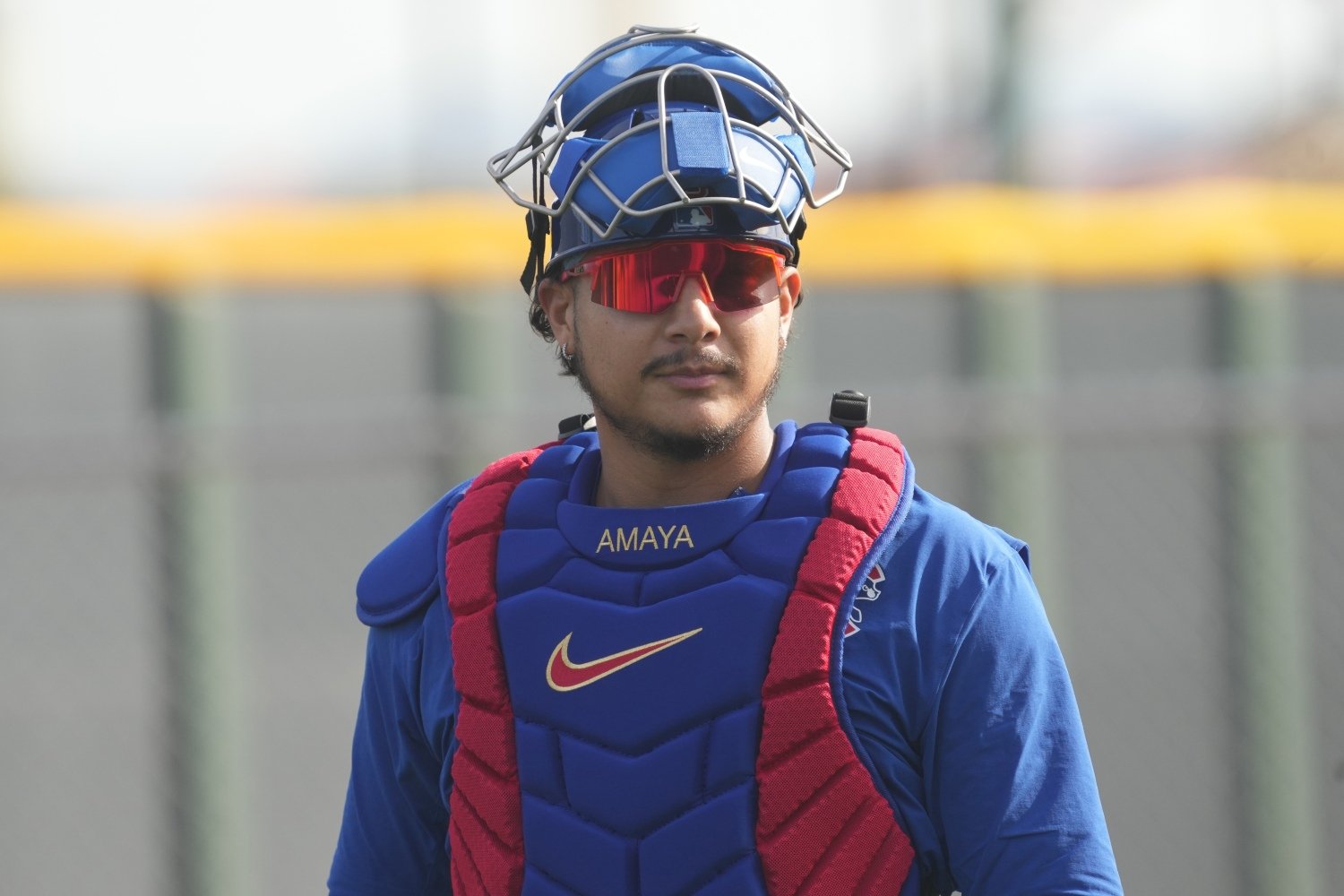
Through no fault of his own, Miguel Amaya was one of the Cubs’ most disappointing stories of 2025. In theory, he showed some very encouraging things. In reality, it’s hard to deliver much of anything across 28 games and 103 plate appearances. Injuries derailed his campaign.
Amaya hit the injured list with an oblique strain in late May. He took a long time to get back to the active roster and, upon his return, was shut down for the year when he viciously sprained his ankle in mid-August. Such disappointment stems not only from a lost year, but the expectations that were set forth as a result of the second half of the 2024 campaign.
Two years ago, Amaya got off to a brutal start. His first-half wRC+ was 59, while he hit just .211 and reached base at a paltry .266 clip. Somewhat famously, Amaya revamped his approach and his mechanics almost entirely. That yielded immediate results: a 112 wRC+, a .271 average, and a .316 OBP after the All-Star break. His slug came along with everything else; his slugging average leapt from .288 in that first half to .444 in the second. There was a great deal more elevated contact, and the overall quality of the contact improved.
Given the small sample, though, the question persisted about whether the improvements Amaya demonstrated were sustainable. It turns out, they were, or at least might have been. Amaya’s first 100 plate appearances bore a .280/.313/.505 line and a 125 wRC+. The catcher who was once considered an heir apparent to Willson Contreras behind the plate at Wrigley finally looked ready to do so, though he benefited from being in a true timeshare with Carson Kelly even while he was in the lineup.
Amaya and Kelly are set to resume their duties as the team’s catching tandem. The latter, however, was able to take advantage of Amaya’s absence. Kelly (115 wRC+) turned in his first above-average offensive season since 2021, posting the highest average of his career (.249) and his best OBP (.333) and slugging (.428) since that 2021 campaign. Such an output from a position where offense is a secondary concern could impact the timeshare early in 2026.
The assumption is that the total body of work will earn Kelly an early edge in playing time, despite the fact that he didn’t sustain the numbers posted in a torrid April. It’s a sentiment shared by FanGraphs & Baseball Prospectus, as each have Kelly at 55 percent of the playing time behind the plate and Amaya for 40 percent. FanGraphs threw each another 4 percent of the reps as the designated hitter, while BP offered percent for Kelly and none for Amaya in that role. Either way, the bigger piece of the work goes to Kelly.
That feels somewhat logical. Kelly’s coming off a fine season, even if the splits reveal that it was, perhaps, a career year. Amaya is off a pair of long-term injuries. For a couple of reasons, though, that might not turn out to be the case.
Kelly is a free agent at season’s end. Amaya is not under team control until 2030. Unless you believe in Moisés Ballesteros behind the plate, the Cubs don’t have a long-term plan at the spot beyond Amaya. Craig Counsell and his staff would love to see Amaya win more playing time than third parties project in 2026.
The offensive difference between the two players seems marginal. If the second half of 2024 and early 2025 are to be believed, Amaya may offer more consistency in the quality of contact. Kelly, meanwhile, has a more patient approach at the plate that begets a more consistent on-base presence. Both bring something to the context of the Cubs’ lineup. The opportunity for Amaya to gain some traction in establishing himself as a viable option down the line likely lies in the glove work.
The first thing we tend to look at with catchers is their ability to frame. Immediately, there’s an advantage there, in Amaya’s direction:
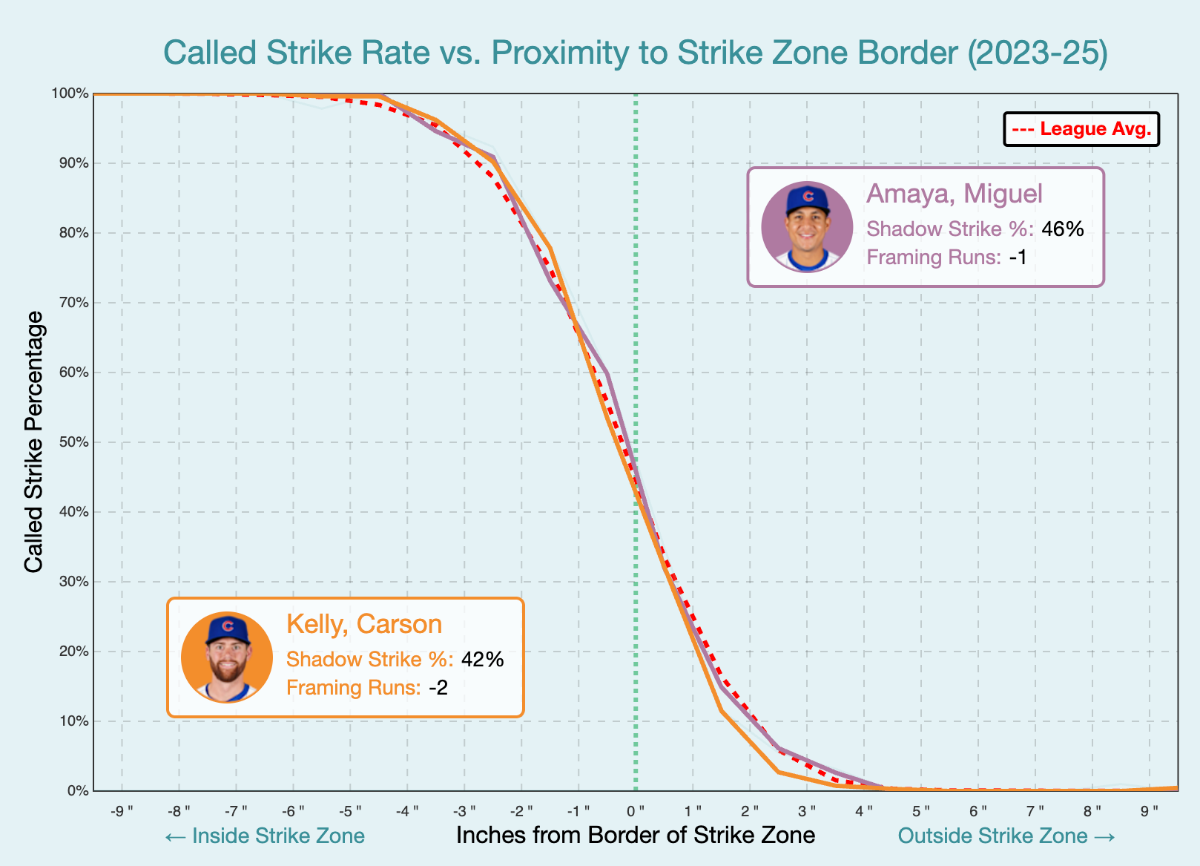
Amaya grades as a better overall framer than Kelly over the last three seasons. Obviously, the rate of called strikes goes down the farther a pitch gets from the zone. But there’s also an interesting quality to Amaya’s game that Kelly lacks:
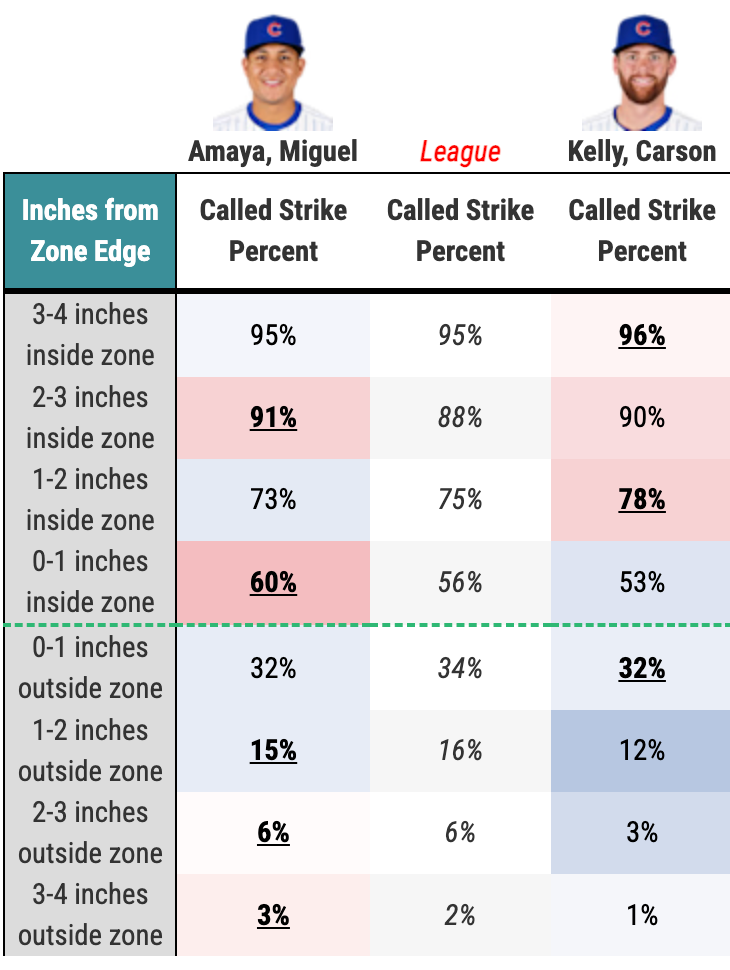
Kelly can grab a strike that is, technically, already a strike more effectively than Amaya can. Amaya, however, is more adept at grabbing a few extra strikes that fail to hit the zone. That’s the essence of framing, in a broad sense. The new ABS system could have a bearing on this, but the understanding has been that ABS will help to make good framers better and bad framers worse. The Cubs have a pair of average framers, but if we’re to believe in that sentiment on a spectrum, it could play to Amaya’s advantage.
It’s an advantage that Amaya carries into blocking, where his Blocks Above Average over the last three years totals 11 to Kelly’s seven. Where Amaya does start to cede some ground, however, is in controlling the run game. Kelly not only boasts faster pop times, but features a Caught Stealing Above Average of 13 in that span, to Amaya’s -4. Ultimately, though, this leads to a trend similar to the offensive side, where each does something well that compensates for the other’s shortcomings. Each half of the Cubs’ duo behind the plate complements the other. That just doesn’t answer the question of how Amaya emerges as a long-term starter out of his time working with Kelly.
The easy answer is that he might not have to. Kelly’s an impending free agent. There may be an organic changing-of-the-guard at the end of 2026 that leads to Amaya’s graduation into the bulk of the playing time, just by staying the course. In a logistical sense, that concept of “staying the course” might be the ticket for Amaya to start to shift the playing time distribution early.
It’s easy to forget about Kelly’s struggles for the better part of last year’s second half. It’s easier still to forget what Amaya turned in on the stat sheet prior to his oblique injury. Factor in the areas where Amaya has the defensive advantages, and it isn’t difficult to imagine a world where his own skill set does the work. Last year’s volume for Kelly may play to his advantage early (as evidenced by the projections liking him for more playing time in 2026), but there’s very much a path for Amaya to do the things he does well in a small sample early on, forcing his way into a more even distribution as it wears on.