
SARASOTA, Fla. — Chris Bassitt’s expected signing added both quality and experience to the Orioles’ rotation, and more than likely completed the club’s major roster-building efforts.
Yes, the roster, and not just the rotation. It’s natural to focus on the latter, given that the major work on the hitting side was finished at the winter meetings and the biggest additions to pitching occurred before the end of 2025.
There will be six months of baseball to determine if the club spent enough, or well enough, or on the right things.
The bottom line is this homegrown returning group now has a lot of help, and any alternate universe where their resources were allocated differently would undoubtedly just shift the scrutiny to other parts of the roster.
President of baseball operations Mike Elias made nine additions who will likely be on the opening day roster: hitters Pete Alonso and Taylor Ward; starters Shane Baz, Zach Eflin and Bassitt; closer Ryan Helsley and reliever Andrew Kittredge; plus bench pieces Leody Taveras and Blaze Alexander. Those players will make over $98 million collectively this year, and arrived as part of an overall free agent spending outlay of over $200 million, which cost the club former top prospect Grayson Rodriguez, reliever Kade Strowd, six well-regarded prospects and a draft pick.
No team would ever turn their nose up at one of the best starting pitchers in free agency when given the chance to sign him, especially not one whose owner said the club was operating without financial constraints.
Putting that aside, the starting rotation was just one segment of the roster that let it down last year and needed an overhaul. Kyle Bradish looked better than ever, and Trevor Rogers was a solitary bright spot on the mound. Dean Kremer continues to be Dean Kremer, and I say that endearingly. But too many starts were made last year by pitchers who simply weren’t good enough, and now those starts will be taken by Baz, a healthy Eflin and Bassitt, rather than Charlie Morton, Tomoyuki Sugano or rookies trying to find their major league footing.
If the $28.5 million going to Eflin and Bassitt were paying one pitcher’s salary, the turmoil that befell the Orioles’ rotation last year would come back into play if things go badly for the returners.
After all, that’s the fear, right? The need for a free agent ace is predicated on the idea that the pitchers the Orioles expect to fill those top few spots end up hurt or underperforming, and in that scenario they need a pitcher who is proven to do what Rogers did for the 2025 Orioles: pitch like an ace and give the team a chance to win every fifth day.
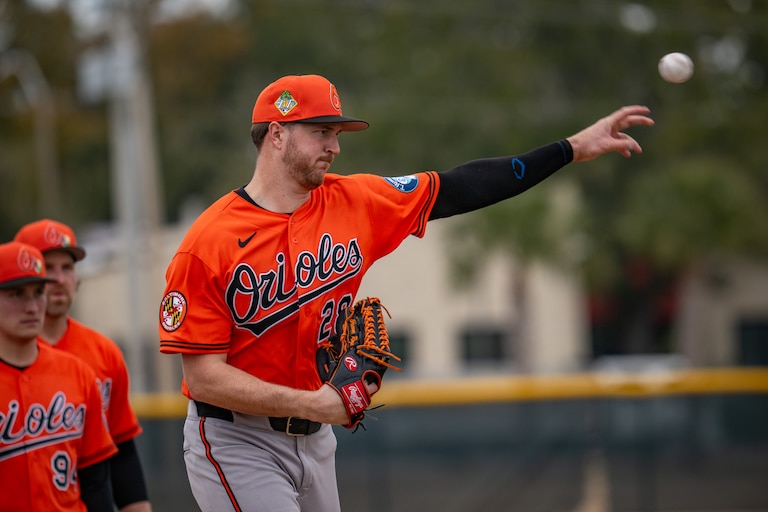 Orioles pitcher Trevor Rogers practices pick-off attempts on the first day of spring training Wednesday. (Jerry Jackson/The Banner)
For a variety of reasons, both Rogers and Bradish being great in 24 combined starts — amounting to one fewer start per month than a workhorse ace would make — did not stop the Orioles from being so bad that manager Brandon Hyde was fired, the coaching staff was overhauled, and the front office had to do a bunch of things they had never done before. The offense was lousy for most of the year, too.
And that needed to be addressed. Remember, so many of the Orioles’ homegrown hitters were arrow-down offensively in the second half of 2024, and the response was to swap Anthony Santander for Tyler O’Neill and run it back. Many spent long stints on the injured list, and all who didn’t were not themselves for most of the season.
You expect health, a fresh perspective from hitting coaches Dustin Lind and Brady North, and a basic return to the mean to improve things with that group. But you can’t count on that to fully restore this once-formidable lineup’s production.
That’s where Alonso and Ward come in, and if the Orioles’ marquee acquisition was a pitcher instead of Alonso, the same level of uncertainty and distrust would be surrounding the lineup instead.
It’s a line of thinking that only just occurred to me, because it’s been two months now since Alonso signed and it already feels like he’s been on this team forever. And to the extent that needing to choose how to allocate resources means there’s a finite amount of them, fair play. It does.
So that, on a basic level, is why the Orioles solved one of their offseason problems with one $35 million per year free agent rather than all of their problems with multiple. There was just a lot more to do than sign an ace in free agency.
This team lost 92 games last year. The scale of the roster additions reflects that, and anything short of this amount of upgrades might have made one or two big ones immaterial.