
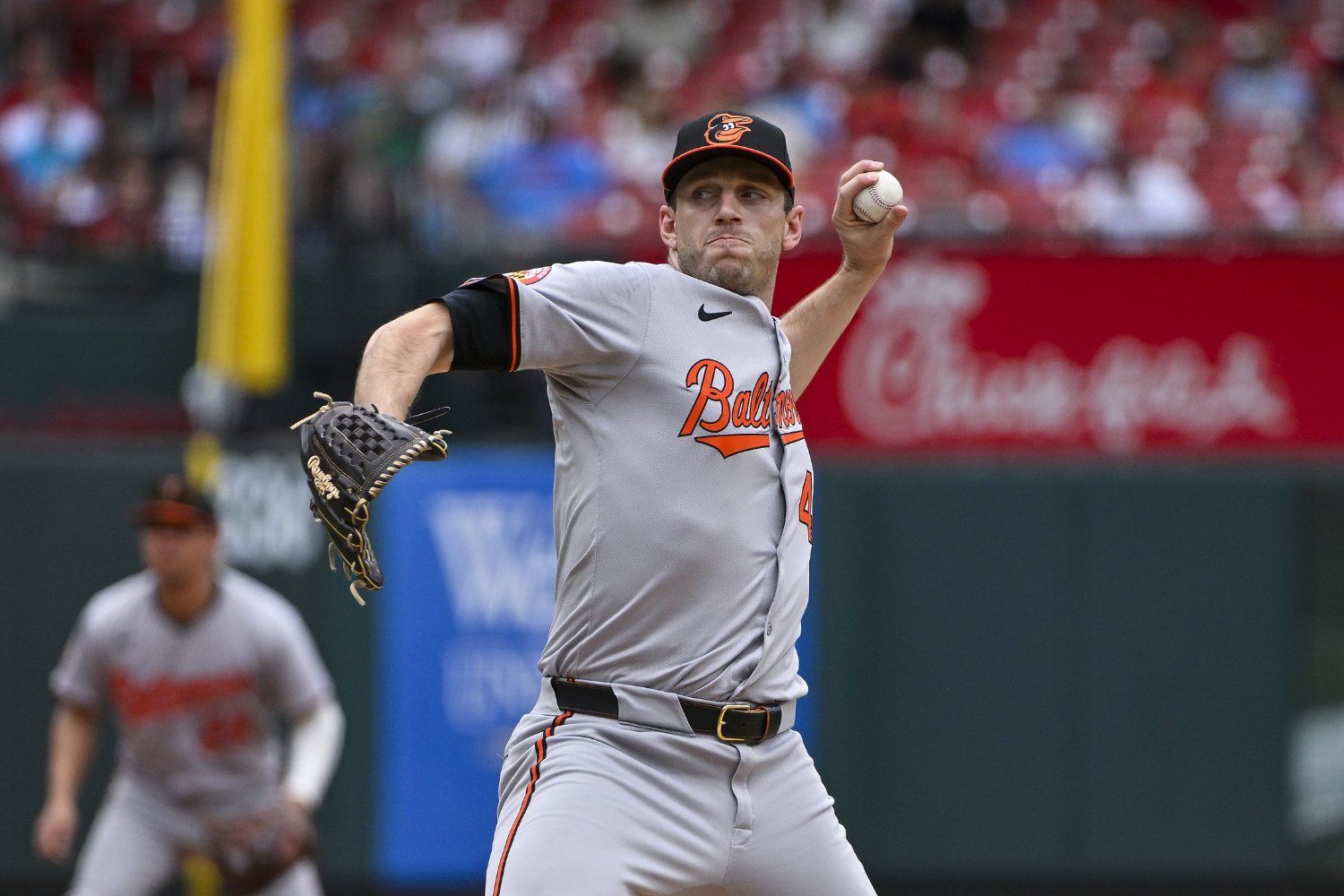
On Friday, the Kansas City Royals announced via social media that they had signed left-handed free-agent pitcher John Means to a two-year Minor League deal.
Means is a local Gardner, Kansas, product who was an 11th-round pick by the Baltimore Orioles in the 2014 MLB Draft. The 32-year-old found success early on in his career as he made the All-Star team in 2019 with the Orioles. That season, he posted a 3.60 ERA, 1.14 WHIP, and 3.2 fWAR in 155 IP. He had another solid season in 2021, posting a 3.62 ERA, 1.03 WHIP, and 2.5 fWAR in 146.2 IP. Unfortunately, since then, he’s struggled to stay healthy.
Since 2022, he’s only made 10 starts and pitched 52.1 innings due to various injuries. His last MLB innings came in 2024 with the Orioles, as he pitched 20.2 innings and posted a 2.61 ERA. While he demonstrated excellent control (17.5% K-BB%), his stuff was questionable that year, and he gave up a lot of hard contact, as illustrated by his Statcast percentile via TJ Stats.
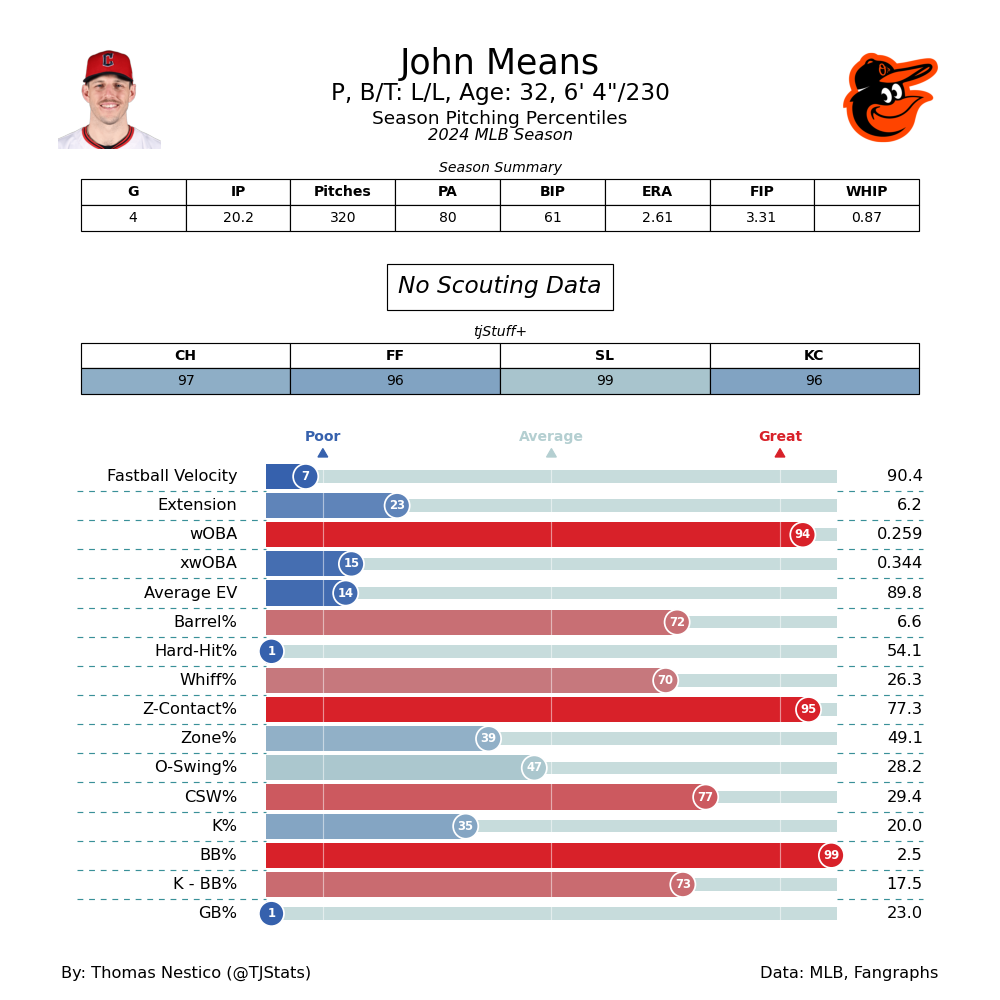
Means did a good job of limiting barrels, as exhibited by his 6.6% barrel rate allowed, which ranked in the 72nd percentile. However, his average exit velocity allowed ranked in the 14th percentile, and his hard-hit rate ranked in the first percentile. Thus, it’s not surprising that his 3.31 FIP was much higher than his ERA in 2024.
When healthy, the Gardner product offers some intriguing aspects as a pitcher. In addition to limiting walks (career 4.9% walk rate), he has demonstrated an excellent ability to generate whiffs and strikes. He has a career swinging-strike rate of 10.9%, and in 2024, he posted a 29.4% CSW%, ranking in the 77th percentile. While he doesn’t generate a ton of groundballs (32.3% career GB%), he seems to be able to limit barrels well enough to avoid serious damage.
However, health has been an issue for Means in his career. He had Tommy John surgery in 2024, and the Orioles opted to let him leave in free agency as a result. The Guardians picked him up last year on a one-year deal with a club option. However, he only pitched 26.2 innings with the Triple-A Columbus Clippers and posted a 6.08 ERA in that sample. The stuff, strike, and xwOABCON metrics didn’t quite impress either, which explains why the Guardians didn’t exercise his club option.
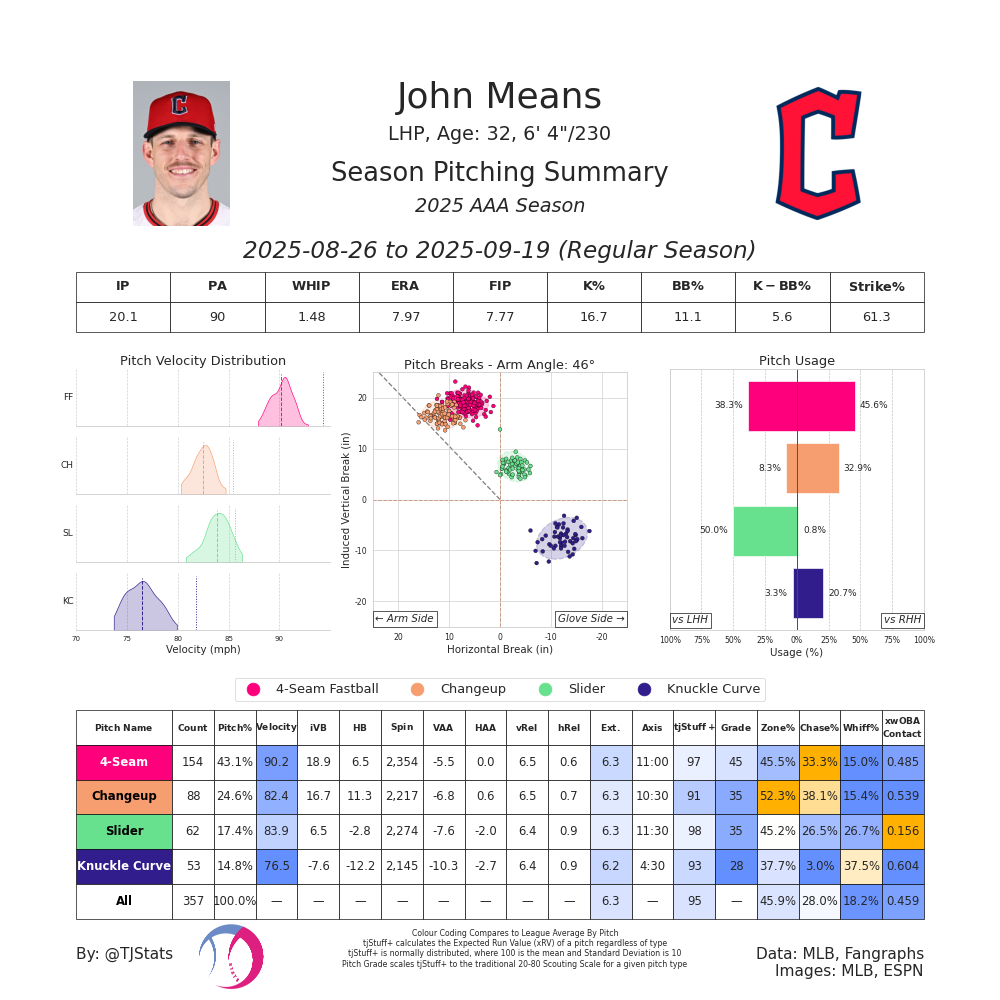
Means not only sported a sub-100 TJ Stuff+, but he also had below-average marks in zone rate (45.9%), chase% (28%), whiff% (18.2%), and xwOBACON (.459). At his age, it seems likely that Means may be nearing the end of his career, barring a dramatic turnaround. Furthermore, his Achilles injury this December, which should keep him out all of 2026, only makes that possibility more likely.
And yet, the Royals were willing to take a chance on him this offseason, offering him that two-year Minor League deal.
Why Did the Royals Pick Up Means?
This deal feels similar to the Kyle Wright acquisition with Atlanta back in 2024 (which also resulted in them acquiring reliever Nick Anderson, who was released mid-season). The Royals picked up Wright, knowing he was going to miss all of 2024, with the hope that he could get healthy and be a factor in the rotation and/or bullpen in 2025.
Unfortunately, that didn’t happen for Wright, as he failed to throw a pitch for the Royals in his two-year tenure. Furthermore, the metrics for the Minors were not only limited (eight starts and 23 IP), but also mediocre (5.48 ERA between Omaha and Northwest Arkansas). The TJ Stats Summary from Omaha wasn’t pretty either, as illustrated below.
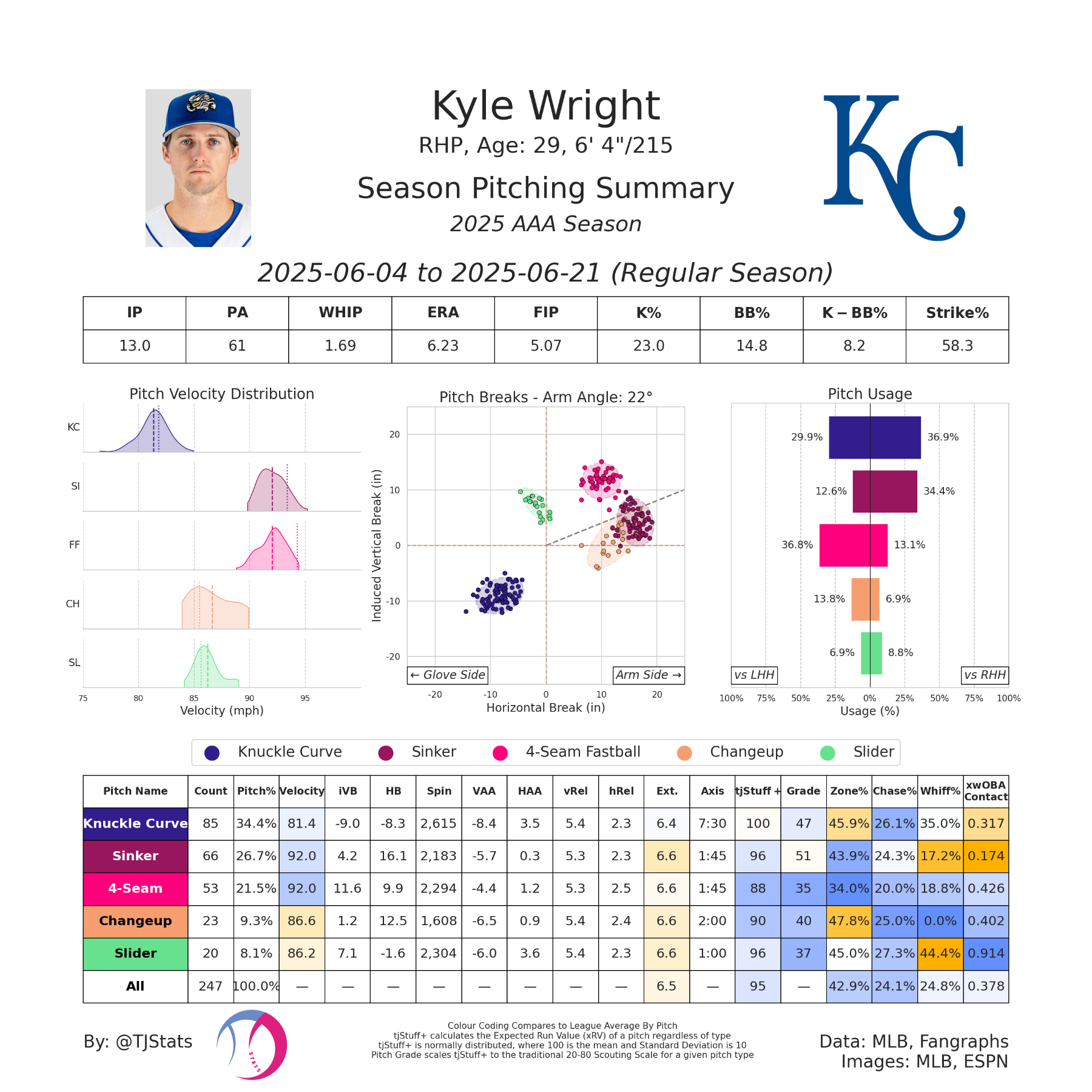
Wright’s profile is very similar to Means’ in Columbus last year, especially in the TJ Stuff+ and zone rate categories. Thus, why would the Royals do this again to themselves with a once-promising but oft-injured pitcher?
First off, there’s probably some local allure in Means being a Kansas high school product. The Royals have seemed to favor acquiring local products, not only in terms of talent (Alex Lange and Connor Kaiser), but also coaches (Connor Dawson). While Means is certainly a project, it’s easier to invest in it when he’s a local guy the fanbase can rally behind.
Another reason why Kansas City may be intrigued by Means is that he has shown the batted-ball profile to limit walks and barrels over his career. He has a career barrel rate of 8.1%, and he’s allowed a barrel rate over 10% in a single season only once (2021). Having that ability should transition well to Kauffman Stadium, even with the changes to the ballpark’s dimensions, starting in 2026.
Here’s a look at his spray chart from 2024, modified to Kauffman Stadium, and it seems like he would still be successful when it comes to how his batted balls would have fared in Kansas City.
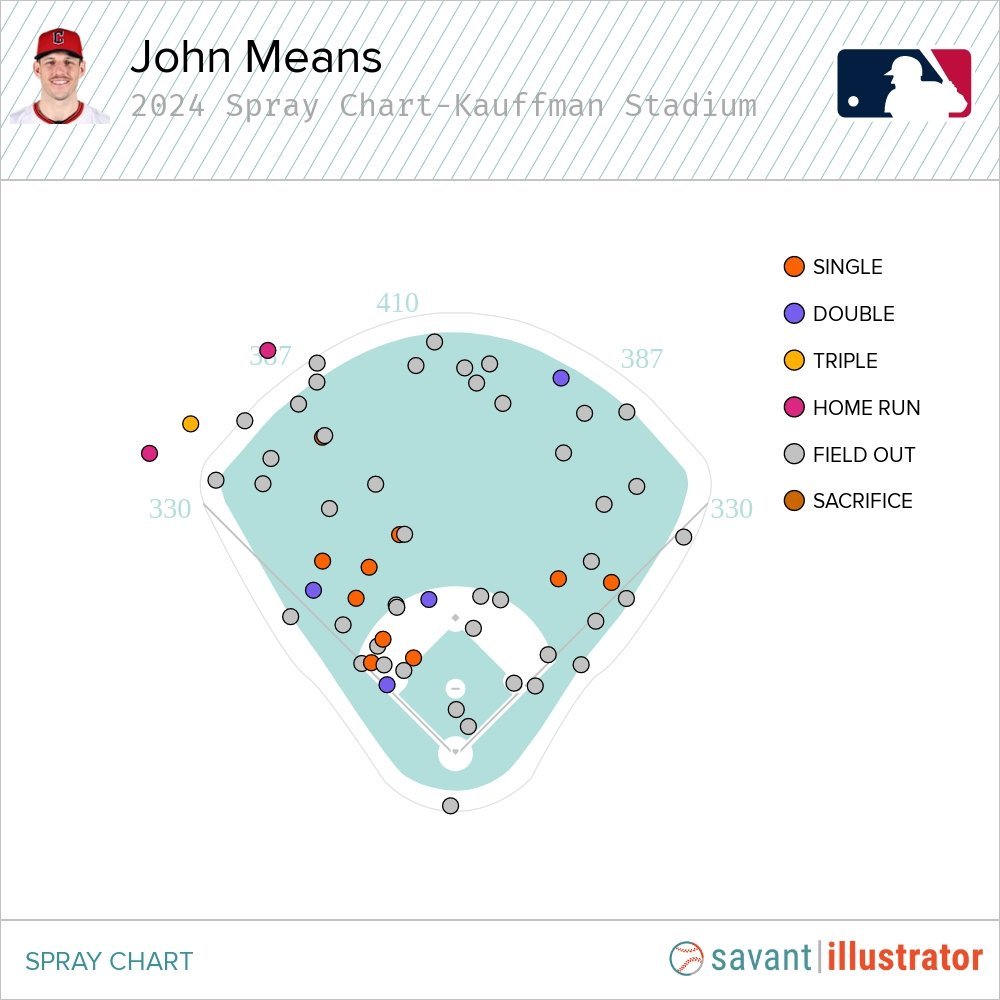
Thus, if he’s fully recovered, it’s possible Means could find a resurgence, especially if the Royals’ pitching coaches can help him refine his pitch quality a bit or add a pitch or two, which has been a calling card of this coaching staff. Seth Lugo and Michael Wacha have found strong career resurgences in Kansas City, as has Michael Lorenzen, who parlayed his two solid seasons there into a new deal in Colorado.
Perhaps, if healthy, Means could be another Royals pitching success story, who could give them the production they need in the middle of the rotation in 2027, which could be thin with Kris Bubic likely gone by then (via midseason trade or free agency) and Alec Marsh likely on the shelf for another season. If he’s not healthy, he could be another Wright, whose career in Kansas City never gets off the ground.
For a two-year Minor League deal, Means is worth taking a chance on.