
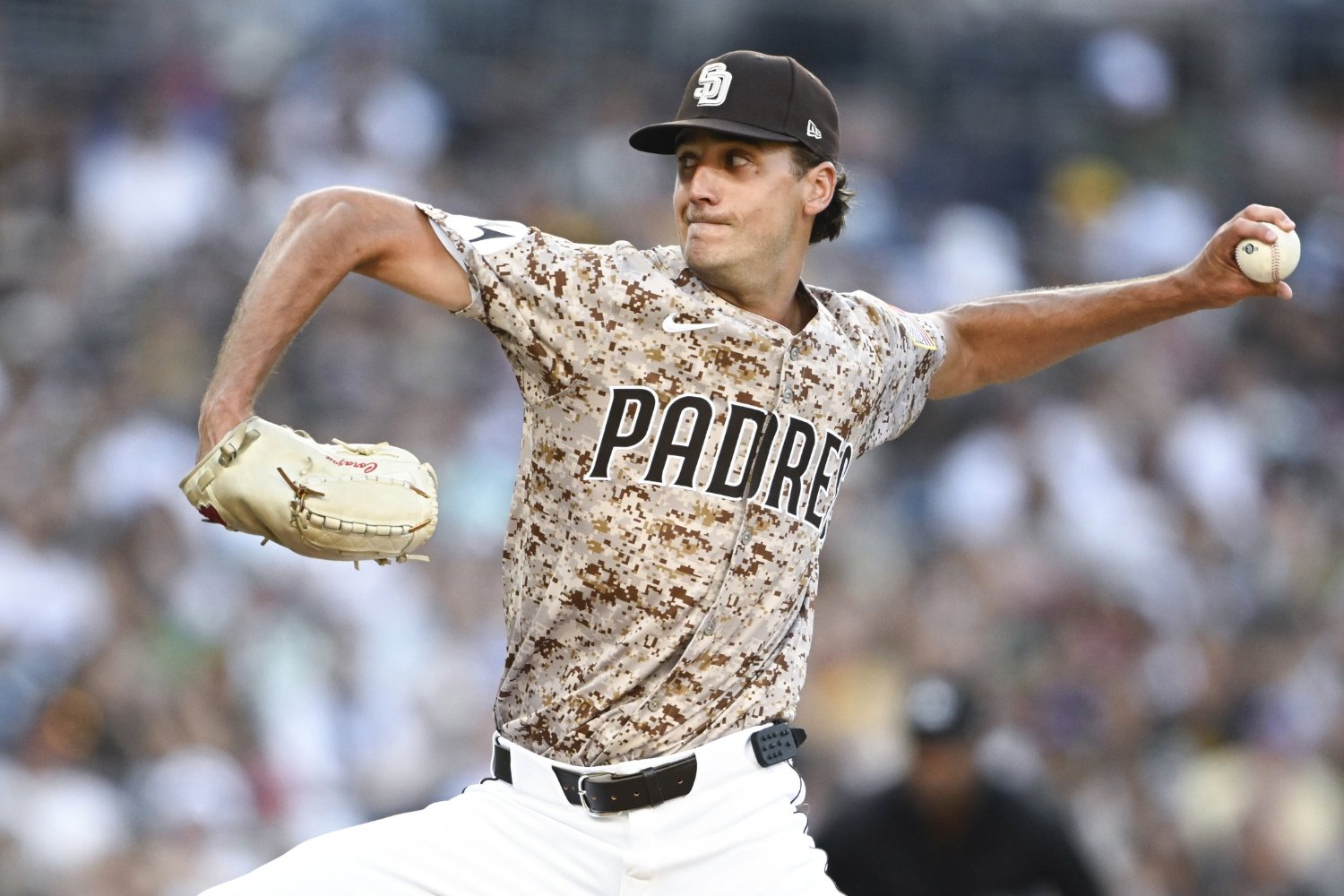
When the San Diego Padres signed Kyle Hart upon his return from the KBO ahead of 2025, it was a move that wasn’t met with a particular degree of fanfare. The former Boston Red Sox draftee had only appeared in 11 big league innings in the years since his 2016 selection, and the results were relatively uninspiring across his minor-league journey. Nevertheless, the team needed depth on the bump and it arrived in the form of Hart. It’s that very scenario that led to him being back in America’s Finest City ahead of 2026.
Hart was able to earn a rotation spot out of camp last year. Save for a six-innings-no-runs-allowed performance against Colorado in April, however, he struggled to maintain his grip on such a role. Five of Hart’s six starts came before the end of the season’s first month, and he went on to make just 20 appearances overall. The results therein were not terrific. He finished with a 5.86 ERA and 5.18 FIP in a year that was indicative of negative value (-0.2 fWAR). He struggled to prevent home runs, with a 13.0 percent rate of flyballs that went over the outfield wall, while neither his strikeout or walk numbers – 20.7 and 7.3 percent, respectively – compensated for that effectively.
Even amid such struggles, though, Hart earned a second contract in San Diego. He agreed to a one-year deal with a club option for 2027. The Padres knew they’d need depth, and Hart will provide it. How much time he actually logs at the top level, however, remains unclear.
Kyle Hart’s Stuff
Without much velocity of which to speak, Hart is a sweeper-driven pitcher; he threw it 33 percent of the time last season. The pitch was thrown far more to left-handed hitters (43 percent) than righties (29 percent), though. For the latter handedness, he incorporated a changeup at 20 percent of the time (a pitch he threw just a handful of times against lefties). There’s a sinker in the mix as well, with an even 22 percent being thrown to hitters standing in either box.
The sweeper and sinker each have their benefits. The sweeper drew whiffs nearly 29 percent of the time last year, and both pitches pinned down opponents’ slugging to under .300. It’s when he begins to graduate outside of his two primary pitches that things start to become problematic. His change, in particular, was touched for a .625 slugging percentage in 2025.
Part of Hart’s struggle is that, regardless of pitch, he works high:

There’s decent horizontal movement on his two primary pitches. He gets 14.1 inches of horizontal break to his glove side with the sweeper and 16.7 inches of run to his arm side with the sinker. There’s very little vertical drop to speak of across the board, though, which represents a problem for a pitcher who doesn’t work with much velocity. Only his minimally used splitter garners anything in terms of vertical drop.
In terms of run value, Hart does get positive results out of each of the sweeper (5) and sinker (2). There’s enough swing-and-miss with the former and effective groundball tendencies wrought by the latter to allow him to work within a framework that can find some success. The issue is when he starts to move outside of his comfort zone with the change and the rest of the crew. None of his other pitches bear a positive run value, with the changeup sitting at -4 on its own.
Kyle Hart’s Arsenal

There’s an argument to be made that Hart should shift his focus toward more of a two-pitch situation. The results are evident in the sweeper and sinker being effective pitches for him, somewhat courtesy of a lower arm angle. There’s a location factor that at least mildly explains his success as well. Not that Hart’s command is elite, but he’s at least able to utilize those pitches to seek the results that each pitch should, theoretically, see. Such is not the case with the others in his mix. With the changeup, there is an intriguing movement profile, but the results haven’t been remotely steady enough to consider it a factor quite yet.
Such an argument exists in a world where Hart ends up as more of a one-inning reliever than even as a long man, let alone a starter. It’s very difficult to find success in volume with only two effective pitches. Unless we see some evolution in the arsenal, though, that may very well be the role for which he’s best-suited.
What Should Kyle Hart’s Role Be In 2026?
Even with a Padres rotation that sits as shallow as this group ahead of the upcoming season, it’d be really difficult to justify a rotation spot out of the gate for Kyle Hart. You’d even be hard-pressed to find an argument that he’s destined for the bullpen, considering where the rest of the group stands. The relief corps is where the Padres actually have some depth with which to work.
Given that, it would appear that Hart’s best shot at regular work within the organization will, once again, come with El Paso. It would at least give him an opportunity to hone the arsenal and discover some command of the secondaries. If he can do that, then there is a path toward contributions at the top level as a backend starter. In the meantime, however, the floor remains simply too low to justify a spot in either the rotation or the bullpen, regardless of how thin the former looks.
Think you could write an article like this one? We’re looking for additional contributors, and we pay for all our content! Please click here, fill out the form, and someone will reply with more information.