
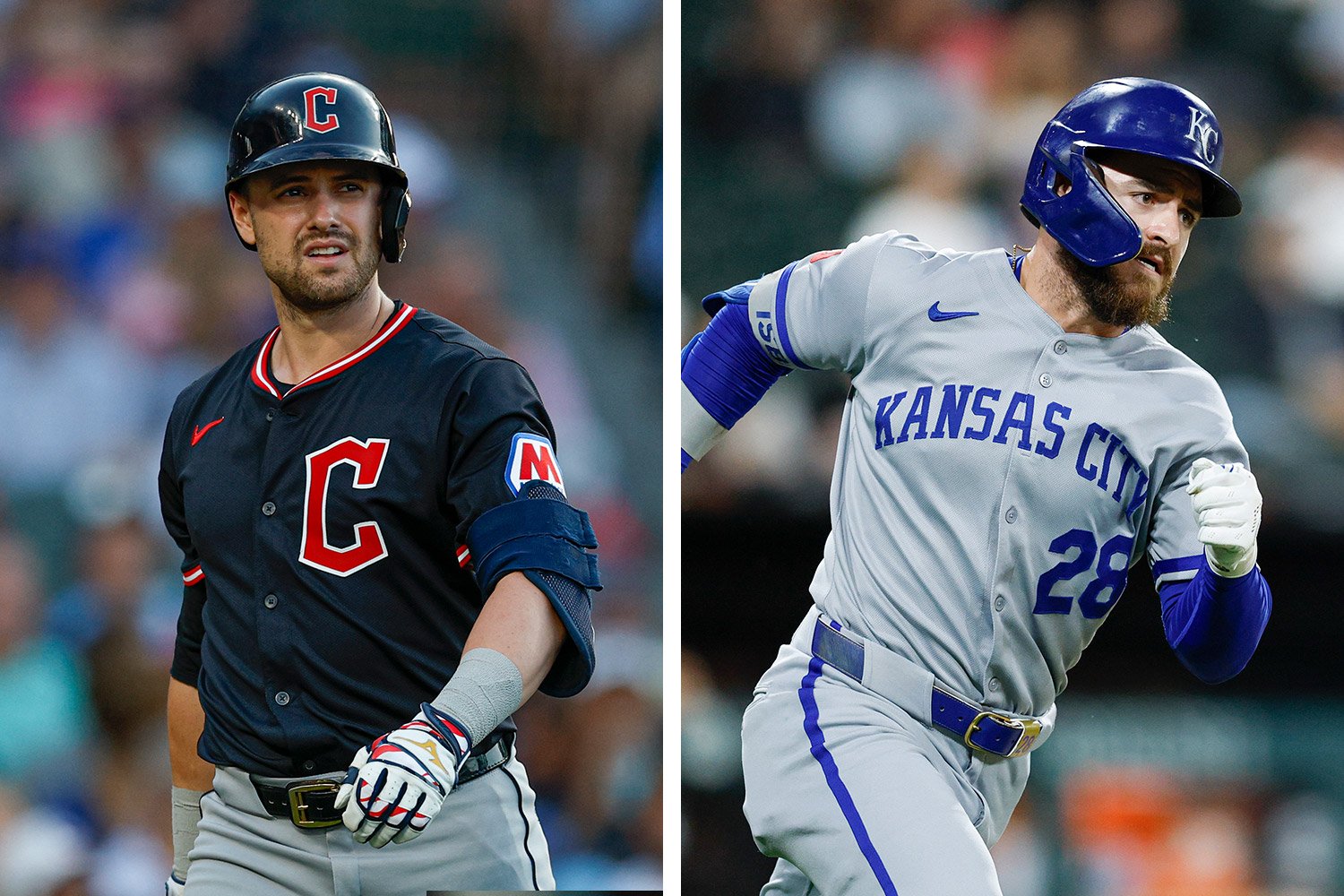
The Kansas City Royals are no longer a rebuilding curiosity. They are a legitimate team on the rise, powered by a deep collection of young talent, a rotation that doesn’t get enough national credit, and a true franchise cornerstone in Bobby Witt Jr. Most positions feel settled or at least promising. Center field, however, remains the loose floorboard in an otherwise sturdy house.
Kyle Isbel handled the bulk of the work there in 2025, and if defense were the only requirement, the job would already be filled. His glove is elite. The problem is that his bat has become the offensive equivalent of bringing a butter knife to a sword fight. That reality likely explains why the Royals signed Lane Thomas to a one-year, $5.25 million deal, giving manager Matt Quatraro a legitimate alternative.
So who should be the Royals’ center fielder: Isbel or Thomas?
The glove that changes games
Isbel’s defensive value is not subtle. In 1,032 innings in center field last year, he posted +9 Defensive Runs Saved and +12 Outs Above Average, ranking fourth and third among American League center fielders in those categories. That’s not just good; that’s game-altering. Balls that look destined for the gap die quietly in his glove, and pitchers get outs they probably already chalked up as hits.
The offensive side, though, keeps dragging the conversation back to square one. Isbel finished last season with a 79 wRC+, his fourth straight year under 83, and his career mark sits at 78. For context, league average is 100, and Isbel hasn’t sniffed it at any point in his big-league career.
What makes it more frustrating is the contrast with his minor league track record. He was a .808 OPS hitter on the farm, but through 496 MLB games, that number has cratered to .653. His Statcast page is flooded with blue, the kind that signals weak contact and limited offensive upside:
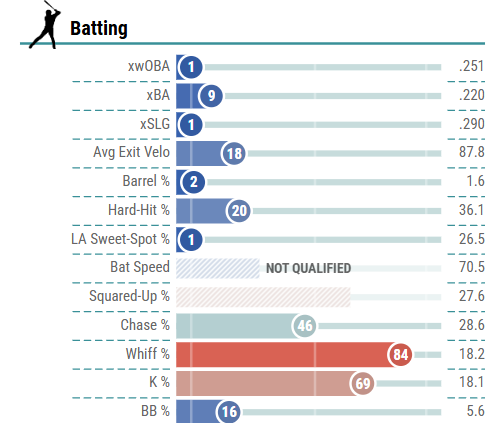
At almost 29 years old, the data suggests this is simply who he is. If he were even a league-average hitter, the Royals wouldn’t be debating this. He isn’t, but his glove still gives him a way to impact games.
The upside gamble
Thomas brings a very different profile. When healthy and locked in, he looks like the kind of player who can tilt a lineup. He has already proven he can clear 20 home runs, blasting 28 for Washington in 2023, and he showed his legs are just as dangerous by stealing 32 bases in 2024. That combination of power and speed is something Kansas City simply doesn’t get from Isbel.
Last season, though, was a nightmare. A bone bruise in his right wrist was only the beginning. Plantar fasciitis followed, limiting him to just 39 games and a brutal 48 wRC+ with Cleveland. Thomas eventually underwent surgery in late September, but he is expected to be healthy enough to compete for the center field job this spring.
Defense is where the gap widens. Thomas doesn’t come close to Isbel with the glove. Even accounting for small samples, the numbers are rough. He posted -1 DRS and -2 OAA last year, and if you go back to the last season where he logged significant innings in the outfield, 2024, the picture gets uglier: -13 DRS and -6 OAA across 1,065 ⅔ innings. Those struggles weren’t limited to center field either; the corners didn’t treat him kindly, either.
A matchup-based answer
This doesn’t have to be an either-or decision. Isbel hits left-handed and owns an 82 career wRC+ against right-handed pitching, compared to a miserable 64 against lefties. Thomas, on the other hand, offers an 84 wRC+ versus right-handers and a 135 mark when facing southpaws.
Against right-handed pitching, the two are essentially the same hitter by wRC+. That makes Isbel the logical choice, because his defense actively helps the pitching staff. When a left-hander is on the mound, Thomas should get the nod. In those situations, he turns center field into a lineup advantage instead of a dead spot, giving the Royals a well-above-average bat at a premium defensive position without sacrificing much.