

Often times in employment matching situations, the early interviewees are at a disadvantage. When many candidates are potential suitors, the first to attempt to sell themselves for the role have to stand out the most. That was the case this winter with Chris Paddack and the Marlins.
“They were the first ones to call,” Paddack said Friday morning as he stepped foot in the Marlins’ newly renovated Jupiter Academy.
The last time Paddack was in Jupiter, he was a bright-eyed 18 year old, recently graduated from his central Texas high school. Now 30, Paddack is embarking on his eighth MLB season. It’s a full-circle moment for the 2015 draftee, one he admittedly didn’t think would ever come.
“When you’re a young kid out of high school, my eyes were on the prize of getting to the big leagues. You think that’s the team you’re going to ride with until your career is over. Very few times does that happen nowadays,” Paddack reflected. “It really is a full-circle moment for me. I go back to my drive down from Texas. I just was like, ‘This is a cool opportunity to be back with the team that gave me that first chance as a young kid.’ The fact that I get to put a Marlins jersey on and show the city of Miami why they drafted me is a pretty surreal moment.”
Paddack rejoins Miami not only with a different mindset, but as a much more complete pitcher. As a high schooler, Paddack didn’t need more than his fastball and changeup to be dominant. During his MLB career, he’s developed a curveball, slider and two-seamer. Most recently, he added a cutter. Last season, Paddack, a self-described north-and-south guy, used a whopping six different pitches.
“You realize really fast that you’re not in high school anymore. I need some pitches that kind of go in different routes, different directions,” Paddack said of his pitch usage. “You look at some of the elite pitchers, they’re always changing their arsenal, always mixing in new pitches, learning different grips from different guys, picking their brains. At the end of the day, we’re the only ones that can manipulate where the baseball goes, finding those grips and tricks and techniques that work for the individual.”
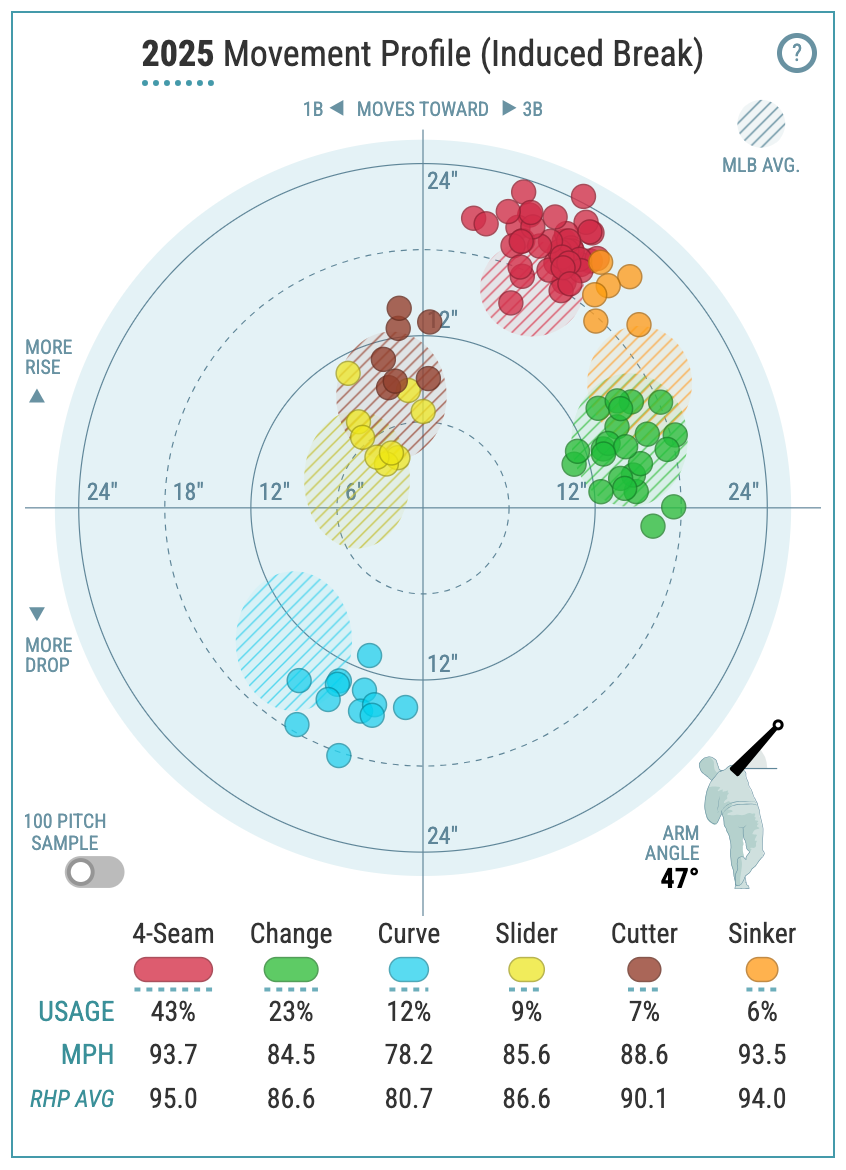
In terms of his selection, Paddack doesn’t stick to any specific game plan—he goes off of his feel for the hitter and the zone at-bat to at-bat.
“That’s the beauty that I’ve learned over the years is you can get guys out in different ways,” Paddack said. “Especially with how good the hitters are, with how much data they have on us, we have to be able to change up that game plan or that approach that second or third time through.”
One thing will always be a priority for Paddack: locating in or around the strike zone, changing eye levels, a trait that before last season, allowed him to work deeper into games and post respectable FIPs. Wanting to challenge hitters is so much a part of Paddack’s game he notes that he may have gotten overzealous with it recently.
“Sometimes I overly compete in the zone and it costs me some base hits with two strikes, or a runner’s on second and third and I’m trying to slow the game down and get out of that jam, and the next thing I know I’m putting up a crooked number and it happened very fast,” Paddack said. “I think over the course of the last couple of years, one, I’ve stayed healthy, and two, just being able to learn to get out of the zone when I need to. Not necessarily being fine because I throw strikes. That’s what I do. That’s why I’m a starter. It’s being able to expand out of the zone when I need to.”
Paddack is confident recent rule changes as well as recent developments to the Marlins’ scientific and analytical approach will be key cogs for him in getting back to striking a proper balance.
“With the new ABS (automated ball-strike) system, I really think it’s going to benefit me personally with my pitch design, how my pitches work at the top of the zone and how my changeup kind of goes underneath,” Paddack noted. “I really think it’s gonna help me get some calls that I might have not gotten in years prior, or just making hitters realize I know how to command the baseball top, bottom, in and out. That might give me some more chases if I do leave the zone on purpose.”
Manager Clayton McCullough is excited about what Paddack can do for his pitching staff. While the veteran will have mostly younger competition nipping at his heels for the chance at a rotation spot this spring, McCullough noted Friday that he expects the righty to be an every fifth day guy when the season opens.
“We think we can really help Chris. We think we can get a lot of his arsenal back into a place where he can perform more like he’s capable of,” McCullough said. “He’s a premium strike-thrower. He certainly has started a lot of games in the major leagues. It gives us another stable arm, we believe, that can fit right into our rotation and also we believe the upside to help him perform very well in 2026.”
Paddack isn’t a flashy arm. He isn’t going to light up radar guns and he probably won’t be a guy who racks up a ton of strikeouts. But he is a veteran presence who has supreme confidence and a great pitcher’s IQ. With the understanding that complacency is never acceptable and keeping up with the game is a necessity, he is looking to cement his strengths and redefine his weaknesses in his return to Miami. With a $4 million buy-in from the front office behind him, Paddack is going to get a chance to return to and stick as a starter as the Marlins’ competitive window opens. This landing spot for Paddack at this point in his career couldn’t be much better.
The expectation is that Paddack is going to get back into his throwing program and start throwing bullpens early next week.