
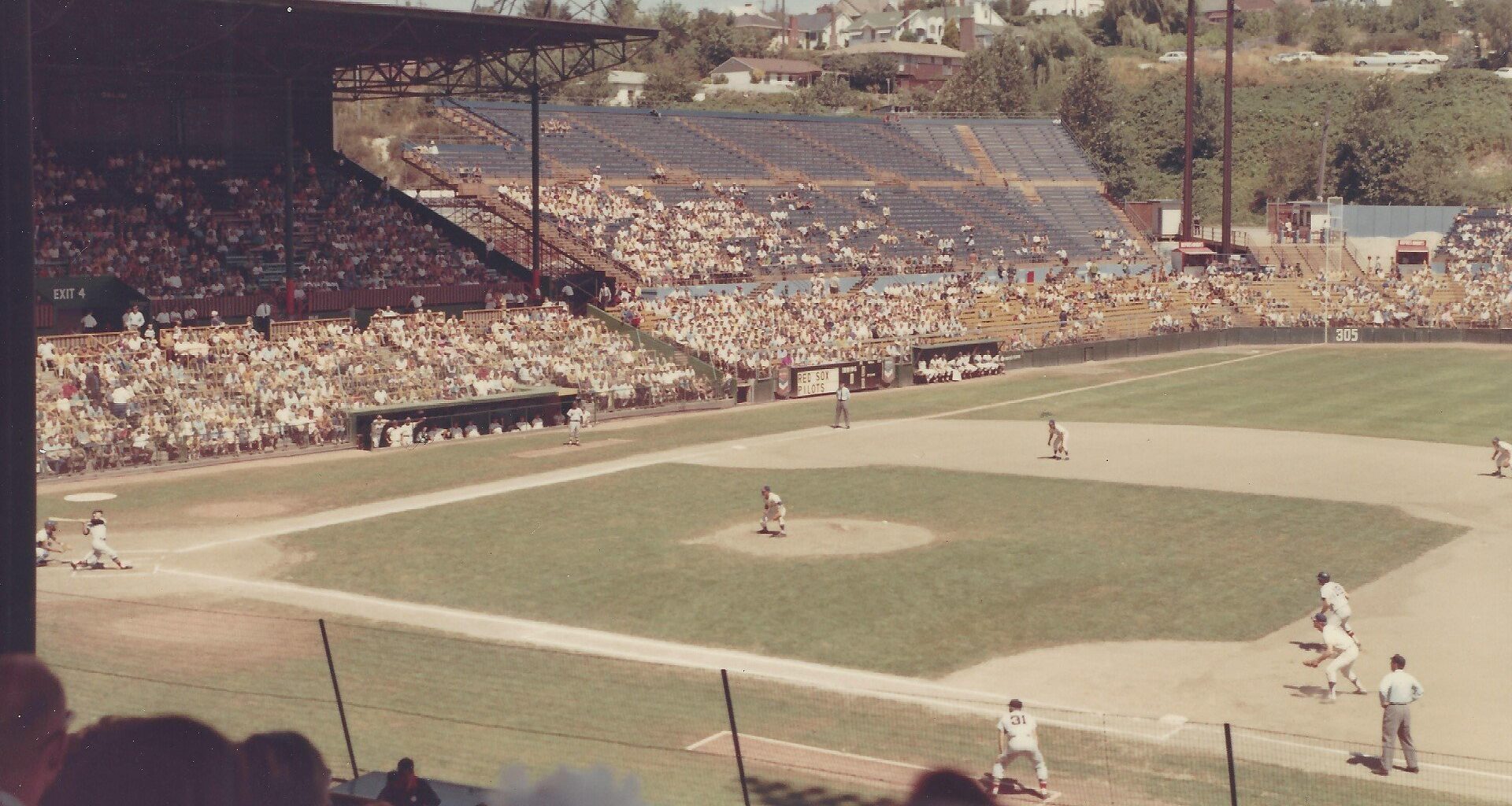
In December 1967, at baseball’s Winter Meetings in Mexico City, a group led by William Daley, Dewey Soriano, and Max Soriano was awarded a major league franchise. Pacific Northwest Sports, Inc. was led by Daley’s $5.5 million, which gave him about 47% of the team’s ownership. A few months later, they announced that the team would be known as the Seattle Pilots and would play at the same stadium that the Triple-A Seattle Angels played in—Sick’s Stadium.
The team was originally scheduled to begin play in 1971, but that schedule was advanced two years when Senator Stuart Symington of Missouri demanded that his Kansas City Royals begin play in 1969. Symington threatened to challenge baseball’s antitrust exemption with legislative action, and Kansas City was awarded the franchise. The American League then forced Seattle to begin play in 1971 rather than 1970 to keep the schedule balanced.
The award was contingent on the Pilots making improvements on the stadium, including expanding the seating capacity from 11,000 to 30,000 by April 1969. This issue would be a bone of contention for the next two-plus years.
Prior to the Pilots, the Seattle Rainiers and Seattle Angels of the Pacific Coast League called the 11,000-seat Sick’s Stadium home from 1938-68. The Seattle ownership group persuaded several major league baseball players, including Carl Yastrzemski, Mickey Mantle, and Joe DiMaggio, to stump for a new domed stadium in Seattle. The $40 million proposal was passed overwhelmingly by the Seattle electorate. So, it looked like a domed stadium was going to be a part of the bright baseball future in the Pacific Northwest.
In late April 1968, the Pilots signed a 20-year contract for a spring training facility in Tempe, Arizona. Baseball Facilities, Inc. (BFI) agreed to construct a 6,000-seat stadium, two practice diamonds, dressing rooms, and other facilities for $500,000.
In perhaps what was a harbinger of things to come for the Pilots, in December 1968, E.B. Smith, president of BFI, filed a $6 million lawsuit against the Seattle owners, saying they did not live up to an agreement to provide capital for the Tempe spring training facilities. Legal wrangling aside, the Pilots opened their spring training season on time.
Nineteen sixty-nine was a crazy season on the baseball diamond.
The Amazin’ Mets. The collapse of the Chicago Cubs. The Baltimore Orioles won 109 games but lost in the World Series.
And the Seattle Pilots made their major league debut.
After splitting a pair of games in Anaheim against the California Angels to begin the season, the Pilots played their first and only Opening Day at home on April 11 by defeating the Chicago White Sox, 7-0, before a crowd of 14,993. Since construction of some of the outfield seating hadn’t been completed, those who had left field bleacher tickets had to wait three innings for workmen to install the seats before they could even sit down.
Eventually, that season, the stadium could seat 25,000, but many of those seats had obstructed views. When there was a large crowd, low water pressure in the main pipeline kept the toilets from working properly. The field had no photo wells, so photographers had to lug their equipment to the top of the grandstand roof to get their shots. A mirror was set in the press box so visiting team media could see the entire field. Suffice it to say, the place was a dump.
The first-year team drew only 677,944 to the decrepit stadium, surprisingly ranking 20th of the 24 major league teams. The only teams that fared worse were the Cleveland Indians, Chicago White Sox, Philadelphia Phillies, and the expansion San Diego Padres. The other expansion teams did better: the Montreal Expos ranked 10th and drew 1.2 million, while the Kansas City Royals drew just over 900,000 and ranked 15th. The Pilots finished the year in last place in the AL West with a mark of 64-98-1.
Rumblings between the team and the city of Seattle began late in the season. All was not well in the city of the Space Needle.
It all started with Mayor Floyd Miller.
On September 5, the mayor of Seattle sent a letter to the management of the Pilots demanding a $660,000 letter of credit and a $150,000 surety bond, payable to the city by September 8. The annual rent for the stadium ($165,000) was paid through December 31, 1969, but the remaining $660,000 under the five-year lease was still outstanding. Max Soriano, the secretary-treasurer of the team, said, “We don’t believe the stadium is complete yet. The agreement says it will be renovated to American League standards.”
This was the first of many shots fired by all sides in the continuing saga of the Seattle Pilots.
After the deadline had come and gone, Miller gave the Pilots two more weeks to pay. This time, Pilots president Dewey Soriano (Max’s brother) said, “We have paid our rent. There is no way we can be kept from playing. All that other stuff—we can get injunctions against that.”
In mid-September, King County executive John Spellman, the Pilots, and other organizations began lease negotiations for the use of the multipurpose domed stadium in Seattle, which was expected to be completed by April 1973.
On October 11, Dick Cullum, a sportswriter for the Minneapolis Tribune, reported that the American League “may oust the Seattle Pilots from membership.” The two main reasons for this unprecedented action were low attendance and the team’s failure to act on providing a new stadium.
There were also reports that Daley and the Milwaukee group led by Allan H. (Bud) Selig had a ‘handshake deal’ that would send the Pilots to Milwaukee for $10.8 million. Further reports said the deal was shot down by the American League, which wanted the Pilots to stay in Seattle and recommended that Daley find a buyer in the Seattle area, even if it was for less money.
An American League meeting scheduled for October 21 included not only league and team personnel, but Mayor Miller and senators Henry Jackson and Warren Magnuson. At the meeting, AL president Joe Cronin listed three conditions for keeping the Pilots in Seattle: 1) Stadium expansion from 25,000 to 28,000, 2) Evidence that a domed stadium would be completed by 1973, and 3) Notification of a change of ownership. Points 1 and 3 would be easy; the second point might be a problem.
A local buyer came forward and said he was ‘thinking’ about purchasing the team, so an owner change in Seattle could be an option. But a sale to the Texas group, led by Tommy Mercer and Lamar Hunt, or a sale to the Milwaukee group led by Selig could also be in the cards.
When the season ended, it was a busy time for the Pilots’ management team, which included Daley and the Soriano brothers. If the Pilots didn’t end up getting kicked out of the league, potential moves to either Dallas-Fort Worth or Milwaukee were discussed. There was scuttlebutt that a local Seattle group wanted in. There were still some options.
In early November, Seattle theatre chain operator Fred Danz and Daley agreed to a purchase deal for a reported $10.5 million. Or did they? A day or two later, Danz told reporters, “It is premature to say we have an agreement. All we have is an opportunity to put together a package, and I’ll start meeting with local fellows to discuss it.”
A week before Thanksgiving, Daley and the Danz group announced that 75% of the club’s stock would be exchanged for a sale price of $10.3 million, dependent on the approval of the American League at its Winter Meetings on December 4. In addition, it was reported that another buyer or buyers had offered as much as $13 million.
Coming soon in Part Two, Milwaukee, Dallas-Fort Worth, and Seattle all clash to gain control of the franchise.
Are you interested in Brewers history? Then check out the Milwaukee Brewers Players Project, a community-driven project to discover and collect great information on every player to wear a Brewers uniform!