
Before diving into this article, we recommend reading previous entries in this series, along with an introduction in part one. With that said, let’s look at the gold standard Padres, bench edition.
Part one: Gold Standard Padres, Infield Edition
Part two: Gold Standard Padres, Outfield Edition
The Bench: The Strategic Reserves
The unsung heroes and the specialists. These are the versatile souls who waited for their moment in the sun, ready to deliver the clutch hit or the game-saving play. A roster is only as deep as its bench, and these are the pillars that hold the foundation together.
C Terry Kennedy “TK” 1982 (WAR 4.1) The Blue-Collar Backstop
AVG: .295 | H: 166 | R: 75 | 2B: 42 | 3B: 1 | HR: 21 | RBI: 97 | SB: 1 | BB: 26 | IBB: 9 | SO: 91 | OBP: .328 | OPS: .814
1982 Padres Team MVP | NL Player of the Week (August 22, 1982)
The Five Pillars of TK
Innovation: Kennedy was a “thinking man’s” catcher who revolutionized offensive expectations for the position in San Diego. The son of MLB manager Bob Kennedy, Terry utilized an “advanced scout” mentality to stabilize the Padres’ staff while overhauling his own offensive approach. He was a pioneer of the “doubles-gap” strategy; rather than chasing home runs in “The Murph’s” cavernous dimensions, he shortened his left-handed stroke to prioritize high-velocity contact. This mastery was defined by his ownership of the 3.5 hole — the corridor between first and second base — which he exploited with such frequency that it became his personal trademark. In 1982, this technical adjustment allowed him to record 42 doubles while playing catcher, tying the National League record for the position and proving that a backstop could be a primary offensive catalyst.
Impact: The 1982 campaign established Kennedy as the premier workhorse of the National League. While maintaining a .295 average, he anchored the Padres’ lineup by leading the team with 97 RBI, a total that ranked in the NL Top 10 and cemented his role as the team’s primary run producer. His durability was record-setting; he led all NL catchers in Games (153) and Innings Caught (1,343.1), effectively serving as the iron man of the San Diego defense. Kennedy’s impact was most visible in high-leverage moments, where he recorded a team-high 15 game-winning RBIs, proving that his offensive production was the engine behind the Padres’ winning record. Defensively, he was the league’s most active backstop, leading the NL in Putouts (851) and providing the veteran stability required for a young pitching staff to take a significant leap forward.
Legend: Terry Kennedy served as the emotional heartbeat of the clubhouse during the “Trader Jack” McKeon era, providing the foundation for San Diego’s 1984 World Series run. Known for blue-collar toughness, he famously endured the grueling 1982 schedule without a comparable backup, refusing days off despite the physical toll of catching 1,300+ innings. He solidified his status as a franchise icon that year by becoming one of the few catchers in major league history to record a 20-home run, 40-double season, a statistical rarity that redefined the ceiling for San Diego backstops. His left-handed swing and clutch performance (15 game-winning RBIs) set the benchmark for every future Padres catcher. At Jack Murphy Stadium, “TK” wasn’t just a player; he was the team’s emerging identity: rugged, reliable, and relentlessly productive.
Iconic Look: Behind the plate, Kennedy served as the physical anchor of the Padres’ defense. Outfitted in a classic steel cage mask and the era’s signature Wilson “West Coast” style chest protector, his frame acted as a heavy-set barrier for pitchers and a brick wall for baserunners. At the plate, he maintained a strict “old school” aesthetic, sporting a flapless batting helmet, thick white cotton wristbands high on his forearms, and no batting gloves. Draped in the Wilson brown-and-gold road pullover—complete with orange-and-yellow racing stripes—he gripped a Louisville Slugger heavy with dark pine tar, emphasizing his gritty approach. This look reflected his workhorse reputation: rugged armor for a catcher who refused to take a day off, paired with a technically precise swing.
The “Did You Know Factor”: On December 8, 1980, Terry Kennedy became the centerpiece of the first “Trader Jack” McKeon masterpiece—a massive 11-player blockbuster that fundamentally shifted the franchise’s trajectory. To secure their cornerstone catcher, McKeon was famously given his choice by the Cardinals between Kennedy and veteran All-Star Ted Simmons; he chose “TK,” trading away future Hall of Famer Rollie Fingers and 1972 World Series MVP Gene Tenace, along with Bob Shirley and Bob Geren. In return, the Padres received a seven-player haul: Kennedy, Steve Swisher, Mike Phillips, John Littlefield, John Urrea, Kim Seaman, and Al Olmsted. This trade remains one of the largest in MLB history, and by 1982, Kennedy had justified the cost by racking up 172 hits, leading all major league catchers, and proving he was the elite offensive force McKeon gambled on.
UTIL Bip Roberts “Bipper” 1990 (5.8 WAR) The Ultimate Spark Plug
AVG: .309 | H: 172 | R: 104 | 2B: 36 | 3B: 3 | HR: 9 | RBI: 44 | SB: 46 | BB: 55 | IBB: 3 | SO: 65 | OBP: .375 | OPS: .808
Padres Team MVP (1990)
The Five Pillars of Bipper
Innovation: Bip was the master of “small ball” and a pioneer of the Leadoff Disruptor role. He used his 5’7″ frame to shrink the strike zone, and his elite speed to turn walks into de facto doubles. As a switch-hitter, he perfected a short-arc swing that eliminated the traditional weak side disadvantage most switch-hitters face. Beyond the box score, his true innovation was his mechanical manipulation of “bat-lag”; by keeping his hands high and deep, he allowed the barrel to stay in the hitting zone longer than traditional slap hitters, enabling him to drive 36 doubles into the gaps. He also mastered the drag bunt through a lower-half pivot that allowed him to initiate his sprint toward first base before making contact, shortening the baseline. Additionally, he utilized a “walking lead” and calculated jump-start technique on the basepaths that forced pitchers to alter their delivery.
Impact: He was the engine of the 1990 squad. Tony Gwynn famously said that Bip “drove other teams crazy.” In 1990, he provided elite versatility by starting 60+ games in both the outfield and at third base, while also logging time at second and shortstop. This “Defensive Chameleon” ability allowed the Padres to maintain an optimized offensive lineup every day, regardless of defensive injuries. On the bases, he reached base 233 times and compelled middle infielders to cheat toward the bag, physically opening up wider holes in the infield for hitters like Tony Gwynn and Jack Clark following him in the lineup. By playing four different positions at a high level, he provided a 5.8 WAR, the 5th highest among all NL position players that year, and his 104 runs scored (4th in the NL) proved he was the premier run-scoring engine in the league despite a lack of traditional power.
Legend: Bip Roberts was the ultimate spark plug, serving as the 1990 San Diego Padres MVP and the emotional igniter for the clubhouse. He earned a reputation as a “Giant Killer,” backed by a .314 average with runners in scoring position against elite rotations like the World Champion Cincinnati Reds and the Dodgers. His 1990 campaign redefined the utility player archetype, as he became the first Padre to log 30+ doubles, 40+ stolen bases, and 100+ runs in a single season. This established him as the “Gold Standard” for the leadoff catalyst in franchise history. Despite being cited by historians as having one of the greatest non-All-Star seasons in MLB history, his 5.8 WAR remains the benchmark for the “Padre Way”—combining relentless grit with high-level defensive versatility.
Iconic Look: Bip Roberts epitomized the 1990 Padres aesthetic, characterized by the white home jersey with brown and orange pinstripes and accents, paired with the solid brown cap featuring the orange interlocking “SD”. His signature look was defined by dark-tinted flip-up sunglasses perched on his bill, worn alongside orange wristbands on both forearms. At the plate, he displayed a high-handed rhythmic bat waggle while sporting a shined-finish batting helmet, often caked with pine tar, and black-and-orange Mizuno batting gloves. On the field, he maintained a classic high-sock aesthetic, wearing his pants cinched below the knee to showcase high-cut brown ribbon stirrups over traditional white sanitary socks. Whether patrolling the outfield or the dirt, his Wilson A2000 glove and dirt-stained jersey reflected the intensity that defined his career-best season.
The “Did You Know Factor”: By the time he became the Padres’ most indispensable player in 1990, many fans forgot that Bip originally joined the club as a Rule 5 draft pick who started the 1986 season with San Diego. It is extremely rare for a Rule 5 acquisition, a player another team was willing to let go by not adding him to the 40-man roster, to develop into a franchise cornerstone. He cemented this legacy in 1990 by becoming the first player in Padres history other than Tony Gwynn to score 100+ runs in a season with fewer than 10 home runs. He is also the only Padre to ever hit over .300, score 100+ runs, and steal 40+ bases in a single season while playing 60+ games at two different positions. Beyond the stats, Bip was a psychological nightmare for pitchers; he maintained such elite bat-to-ball skills that he famously went on a 14-game stretch in July where he didn’t strike out a single time.
IF Manny Machado “El Ministro” “El Capitan” 2022 (7.4 WAR) The Captain of Swag
AVG: .298 | H: 172 | R: 100 | 2B: 37 | 3B: 1 | HR: 32 | RBI: 102 | SB: 9 | BB: 63 | IBB: 9 | SO: 133 | OBP: .366 | OPS: .898
NL All-Star: 3x (2021, 2022-Starter, 2025-Starter) | NL Silver Slugger: 3x (2020, 2024, 2025) | All-MLB First Team: 2x (2020, 2022) | All-MLB Second Team: 2024 | Team MVP: 3x (2020, 2022, 2024) | Heart and Hustle Award: 2022 | NL Player of the Week: August 14, 2022
The Five Pillars of El Capitan
Innovation: Manny made the “impossible play” look routine, fundamentally changing the geometry of the hot corner before the 2023 shift ban by pioneering a hybrid role in which he often served as a deep-right-field “rover.” Known as MLB’s “unicorn infielder,” his ability to throw across his body with elite velocity from the shallow outfield grass redefined defensive expectations, proving he could get runners out from 200 feet away with flat-footed lasers. By trusting his elite internal clock and unmatched arm strength, he turned unconventional positioning into an art form. Offensively, his “calm-before-the-storm” approach has made him one of the most clutch hitters in Padres history, masking an explosive power stroke that relies on maintaining nearly zero head movement and elite hand speed rather than a traditional, high-effort load.
Impact: He provided the swagger and winning culture that transformed the modern Padres. Manny’s 2022 season solidified his legacy as a future Hall of Famer, finishing 2nd in NL MVP voting after carrying a Tatis-less offense through a year of massive adversity. Voted as the National League’s starting third baseman and named to the All-MLB First Team, he served as the team’s singular heartbeat. He posted a career-high 7.4 WAR, the highest mark by a Padres position player since Ken Caminiti’s 1996 MVP season. He led the club in nearly every offensive category with a .298 average, 32 home runs, and 102 RBIs. Despite a gruesome mid-season ankle sprain, he gutted out 150 games and hit .322 in high-leverage moments. By fulfilling owner Peter Seidler’s vision of “slaying the dragon up the freeway” in the NLDS, he shifted the city’s identity from underdog to perennial contender.
Legend: He is the greatest power hitter to ever wear a Padres uniform. He officially cemented this status in 2024 by surpassing Nate Colbert’s franchise record of 163 home runs to become the club’s all-time leader. During his historic 2022 campaign, he became the first Friar since Tony Gwynn to win back-to-back Player of the Week honors and became one of only 17 players in MLB history to reach 1,500 hits and 250 home runs before age 30. His consistency earned him a place in the most exclusive offensive circle in San Diego history, joining Ken Caminiti as one of only five players to record a 30-home run, 100-RBI, and 100-run season. By recording his 2,000th career hit in 2025 and signing a historic $350 million “Lifetime Pact” in 2023, Manny has transformed from a superstar arrival into a permanent monument of the franchise.
Iconic Look: Manny is the architect of the modern Padres’ Swag Diego identity, characterized by a short fade hairstyle, Oakley sunglasses (specifically Hydra and Sutro models), and Jordan Jumpman branding on his cleats and batting gloves. In 2022, this look was defined by the classic white home uniforms with brown pinstripes and gold accents, which he helped reintroduce in San Diego. His gear featured a custom Rawlings infield glove sporting exclusive Platinum labels, a rare mark of defensive excellence. His signature is capped off by a home run trot featuring a “no-doubt” bat drop followed by a smooth glide around the bases. The ultimate accessory of this era was the “Swag Chain”—a massive, spinning gold and brown medallion featuring the Padres’ SD logo, which Manny commissioned from a luxury jeweler in 2021 to reward home run hitters.
The “Did You Know Factor”: Beyond the diamond, Manny is a pillar of the San Diego community and its sports culture. In 2024, he and the Padres Foundation made a $350,000 donation to the San Diego Rescue Mission to support the South County Lighthouse, a project honoring the legacy of the late Peter Seidler. His commitment to the city’s future was further cemented in 2023 when he became a founding part-owner of San Diego FC, the city’s Major League Soccer expansion team. His leadership even extends to the front office; in 2019, he famously marched into management’s office to demand that Fernando Tatis Jr. make the Opening Day roster, an act of veteran advocacy that changed the franchise forever. Even his famous nickname, “El Ministro de la Defensa”, has historic roots, bestowed by fans in the Dominican Republic during his defensive clinic in the 2017 World Baseball Classic.
Dave Winfield “Big Dave” “Winnie” 1979 (8.3 WAR) The Three Sport Stud
AVG .308 | H 184 | R 97 | 2B 27 | 3B 10 | HR 34 | RBI 118 | TB 333 | SB 15 | BB 85 | IBB 14 | OBP .395 | SLG .558 | OPS .953 | OPS+ 166
NL All-Star: 4x (1977, 1978, 1979-Starter, 1980) | NL Gold Glove: 2x (1979, 1980) | Padres Team MVP: 2x (1978, 1979) | Padres Team Captain: 2x (1978, 1979) | NL Player of the Week: June 3, 1979 | San Diego Padres No. 31 Retired: 2001 | Padres Hall of Fame: 2000 | MLB Hall of Fame: 2001
The Five Pillars of Big Dave
Innovation: Winfield was a pioneer of sport-specific training, using specialized vision-tracking and developing his own “SST” rotational-resistance equipment decades before functional movement became an industry standard. He further redefined the “big man” archetype by pairing his massive power with elite-level speed, becoming one of the first players of the era to master the “five-tool” skillset and regularly surpass 20 stolen bases a season. Off the field, his forward-thinking was equally disruptive; in 1977, he became the first active athlete in history to establish his own 501(c)(3) foundation, setting the modern blueprint for the athlete-philanthropist and creating a template for community impact that is now the gold standard across all professional sports.
Impact: In 1979, Winfield delivered one of the most statistically dominant seasons in National League history, leading the league in RBIs (118) and total bases (333). He single-handedly carried a lineup that lacked supporting power, accounting for nearly 20% of the Padres’ total runs batted in while serving as team captain for both the 1978 and 1979 seasons. This dominance made him the first San Diego Padre ever voted by fans to start an All-Star Game—one of four selections he earned in a Padres uniform. Defensively, he redefined excellence in right field, winning the first of his two Gold Gloves by leading all National League outfielders in putouts (386) and assists (16), while utilizing a legendary “cannon” arm that also led the league in double plays turned by an outfielder (4).
Legend: Dave Winfield stood as the Padres’ first true homegrown superstar, proving the young franchise could develop a first-ballot Hall of Fame talent. His status as a once-in-a-century athlete was forged as the only person ever drafted by teams in the MLB (Padres), NBA (Hawks), ABA (Stars), and NFL (Vikings)—an incredible feat considering he never played a single down of high school or college football. Winfield furthered this myth by bypassing the minor leagues entirely, utilizing a “directional” power swing to generate elite contact and shatter the stereotype that 6’6″ hitters were prone to high strikeout rates. A 12-time All-Star and 7-time Gold Glove winner, his immortality was cemented by joining the elite 3,000-hit and 400-home run club.
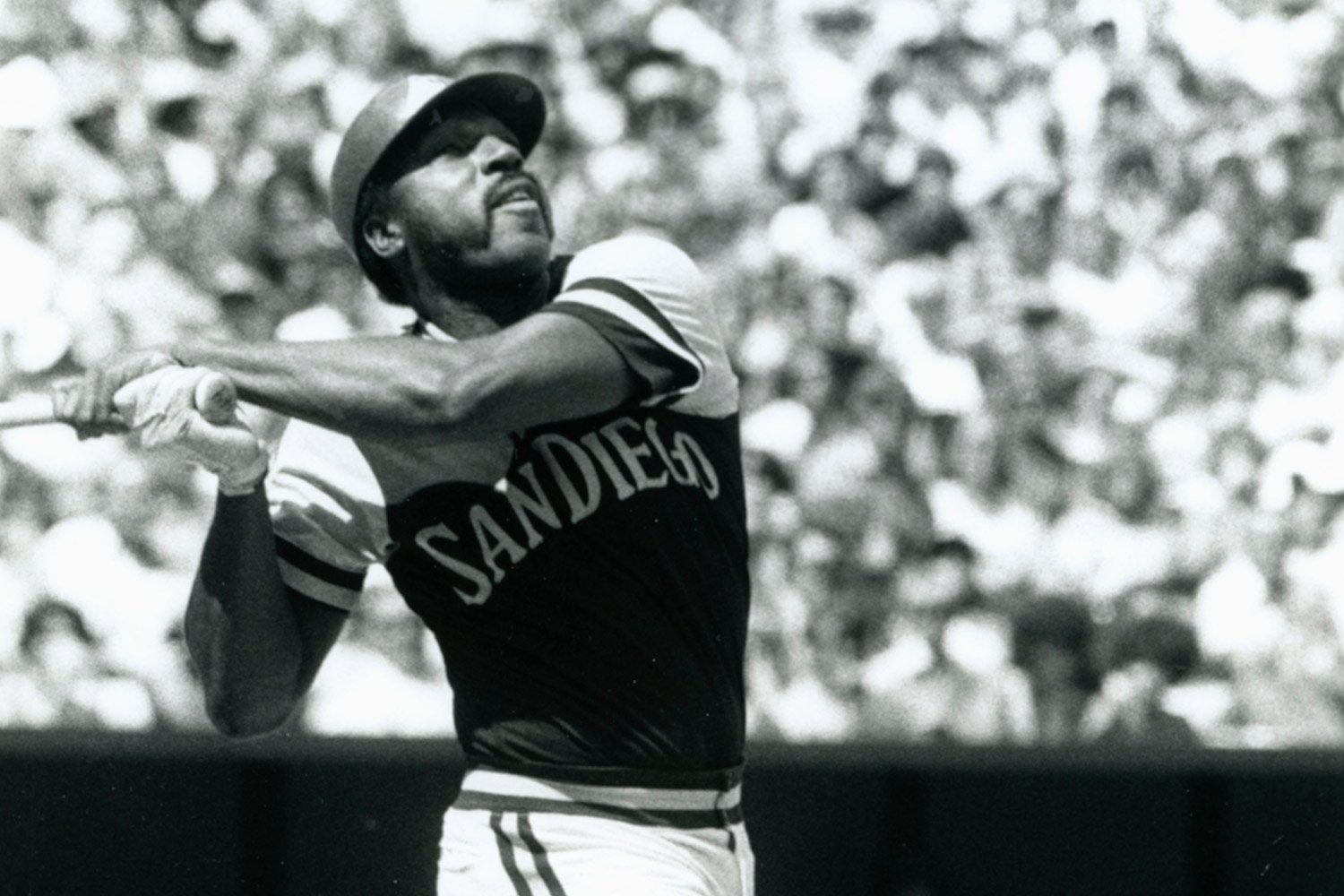
Iconic Look: Winfield’s visual identity was defined by the bold 1970s San Diego baseball look. He is the face of the “Pullover” era, transitioning from the solid “mustard” yellows of his debut to the iconic brown jerseys with gold sleeves and the classic brown hats featuring the gold “bell” front panels. In 1980, his final season with the club, he helped introduce orange accents—a style that would carry the franchise through its 1984 World Series run. In the box, he stood tall with a wide stance wearing his signature flapless batting helmet, a trademark he maintained throughout his entire career. He paired a massive 35-inch Louisville Slugger, which looked like a toothpick in his hands, with oversized brown Rawlings wristbands and high-cuffed pants that put his solid brown stirrups on full display.
The “Did You Know Factor”: Winfield’s legendary athleticism was so dominant that in 1973, he was named the College World Series MVP as a pitcher, not an outfielder, after striking out 29 batters in just 17 1/3 innings with a 0.52 ERA. His career also features one of the most bizarre “international incidents” in sports history; in 1983, during a game in Toronto, a warm-up toss accidentally struck and killed a seagull on the field, leading to his actual arrest by Ontario police before the charges were quickly dropped. Despite his massive power, he was remarkably consistent, becoming one of the few players in history to collect over 3,000 hits without ever having a 200-hit season. Most significantly, when he was inducted into the Hall of Fame in 2001, he chose to become the first player ever depicted on a Cooperstown plaque wearing a San Diego Padres cap.
Think you could write an article like this one? We’re looking for additional contributors, and we pay for all our content! Please click here, fill out the form, and someone will reply with more information.