
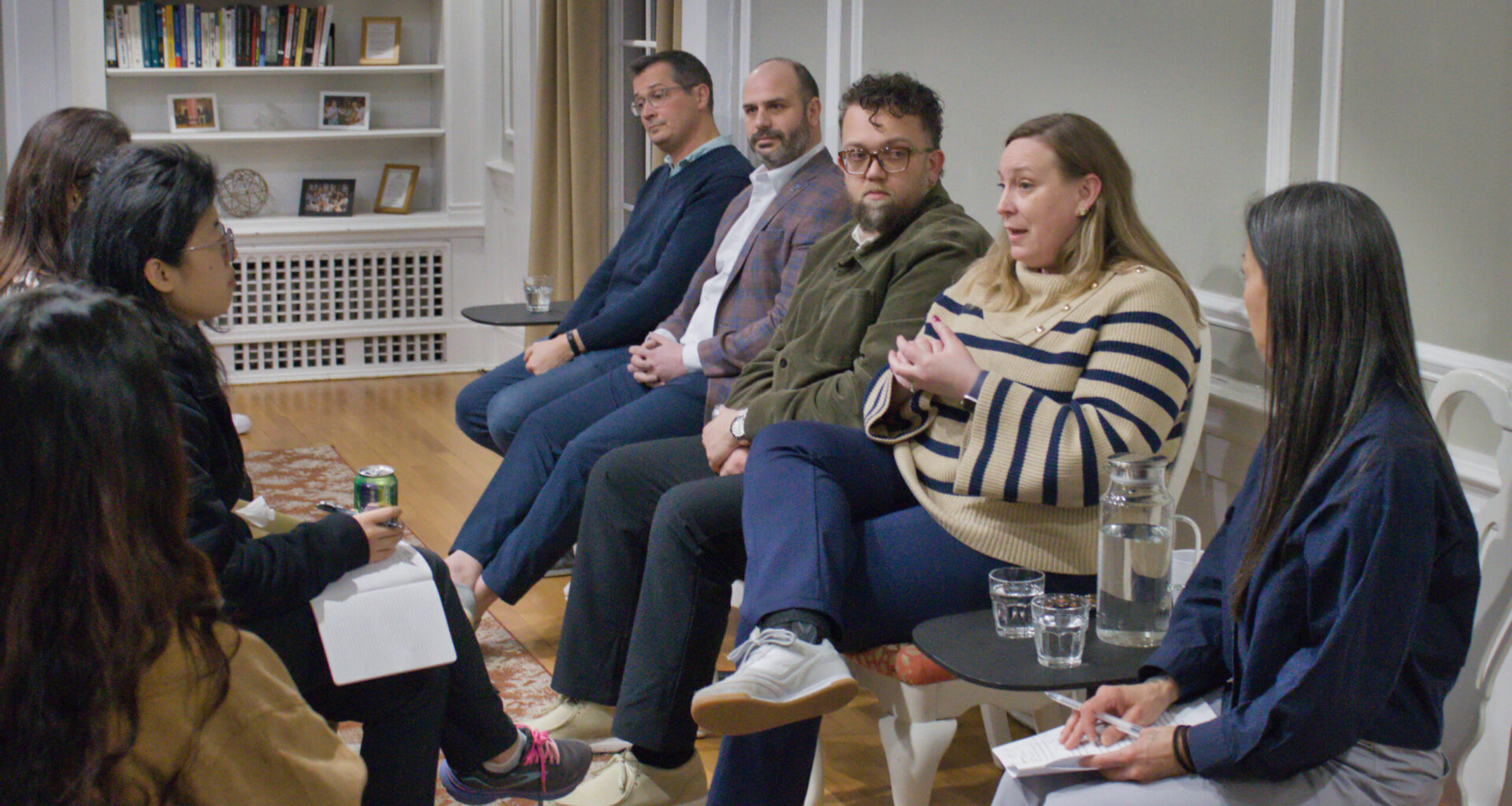
Meghan Essman, director of community relations for the Cardinals, speaks to audience members about the challenges of community engagement for sports teams (Jun Ru Chen | Staff Photographer).
Representatives from all three of St. Louis’ major league sports teams — the Cardinals, the Blues, and St. Louis CITY Soccer Club — gathered at WashU’s Stix House to talk about the importance of community engagement in an ever-changing sports landscape on Wednesday, Feb. 4.
The talk centered on how sports viewership has changed in an era of social media, necessitating more emphasis on community development to keep viewers engaged. Additionally, the speakers covered ways in which sports organizations engage with fans, alongside the history and entanglement of sports and racism within St. Louis.
The panel included Meghan Essman, Director of Community Relations for the Cardinals; Ken Early, Director of Community Relations for St. Louis CITY SC; Randy Girsch, Vice President of Community Development for the Blues; and Noah Cohan, Assistant Director of WashU’s American Culture Studies department.
The panelists started the discussion by recounting their favorite sports-related memory. Girsch remembered seeing St. Louis come together over the Blues winning the Stanley Cup in 2019.
“Nobody cared who they were standing next to, who they were around. They were all just high-fiving,” Girsch said. “And the way sports unify a community, in the moments that provide civic pride — everything you do, it all culminates then.”
The event was the latest in a series of conversations held by the Gephardt Institute called Civic Cafés, which bring community leaders and elected officials to campus to share their stories and participate in conversation around what civic engagement means to them.
Other panelists agreed that sports provide a unique lens to build community and connection. Cohan spoke about his research into how sports can be a source of personal identity for Americans
“There are lots of little pieces that we put together that help us shape the person that we are, and sports plays a bigger role than ever in that,” Cohan said. “Sport is one of the last pieces of American culture that unites people from different political viewpoints and different cultural positionings.”
Another theme from the panel was that sports organizations are unique in their ability to engage with a diverse set of community causes.
Girsch said that the Blues’ community outreach programs are focused on adaptability and meeting people where they are.
“We launched our North City Blues program, which is a free program where kids come down to Enterprise Center every Wednesday from a couple schools in North City and learn to skate,” Girsch said. “And they actually provide STEM curriculums for the kids to do off the ice … They’re teaching different STEM concepts to the kids, because a lot of them don’t have after-school programs, which have been cut by the government budgets.”
Essman also spoke about unorthodox ways of addressing community needs.
“We’ve created a partnership with Eye Thrive to develop a mobile vision clinic because Missouri does not require in-school vision tests anymore,” Essman said. “This is providing a vital service to those that don’t have access to glasses. Once the screening is done, kids can actually have glasses made on the spot.”
Essman highlighted the fact that the Cardinals also focus on education.
“We partnered with the St. Louis County Library to create a bookmobile, which has 5,000 [books and audiobooks] and has had over 150,000 [interactions],” Essman said. “It’s not just about playing the game. It has to be about serving your community.”
First-year political science student Eliana Reiter was inspired by the ways each organization was finding niche and important ways to help its neighbors.
“It was interesting to me how many initiatives they have that I had never heard of,” Reiter said. “One thing that stood out to me was how they fill voids due to government inaction. Sports teams have positioned themselves in this city as a place for people and different organizations to go to when they need something that the city isn’t providing.”
The panelists also spent time talking about the struggles of working in community development, especially in a city like St. Louis, which has many different areas of need.
Early said the STL City club can struggle to meet so many requests. “I think we have 160 or 180 requests for things every month,” Early said. “And it can be a donation basket, or tickets, or ‘can a player come do this thing with a birthday party,’ all sorts of different things.”
Essman also said that the need can be larger than what an organization can keep up with.
“I wish I had more staff and more ability because, a lot of times, community staff tends to be the smallest department because you don’t tend to be revenue generating,” Essman said.
“How do you find a way to make a connection with the fans who feel like you may have let them down with the product that’s on the field?” Essman continued. “And how does that impact your fundraising dollars? Because if the stands aren’t full, or fans aren’t engaging, then how are you able to make a difference?”
The panelists also agreed that the sports and entertainment environment is constantly changing, and that connecting with the community must change with it.
“It’s an ever changing landscape–the whole world, but specifically, community needs,” Girsch said. “Kids engage with teams way differently from when I was a kid. Now it’s all social media. It’s all digital, and our job is to try to get kids out playing.”
When the Civic Café opened the floor to audience questions, Fred Wooten, a St. Louis native pursuing a Geographic Information System certificate through the WashU CAPS program, asked panelists why they thought St. Louis sports in particular had changed so much.
“The landscape is changing. What made me want to play baseball and football was looking at a guy from the neighborhood. You don’t have that,” Wooten said. “You used to be able to wake up in the morning and go to Forest Park and just stop by and look at a baseball game. Now, you drive by the park, and there’s nobody out there.”
Essman answered that while the dynamics of major league sports have shifted away from home-grown talent, separating the team from the community, that has only made the effort to engage with St. Louis more important.
“St. Louis is cold in the winter. A lot of [the players] don’t live here, and that is a challenge,” Essman said. “But [the Cardinals] have our Redbird Rookies program. It’s a youth baseball and softball program. We’re going to different communities and trying to grow the game.”
Early also pointed out that St. Louis’ culture can make out-of-town players feel inauthentic to neighborhood functions or community events.
“It’s a little bit of a reset to figure out how St. Louis expects to engage with professional sports teams,” Early said. “I think we are an accessible, blue-collar town where people don’t want Ferraris pulling up at a youth soccer event.”
Cohan added that the issue goes deeper than the players and that sports have shifted from a public activity to a private one.
“The dynamics of sports parenting have really changed. Everybody nowadays, if their kid shows any interest, they’re going straight to a private club. So that sort of pick-up playing in the parks, they just don’t exist in the same way anymore,” Cohan said. “It’s less civically minded, it’s less community minded.”
Cohan also said that past research he had participated in found that St. Louis’ particular history of racism and segregation has made the dynamics of engaging with sports, especially publicly available courts and playing fields, complicated.
“We did a lot of research on the publicly available outdoor basketball facilities in St. Louis,” Cohan explained. “How can it be that Forest Park did not have basketball hoops? How could it possibly make sense that that park which had archery facilities and a rugby field didn’t have basketball?”
Cohan said that the motivations for these inconsistencies across publicly available sports are rooted in prejudice.
“We demonstrated, via interviews and historical research, that this was because basketball — because it is very prominently played by African American men and women at the highest level — is often associated with Blackness,” Cohan said. “The people of St. Louis, especially the white people of St. Louis, did not want basketball hoops in their communities.”
While Forest Park now does have basketball courts, in part because of Cohan’s own research, this divide is still a balancing act for sports organizations.
“I think for these institutions, they’re reaching out to everyone, but there’s a kind of extra burden given the history of racism and segregation in St. Louis to make sure they’re connecting with the African American community,” Cohan said.
Essman agreed, citing the need for authentic engagement.
“I think it’s finding the touch points. It’s finding ways to continue to talk to who your fans are and understand who they are and the motivations that they have for wanting to engage,” she said. “And then finding ways to authentically deliver that programming to them.”