
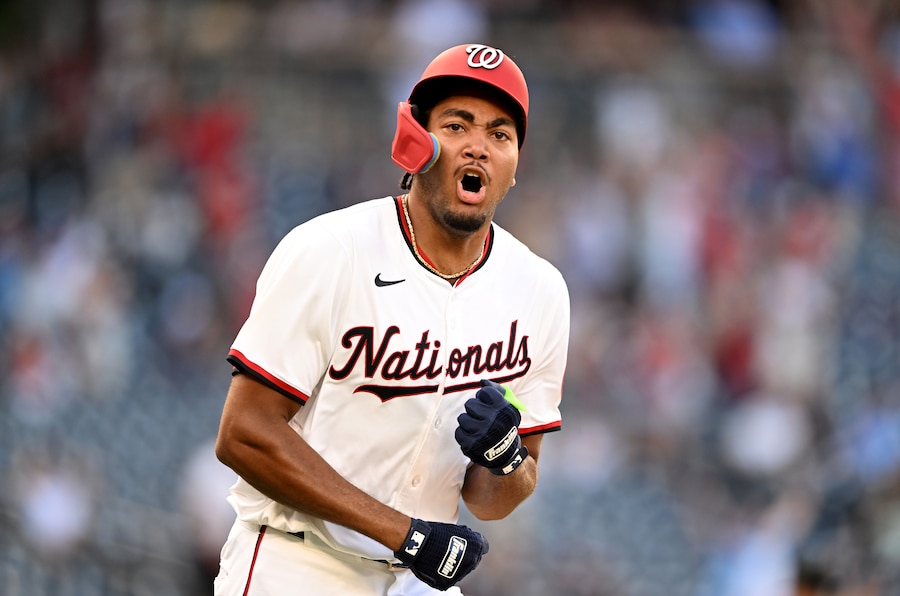
WEST PALM BEACH, Fla. — Just a few phone calls into his new job this winter, Blake Butera was taken aback. This should’ve been the easy one for the Nationals manager — a 23-year-old All-Star who had just survived a 96-loss season with personal accolades and a bright future.
And yet the laid-back, even-keeled tone from outfielder James Wood conveyed something much different than complacency or satisfaction.
“He just sounded like he was disappointed after last year,” Butera said.
It caught the manager off guard slightly, because just about every metric showcased a stunning performance during Wood’s first full season as a big leaguer.
“I told him there aren’t many players at his age who had the type of season that he had and are disappointed about it,” Butera said. “Not that he didn’t think he had a good year. He just thinks he has a lot more in the tank and wanted to finish better than he did. You can just tell by what he did all offseason, the work that he put in, that he’s pretty motivated.”
The Nationals are banking on their belief that Wood is not a finished product. He impressed with an .825 on-base-plus-slugging percentage and 31 home runs. He competed in the Home Run Derby and launched balls that nearly left the stadium. He made fans flock to Nationals Park, eager to see this Olney native.
“He’s not close to being done in terms of achieving his ceiling.”
Paul Toboni, Nationals president of baseball operations
As president of baseball operations Paul Toboni lays the foundation for Washington to develop from a rebuilder into a contender, Wood is a keystone piece. And his disappointment over the way last season ended may be why the Nationals are convinced they have a franchise player in their midst.
“He’s huge to this. It’s one of the first things I told him. He’s right in the middle of all this,” Toboni said. “It’s the fact he works, he’s a great influence on everyone else in the clubhouse, he’s from the D.C. area. I think he means a lot to the area, and we’re really lucky to have him within our doors. …
“He’s not close to being done in terms of achieving his ceiling. He had an amazing year last year. I think there are things he can clean up offensively and defensively that will allow him to really take off.”
Wood said the whirlwind of the season didn’t allow him much time to breathe, but this winter he diagnosed what worked and what didn’t.
Take, for instance, his defense. For being 6-foot-7, Wood runs well. But there’s more to outfield defense than speed, so Wood paid attention to pre-pitch actions alongside outfield coach Corey Ray so he’s better prepared to make a play on a ball in left field.
Still, Wood tempered expectations. He joked that he won’t become “Spider-Man or anything” like his center field partner, Jacob Young, who is known for eye-popping catches.
“I focus a lot on hitting in the offseason, but I just think defensively I could’ve helped the pitchers out a little bit more,” said Wood, who finished with minus 7 outs above average, according to Statcast. “I think that’s one way as a team we can take a big leap. I know the pitchers will appreciate that a lot. Not only just swinging the bat better as a team, but overall, defensively as a team, trying to help our guys out.”
Wood impacts the game with his bat, though, and there was much to like the last year and a half. He debuted midway through 2024 and produced a .781 OPS, then he compiled an even better season across 157 games by driving 69 extra-base hits.
He managed that jump by increasing his already high bat speed, which allowed him to produce contact that left his bat at 95 mph or faster at a 56.3% rate (which ranked in the 98th percentile among major leaguers). When he was at his best in the first half, he shrank the strike zone and walked as often as anyone in the majors.
At the same time, however, Wood was susceptible to swing and miss. He struck out a major league-high 221 times. The Nationals will live with that if it means he clobbers pitches in his sweet spots.
“Some of the best players in the game swing and miss a lot, too,” Wood said. “That’s just part of the game. You’ve just got to be selective in which pitches you go after and just hunt the heart of the zone, because that’s where the damage comes from.”
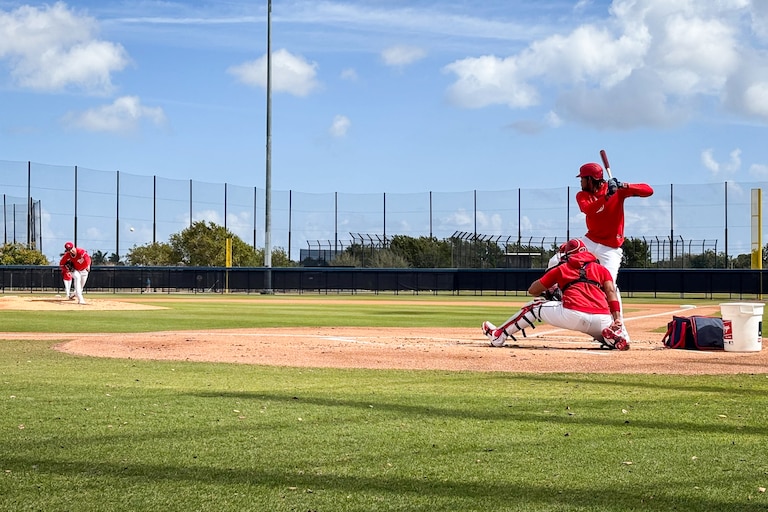 Nationals outfielder James Wood faces pitcher Foster Griffin in a live batting practice session during spring training. (Andy Kostka/The Banner)
That’s a message Toboni and Washington’s hitting coaches have echoed. They don’t want Wood to change what makes him a threat.
“We want to be really aggressive to the areas he does a lot of damage, so if you think about where he does damage in the zone, make that your strike zone, James,” Toboni said. “What he’s really good at is, oftentimes, he gets a pitch in the black early in the at-bat, takes it for a strike, and he’s all good with it. If you look, his anxiety level doesn’t increase at all in the at-bat and he’s totally fine with that. If anything, I’m hoping that approach can rub off on a lot of our other guys.”
Wood throttles mistakes. On pitches he made contact against in the upper middle part of the zone, Wood recorded a 1.154 slugging percentage in 2025. The down-and-away offerings, meanwhile, produced a .300 slugging percentage. He can afford to be choosy, turning his nose up at certain areas with fewer than two strikes if it means he may face something in his wheelhouse.
Of course, in the second half of the season, Wood saw those gaudy numbers decline. Before the All-Star Game, his OPS was .915. In the second half of the season, he posted a .690 OPS in his final 62 games and he struck out 105 times.
When asked if he had pinpointed a cause for the decline, Wood said his timing was off, “and I think that kind of leads to a whole different other list of issues,” including swing decisions.
There’s no simple answer for a hitter to rediscover his timing during the season, but Wood said a focus on his lower half is key. That took the form of strength training this winter, along with slight mechanical adjustments that he hopes will prevent a second-half drop-off.
“Just developing a strong base there, something that can kind of carry me through 162,” Wood said.
The Nationals are relying on Wood to be out there as much as possible, after all. Among all the young players on this team — and there are many — Wood stands out. It’s his size. It’s his bat. It’s his demeanor. Combining it all, Washington may see even more success from the local kid.