
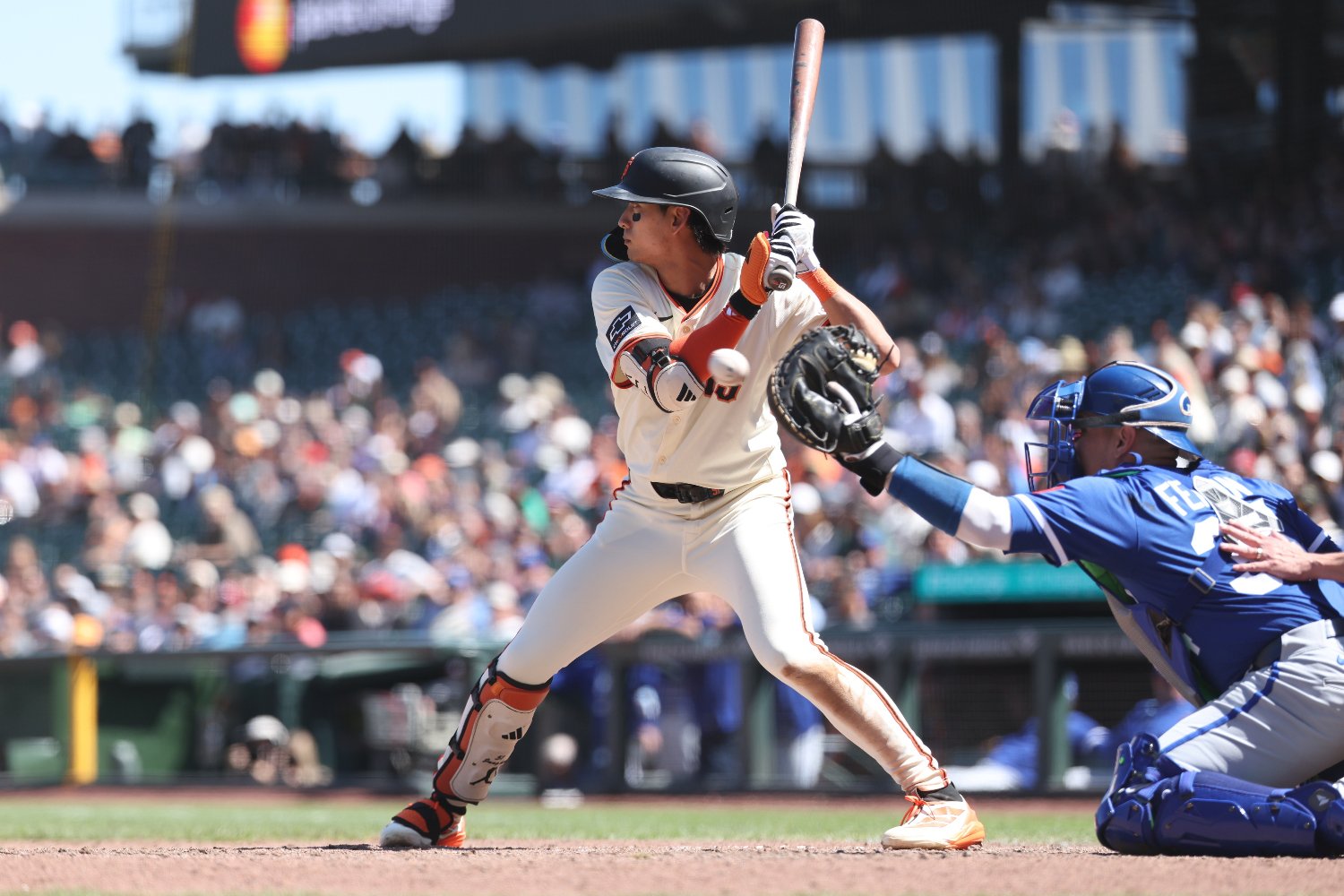
In part one of a three-part series on Royals catching defense, I looked at blocking metrics and how Kansas City catchers have struggled in this category. In part two, I am going to look at catcher framing, which has been a controversial area for the Royals’ catchers over the past five years.
Historically, Kansas City has had a bad reputation for catcher framing, especially with Salvador Perez, who’s been a frequent target of critics (especially regarding his Hall of Fame candidacy). That said, since Matt Quatraro took over as manager and Paul Hoover became bench coach (primarily working with catchers), the framing metrics have shown some improvement. And yet, it seems like we don’t hear about the Royals’ progress in this area of catching defense
Let’s take a look at the Royals’ catcher framing data, how they ranked as a team last year and fared individually, and what they have done under Quatraro and Hoover the past three years, compared to the previous three years (2020 to 2022) under manager Mike Matheny.
Royals Catchers Were Mediocre Individually Last Year (But Not Horrible)
When it comes to framing, Statcast’s framing runs are pretty much the gold standard. Framing runs are tied to strike rate and the number of extra “strikes” a catcher is able to acquire due to their framing ability.
Below is a definition of catcher framing runs via Baseball Savant.
Quote
Catcher framing is the art of a catcher receiving a pitch in a way that makes it more likely for an umpire to call it a strike…Strike Rate shows the cumulative total of all zones. Catcher Framing Runs converts strikes to runs saved on a .125 run/strike basis, and includes park and pitcher adjustments. To qualify, a catcher must receive 6 called pitches per team game.
According to Savant, there were 57 catchers in baseball who qualified with enough pitches seen. Here’s a ranking of those pitchers by catcher framing runs, with Freddy Fermin and Perez being highlighted, as they were the only Royals catchers who qualified in 2025.
Fermin ranked 30th in baseball with -1 catcher framing run mark and a 43.6% Shadow Strike% (shadow strike rate measures how well a catcher garnered strikes in the “shadow” zones, which are the edges of the strike zone). Perez lagged behind Fermin at 49th. The Royals captain had a -7 catcher framing runs mark and 39.7% Shadow Strike%,
That said, while both were mediocre (Fermin less so than Perez), they weren’t horrible by any means. Eight catchers were worse than Perez, including some big-name ones like Philadelphia’s J.T. Realmuto (-8 catcher framing runs), Washington’s Keibert Ruiz (-9 catcher framing runs), the Dodgers’ Will Smith (-10 catcher framing runs), and the White Sox’s Edgar Quero (-13 catcher framing runs).
When it comes to how the Royals’ catchers fared individually, including Luke Maile and Carter Jensen, who didn’t qualify, things looked a little more optimistic. Maile actually proved to be a solid framing catcher, and Jensen’s framing proved to be much better than his blocking in his short MLB debut.
The veteran Maile led all Royals catchers in framing runs (2) and Shadow Strike% with 46.3%. Jensen had zero framing runs, but his 40.4% Shadow Strike% was better than Perez’s, though his sample was incredibly minuscule (551 pitches, which is nearly half of Maile’s total).
Overall, the Royals ranked 20th in baseball last year with a framing runs mark of -3. That mark was better than the Reds (-7), Twins (-9), Dodgers (-11), Rays (-12), and White Sox (-16).
Where the Royals Stood In Terms of Catcher Framing Before Hoover
The Royals have long had a rough reputation for being a bad-framing team. That was certainly the case during the Mike Matheny era, which didn’t seem to prioritize catcher framing as much as the manager who succeeded him.
Here’s a look at how the Royals fared as a team compared to the rest of the league in terms of total catcher framing runs from 2020 to 2022 (which is Matheny’s managerial tenure).
As Royals fans can see in the table above, the Royals were 38 catcher framing runs below average. That was the second-worst mark over that three-year span, better than only the Orioles, who had a -43 framing runs mark. Their 45.2% Shadow Strike% was also the second-worst mark in baseball from 2020 to 2022.
Over that time, according to Savant, Perez accumulated -25 catcher framing runs and a 44.8% Shadow Strike%. MJ Melendez was slightly better in terms of framing runs, as he had a -16 mark. However, his 41.8% Shadow Strike% was three percent worse than Perez’s. Thus, it makes sense why the Royals eventually moved Melendez off catcher (though his outfield defense wasn’t great either).
While Perez was still a solid slugging catcher and known for his work with pitchers, his framing from 2020 to 2022 highlighted his and the Royals’ struggles in this important area of catching defense.
Hoover’s Work With Catchers Paying Dividends
When the Royals hired Quatraro, they also brought Hoover from Tampa to serve as the Royals’ bench coach. One of the big reasons Kansas City hired him was that he was not just an analytical type but also a great communicator who could help catchers improve in an area of catching defense that had lagged for years.
Here’s what was said about Hoover in an article by Anne Rogers in 2023, early in Spring Training that season.
Quote
The Royals were impressed with Hoover’s background and the things he focuses on to improve a catcher’s skills. There has been so much talk about improving the Royals’ pitching staff, and the catchers are part of that conversation; they want to improve, too. Discussion has revolved mainly around catchers’ setups.
“Where are they on the plate, their distance in relation to the hitter, how far back they are, some of those real simple things that are very correctable seem to be at the forefront of what [Hoover’s] looking for,” general manager J.J. Picollo said. “We’re not trying to turn balls into strikes. We’re trying to make sure strikes are called strikes.”
The overarching theme to the Royals’ Spring Training so far is for their pitchers to fill up the strike zone as much as they can. Baseball America recently looked at a simple way the Rays help pitchers improve control by having their catchers set their target in the strike zone rather than on the corners. Catchers are trying to set their pitchers up for success by targeting the middle of the plate and letting the pitch movement work.
Obviously, framing does not exist in a vacuum. To frame pitches effectively, the Royals not only needed catchers with better form and setup (which Hoover worked on immediately), but also pitchers who could hit those shadow zones.
That wasn’t the case in the Matheny era, as the Royals’ pitching staff was subpar. Even in 2023, the Royals’ framing didn’t exactly stand out, mostly because the pitching staff remained poor. However, when Kansas City added effective pitchers to the staff (Cole Ragans, Michael Wacha, and Seth Lugo), things changed not only in terms of pitching ERA, but catcher framing runs as well.
Below is a breakdown of team rankings by total catcher framing runs from 2023 to 2025. Notice where the Royals catchers fare in this latest set of rankings.
The Royals ranked 14th with zero framing runs and a Shadow Strike% of 44.9%. Interestingly enough, their Shadow Strike% is lower than the previous three-year sample, but that’s mostly due to Shadow Strike% being down across the league over the past three years compared to 2020 to 2022.
Still, Kansas City catchers under Hoover saw a 38-run improvement over the past three years. The only more dramatic one is the Orioles, who had a +2 framing runs mark after a -43 total from 2020 to 2022. The main difference, however, between Kansas City and Baltimore is that the Orioles had Adley Rutschman behind the plate starting in 2022. The former No. 1 overall pick is a two-time All-Star and came in with a reputation as one of the best framing catchers in baseball when he debuted.
The Royals have continued to have Perez as their primary catcher. Under Hoover, Perez has produced a -8 catcher framing runs mark from 2023 to 2025, which is 17 runs better than what he produced from 2020 to 2022. He also did this with almost 400 more pitches seen.
Now, is Salvy an elite framing catcher? Not at all. However, he has worked hard to become an average to slightly below average one after being such a poor framer for years. With ABS coming to the Major Leagues this year, Perez, with his better framing, should only improve his stock as a Hall of Fame candidate in 2026. That should be especially true this year with Jensen likely giving the Royals captain a much-needed spell behind the plate on regular occasions, much like Fermin did the past two seasons.
Framing is not necessarily a “strength” of this Royals catching group (or at least not yet, anyways). That said, under Hoover, they have not let framing be a dragging “negative”, a narrative that haunted Perez and the Royals for years.
If Jensen can turn into a good framing catcher under Hoover, or perhaps also Blake Mitchell, who’s waiting in the wings in the Minors? Then the Royals will continue to develop into an organization that’s a far cry from what most baseball fans were used to during the Dayton Moore era (a good thing in the short and long term).