
The easiest thing in the world to do after an opening weekend sweep is panic.
It is easy to scroll through box scores and social media and mistake three losses for a diagnosis. It is easy, in an era built on immediacy, to treat February baseball like postseason baseball or to decide what a team is before it has had time to become anything at all.
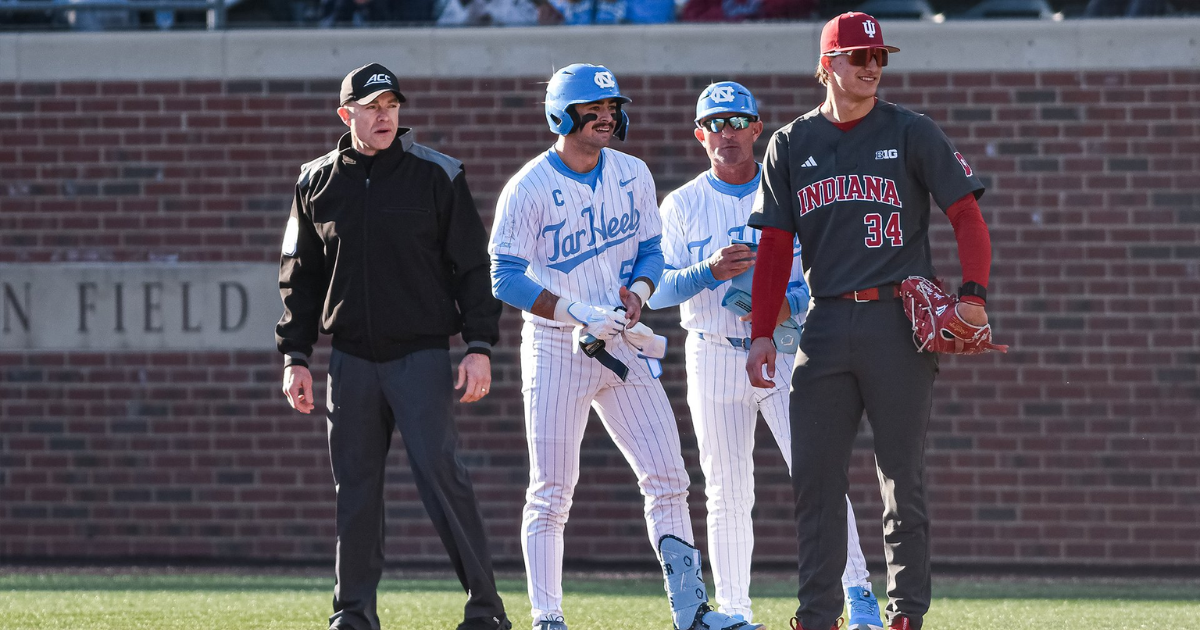
Indiana baseball opened its season this past weekend on the road against the No. 11 team in the country and came home 0-3. The reaction in most circles was predictable. The postmortems began early.
And yet, I left the weekend more encouraged about the Hoosiers than I was when it began.
That is not blind optimism. It is the product of watching three days of baseball that, while imperfect and at times maddening, revealed a team with perhaps a higher ceiling than I expected.
Let’s address the obvious.
Aiden Stewart’s throwing error in the ninth inning of the series finale was bad. There is no elegant way to dress it up. Indiana was one out away from beating a top-15 team on the road in its first weekend of the season. The ball made it just a few inches. The inning continued. North Carolina tied the game and eventually walked it off in the 11th.
That moment will linger, and probably rightfully so.
But a singular, freak play does not invalidate everything else that happened in Chapel Hill. It does not erase 26-plus innings of mostly competitive baseball. It does not transform what looked like a capable team for most of the weekend into a broken one.
Despite the sweep, I am higher on Indiana today than I was a week ago, and that belief begins on the mound.
This pitching staff does not have a household name at the top. There is no obvious Luke Sinnard or Connor Foley anchoring the rotation. What it might have instead is something Indiana has not consistently possessed in recent years: multiple trustworthy starters who look capable of navigating a lineup more than once and keeping this team in games.
Tony Neubeck set that tone Friday night. Four innings. One hit. No runs. Sixty-two pitches. He was efficient, controlled and composed. The limited pitch count was a product of February caution, not early distress, and it is reasonable to expect those four innings to stretch as the season progresses.
Jackson Bergman was solid Saturday and, even with three earned runs charged to him, still looks like a pitcher with the stuff and presence to lead a staff. Brayton Thomas, quietly, may have been one of the weekend’s most important developments. He looked like a legitimate Sunday starter, something Indiana has not reliably had in years.
Sundays have often been survival mode for Indiana in recent years, with makeshift solutions and high-scoring games that felt more like coin flips than competitions. That did not happen in Chapel Hill.
In the weekend’s equivalent of a Sunday game, the second of Saturday’s doubleheader, Indiana allowed one run in 8.2 innings and four total runs across 11 innings. That is not normal for a staff that, in recent seasons, has spent Sundays trying to outscore its deficiencies on the mound.
Across the entire weekend, Indiana’s three starters allowed four of the team’s 22 earned runs.
Four.
That number may matter more than the final scores.
SEE ALSO: Defensive miscues doom Indiana baseball in opening-weekend sweep at North Carolina
The bullpen was uneven, but it was not empty.
Reagan Rivera’s power-conference debut was rough. Xavier Carrera’s collegiate debut was rough. Both are true. Both are February realities for pitchers expected to carry meaningful roles this season.
There was also Michael Sarhatt, who allowed one hit and no runs across 2.2 innings Friday. There was Gavin Seebold, who delivered 3.2 innings of one-hit baseball in the finale. There was Jackson Yarberry, who, after watching Stewart’s error extend the ninth inning, regrouped and posted a scoreless 10th to give Indiana another chance.
North Carolina scored 18 of its 26 runs in just four innings — the fifth and sixth innings of the first two games. Those four innings largely shaped the perception of the weekend. Remove them, and what remains is a staff that competed, attacked and looked capable of being one of the better groups of Jeff Mercer’s tenure.
The most visible problem in Chapel Hill was the defense, and it deserves to be acknowledged honestly.
Errors extended innings. Shortstop Cooper Malamazian had three of them on the weekend. Context, however, matters.
Indiana has practiced outside only a handful of times since the new year. Most of the buildup to opening day took place indoors, on turf, in controlled environments. Then the season opened on real dirt, in real wind, against real speed. A clean weekend was never likely.
That does not excuse mistakes. It does help explain them. Defensive sharpness is built through repetition. It stabilizes with routine. It improves as teams from the Midwest reacclimate to outdoor baseball. Rust is inconvenient. It is frustrating. It is also temporary.
Offensively, the numbers at face value are underwhelming. A .154 average. Thirty-two strikeouts. Twenty-three runners left on base.
They also came against the best pitching staff Indiana will see all season.
North Carolina’s Friday starter was an All-ACC second-team selection a year ago and a preseason All-American ahead of this season. The Tar Heels do not just have one of the best staffs in the ACC. They have one of the best staffs in the country.
Indiana did not look completely overmatched at the plate. The Hoosiers worked counts. They drew walks. They put traffic on the bases. Leaving 23 runners on base is maddening, but it also means 23 runners reached.
That matters.
If the struggles persist against staffs not wearing Carolina blue, then concern becomes warranted. If they do not, Chapel Hill becomes what it was meant to be all along: an early-season stress test.
All told, Indiana was one out away from leaving North Carolina with a win over the No. 11 team in the country on opening weekend — the kind of early-season road result that shows up again in May when NCAA Tournament resumes are being sorted.
That is what makes this weekend so frustrating if you’re the Hoosiers. Not that Indiana looked overwhelmed. Not that Indiana looked outclassed. But that Indiana played well enough for a different outcome and came painfully close to earning it.
If that throw finds a glove, the narrative softens. But the underlying truth does not change.
Indiana pitched well enough to win. Indiana competed well enough to win. Nobody should be fired. The sky is not falling.
Indiana left Chapel Hill without a victory. And yet, I’m higher on this team today than I was a week ago.
Not yet a member of TheHoosier? Join our community for Just $1 and get a complimentary year of The Athletic included with your membership. Join here!
Make sure to follow and subscribe to all TheHoosier social media platforms so you never miss any of our content including X, Facebook, YouTube, Spotify, Apple Podcasts, and Pocket Casts.