
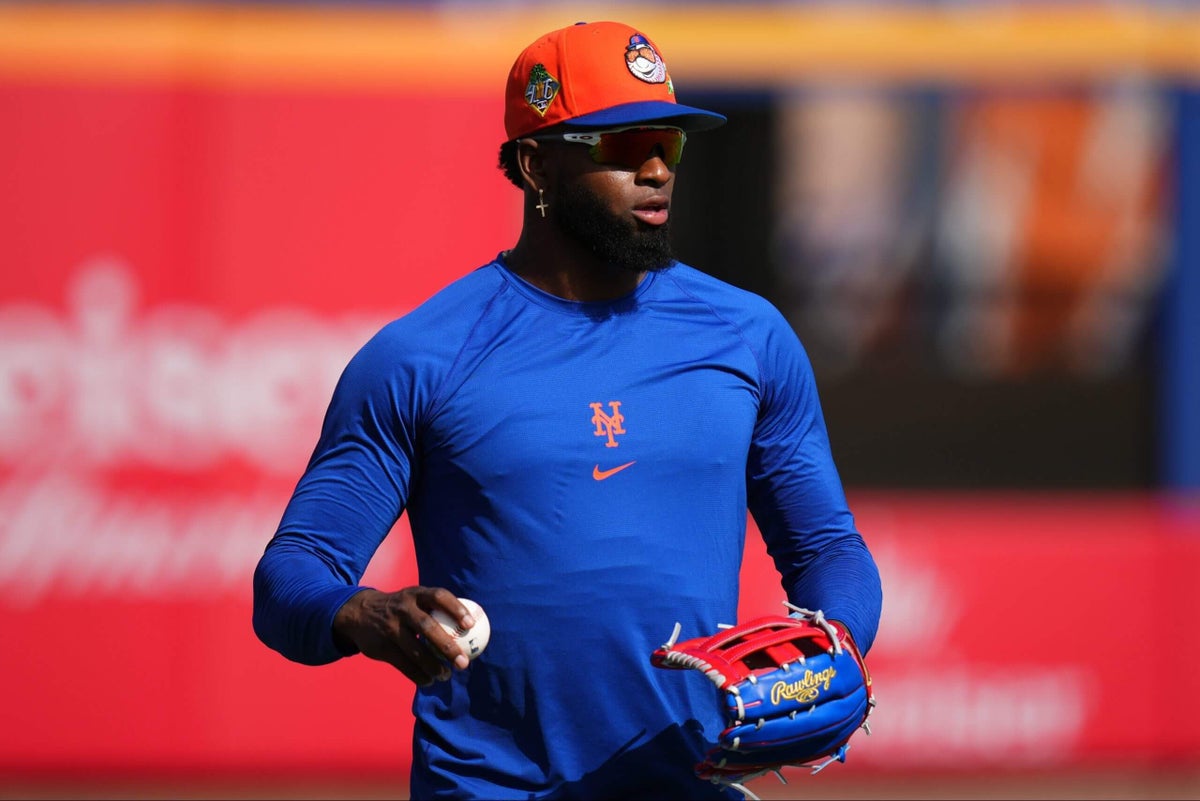
PORT ST. LUCIE, Fla. — Step one for the New York Mets and Luis Robert Jr. is making sure he’s fully healthy.
“The tools are there: elite power, the defense, the speed,” manager Carlos Mendoza said. “When he’s healthy, we saw in 2023 a lot of the things he can do. We’ve got to keep him healthy.
“It was just the history of the lower-half injuries. He’s just got to get stronger there.”
In Robert’s case, that starts with his base and strengthening the lower half of his body. Robert’s two stints on the injured list last season came with hamstring strains, costing him 45 days. The two worst injuries of his major-league career were hip flexor strains, costing him 59 days in 2024 and 97 days in 2021.
“Once the offseason started, the focus was to strengthen where I had the injuries I’ve dealt with,” Robert said through interpreter Alan Suriel.
To that end, the Mets will ease Robert into game action this spring, with him unlikely to make his Grapefruit League debut until the second week of the schedule.
“That’s their plan,” Robert said. “I trust in them because they want what’s best for me.”
Robert is one of several players the Mets will slow-play this spring. Francisco Alvarez, Jorge Polanco and Brett Baty are all unlikely to appear in the first week of games. That’s an approach the Mets have taken with some starters in the past, most notably with Brandon Nimmo.
Of that group, only Baty is dealing with a new physical issue: a tweak of his right hamstring suffered about two weeks ago. That has limited him from getting reps in the outfield this spring so far — a potentially significant development given the Mets’ plan to deploy Baty as a super-utility player. Right field remains an open job, with prospect Carson Benge, veteran Tyrone Taylor and minor-league signees M.J. Melendez and Mike Tauchman joining Baty in the mix.
“He’s in a good spot now,” Mendoza said of Baty. “We’ve got time here. … We’ll come up with a better plan once he’s full go.”
The gradual progression into the Grapefruit League schedule is a reminder that the Mets’ overhaul of their position-player core came at the expense of some durability. Pete Alonso missed 20 games in the last five seasons; he played all 162 each of the last two years. Nimmo played in at least 150 games each of the last four years.
Robert has averaged 104 games over the last five years, Polanco has averaged 110 games over the last four years and Bo Bichette has averaged 118 games over the last three years. (While Marcus Semien missed 35 games last season, he had been one of the sport’s iron men before that, missing only 14 games over the previous seven seasons.)
That proactive approach Mendoza mentioned may last into the regular season, with the club looking more aggressively for off-days for core starters.
“The mindset and the goal (is) for 162, but how good of a player are you going to be for 162?” Mendoza said. “Would we rather play you for 150 or 155 and get the best version of yourself? That’s part of the relationship here. They know they have a responsibility, and being in the lineup is part of it. We’ll adjust when we need to and get the best out of them. That’s our job.”
When new Mets pitching coach Justin Willard watched Christian Scott throw his fastball live for the first time, he said he thought to himself, “Wow, OK, that is different.”
After missing the 2025 season because of a combined Tommy John surgery and internal brace procedure, Scott’s fastball is sitting at 95 mph. Batters describe Scott’s fastball as “lively” and “explosive,” especially because he throws from a low arm slot.
While rehabbing, Scott worked on two new pitches, a cutter and a changeup. He introduced both offerings during a live batting practice session on Monday. Against Semien, Bichette and Juan Soto, Scott racked up a few swings and misses. Afterward, he solicited feedback from Semien and Soto.
“I feel like I can get anybody out at this level when my stuff’s on and I’m competing in the strike zone,” Scott said.
Behind the Mets’ projected top six starters, Scott offers some insurance as a depth option. Early this spring, he is demonstrating he may provide more than that down the road.
Along with Benge, other notable prospects in major league camp at spring training for the first time include infielder/outfielder A.J. Ewing, corner infielder Jacob Reimer, catcher Chris Suero, starter Jack Wenninger and reliever Ryan Lambert.
Lambert, a right-hander who can throw harder than 100 mph, is worth watching as a potential early-season call-up. Over the offseason, Lambert added a kick changeup.
Ewing is expected to see most of his time this season at center field and second base (more center field than second base) with occasional action at the corner outfield spots. Reimer’s primary position is expected to be third base with a sprinkle of first base.