
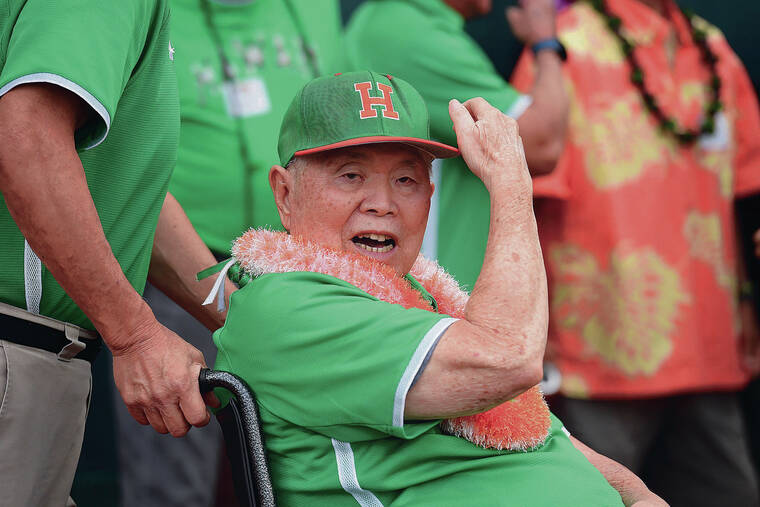
This Friday, raise a glass — clink! — at a party for the Les.
More than 50 former University of Hawaii baseball players will be in attendance at a ceremony celebrating legendary head coach Les Murakami’s 2025 induction into the College Baseball Hall of Fame. The 6 p.m. event precedes the game between UH and Wichita State at Les Murakami Stadium.
“I’ll be there,” said Rick Bass, who was a Los Angeles-reared outfielder on the Rainbows’ 1980 College World Series team. “It’s a great opportunity to honor him. He was around the same age as my parents. He was like my island father. Not just him, his wife and kids all looked after me. They treated me as part of the family. Thanksgiving I’d be at their place. Even my mom and dad appreciated him.”
Two players who went on to successful pro careers — Glenn Braggs and Joey Meyer — will be in attendance. The stars of the 1970s — Derek Tatsuno, also a Hall of Fame member; Gerald Ako; and Curt Watanabe — sent in their RSVPs. The sign-up sheet also includes Bill Blanchette, Matt Apana, John Matias, Markus Owens, Randy Inaba and Steve Otani. The so-called “batgirl,” Renee Nishi, and her mother, Rosemary Nishi, who ran the concession stand at Rainbow Stadium, will be part of the festivities.
“Fantastic,” the 89-year-old Murakami said of the guest list.
Asked about his induction, Murakami said, “that’s fantastic.”
Don’t miss out on what’s happening!
Stay in touch with breaking news, as it happens, conveniently in your email inbox. It’s FREE!
Dot Murakami acknowledged her husband is “a man of few words. He’s such a humble man. He feels honored, but he’s not going to make a hubbub about it.”
Among Murakami’s accomplishments were a record of 1,079-570-4 that included six Western Athletic Conference titles, 10 NCAA Regional appearances and a runner-up finish in the 1980 College World Series.
Murakami turned a “temporary” job in 1971, UH’s first season competing in NCAA Division I, into a 30-year stint as head coach. For the first decade of his coaching career, Murakami was considered a “part-time” coach. His “day job” was with UH’s auxiliary services, where he oversaw the Manoa campus parking.
In recruiting pitcher Carl Furutani in 1973, Murakami shared his vision of the Rainbows playing in a first-class stadium while competing for championships. Outside Murakami’s portable wooden office, Furutani saw a dirt practice field that was being shortened by the construction of a parking structure.
“I believed him,” said Furutani, who signed with UH to begin a 27-year association as a pitcher and then assistant coach.
“He was the guy who sold dreams,” Ako said. “He was a baseball coach, but to me he also was a salesperson who sold everybody dreams.”
In the early to mid-1970s, Ako said, kids emulated the Triple-A Hawaii Islanders in backyard Wiffle Ball games.
“As young kids, we didn’t grow up being Rainbows,” Ako said. “We grew up being Hawaii Islanders. He changed the tide of that. All of a sudden from Islanders, that changed.”
In 1974, Murakami asked athletic director Paul Durham for money to build an on-campus, aluminum-seated stadium in what was called the “quarry.” Durham denied the request because of a lack of funds. A few months later, Durham noticed there appeared to be construction underway in the quarry. Murakami had used his influence with lawmakers to build UH’s first baseball field.
As the legend goes, the grass from the recently shuttered Honolulu Stadium was replanted in UH’s new field.
Former UH catcher Collin Tanabe recalled working a summer job maintaining the field. Construction of the batting cage was stopped when the project ran out of money for materials. Told of the work pause, Murakami said: “Order whatever material you need and I’ll get the money.”
A few days. later, Murakami paid off the bill.
“That guy had so much power,” Tanabe said. “We go to the World Series and in a couple years — bam! — a new stadium’s being built. It was like, wow. Compare that to what’s happening with Aloha Stadium now.”
In 1977, the state’s best high school pitcher, the left-handed Tatsuno, led Aiea High to the championship. But Tatsuno was not heavily recruited. His interest in USC and Oregon was not reciprocated. Arizona coach Jerry Kindall said he did not have available scholarship money. UH assistant coach Dave Murakami shared his cousin Les Murakami’s vision.
“That’s what made my decision easier to stay home,” Tatsuno said. “My freshman year we played USC, Arizona State, Florida State, Oklahoma, BYU. We played good schools. Coach Les always said to be the best, you have to play the best. In fact, ’77 was the only year UH hosted a Regional. We went to the Regionals that year.”
In 1978, Murakami was miffed when the 38-14-1 Rainbows did not receive a postseason bid. That year, the Rainbows went 5-0 against Oregon, 4-0 against Oklahoma, 5-1 against UCLA, and 3-1 against California. The next year, the Rainbows won 24 of their first 25 and, at one point, were 60-3. Tatsuno won an NCAA-record 20 games, and the Rainbows made it to the Regionals. In 1980, they fell a victory short of winning the national title.
Through it all, Murakami also coached third base with his hands on his hips or with his arms folded.
“My mother asked him once, ‘Don’t just stand with your hands over there,’” Ako recalled. “He said, ‘What else am I going to do with my hands?’”
Murakami coached the Rainbows until he suffered a stroke on Nov. 2, 2000. In 2001, he was inducted into the UH Circle of Honor. He also was inducted into the American Baseball Coaches Association’s Hall of Fame. In 2002, Rainbow Stadium was renamed after Murakami.
“On the field and off the field were two different people,” former UH pitcher Wes Kimura said. “On the field, he was very stoic, very matter of fact, brutally honest. Off the field, he was very engaging, a very good host at get-togethers, fun. Both sides were amazing.”