
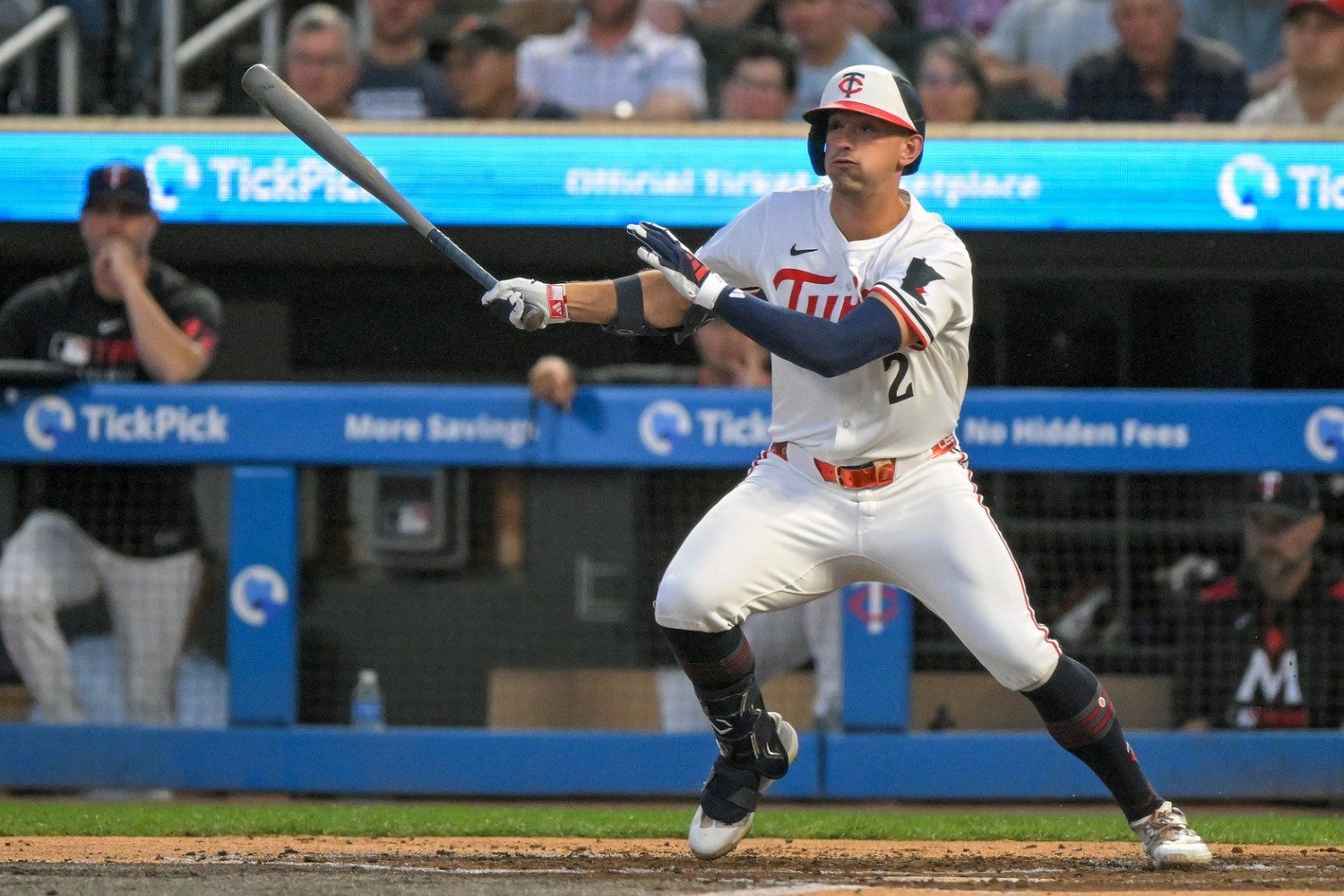
In his first two seasons with the Twins, Brooks Lee has hit .232/.279/.357 with 19 home runs and a 75 wRC+ over 712 plate appearances. He’s struggled to reach base, often chasing pitches outside the zone, leading to weak contact and a high whiff rate. On the bright side, the 25-year-old generated plus power last season, while consistently posting a low strikeout rate. However, his poor swing decisions have led to him entering his third season at an early crossroads, straining to prove he belongs in the majors.
Minnesota will afford him ample opportunity to accomplish that; he’s penciled in as the club’s Opening Day starting shortstop. Yet, with ascending shortstop prospect Kaelen Culpepper expected to begin his 2026 campaign at Triple-A and 2025 first-round draft pick Marek Houston not too far behind them, time is running short. What did Lee do in an effort to break out at the plate in 2026, staving off Culpepper and Houston? Let’s take a look.
Drafted as a switch-hitter, Lee had always performed better from the left side, in college at Cal Poly and in the minors. Unfortunately, that trend failed to continue with the parent club. He’s put up a dreadful 68 wRC+ over a combined 482 plate appearances from the left side of the plate the past two seasons, compared to a 77 wRC+ over 230 combined plate appearances hitting right-handed. Obviously, both results are undesirable, but the majority of any switch-hitter’s at-bats will come from the left side, and Lee felt confident he’s better than his numbers in thos situations. That being the case, he prioritized improving as a hitter from the left side, while keeping his right-handed swing stable this offseason.
“[I’m] just trying to find one swing that I could stick with left-handed, not make so many adjustments,” Lee said. “I felt like this offseason, I made the least amount of adjustments. Didn’t look at video that much. I felt good just trying to hit the ball the other way more. I didn’t really do that last year, left-handed. I feel like, right-handed, I did. I got a lot more hits, and so, yeah, that was kind of a big focus. See the ball deeper so I could hit it that way. And I think that’ll help with chasing.”
Lee already made a slight adjustment to his contact point, according to Statcast. His average intercept point from the left side was 29.0 inches in front of his center of mass in 2025, nearly two inches deeper in the hitting zone than in 2024 (31.8 inches). Yet, as noted earlier, his adjustment didn’t yield a meaningful improvement in results. Interestingly, Lee stands a few inches closer to the plate and very slightly deeper in the box as a lefty than he does as a righty. That should produce deeper contact points, naturally, but there’s plenty of room for (especially) him to set up even farther toward the catcher, changing the equation again.
There is no evidence to suggest that Lee will actually do that. Yet, if he (in collaboration with new hitting coach Keith Beauregard) believes seeing the ball deeper would improve his chase rate, one way to do it could be to create a few more inches of space between himself and the pitcher. If he can continue mashing fastballs from both sides of the plate while chasing offspeed and breaking pitches less often, Lee could become the self-actualized switch-hitter Twins Territory has yearned for him to become since his electric 2024 debut, while producing 20+ home run power.
If Lee undergoes only modest improvement early next season, he could still be usurped by Culpepper, effectively ending his chances of becoming the club’s long-term shortstop. A long-term role as a utility infielder who could bounce between second base, third, and short (and maybe potentially first base) is still in the cards with Lee. At the same time, a very disheartening reality exists: Lee could be demoted to Triple-A if his struggles continue in 2026. He’s fast-tracked himself to make-or-break status, and his ability to improve as a left-handed hitter will be the deciding factor in his ability to remain in the majors.
Twins Daily’s John Bonnes contributed to the reporting in this piece.