
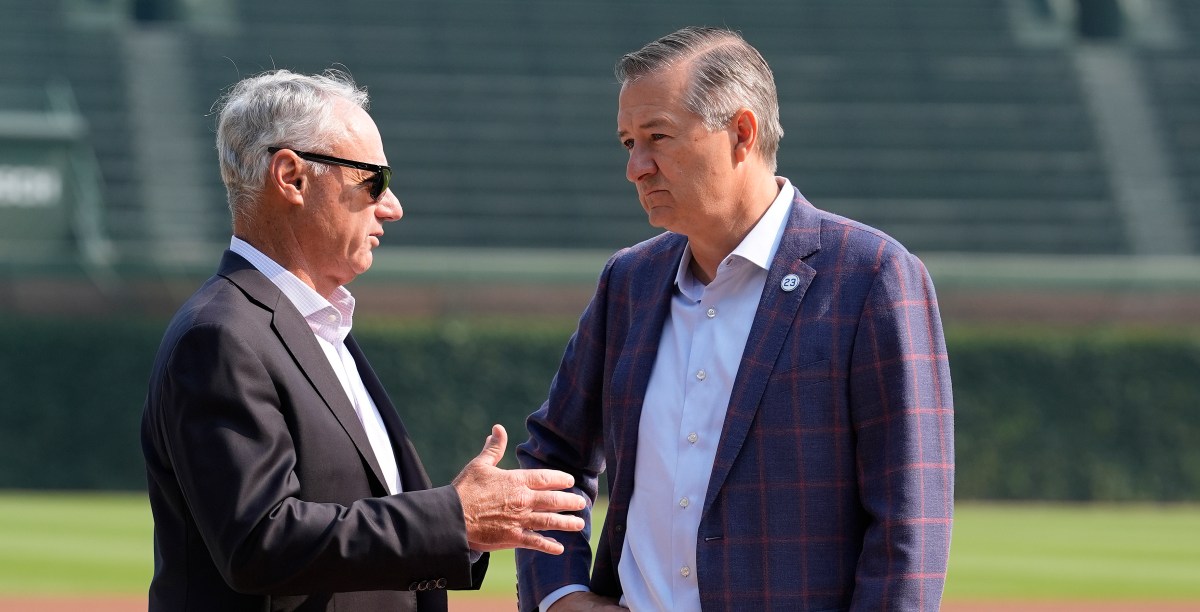
Commissioner Rob Manfred has made no secret that he would like to have all 30 MLB teams’ local TV rights to be able to sell to prospective buyers after the 2028 season, along with national rights. The theory is that doing this would get a higher price than just having the league’s national rights for sale.
All the current national TV deals end after 2028, so Manfred would like to have all local rights — or as many as possible — in-house at that time.
“We love our independence,” Chicago Cubs chairman Tom Ricketts said at Cubs camp in Arizona on Monday.
And this is likely true for teams like the Dodgers, Yankees, Mets and Red Sox (among others), who all own their RSNs and who are still making pretty good money from local TV rights. The article goes on to say that Manfred might be able to put together a package without all 30 teams’ rights. Further:
A copy of MLB’s constitution the league submitted in a court case in 2023 says that a majority owner vote is required for any league action related to video media rights. It also says a three-quarters vote is required for anything affecting revenue sharing “from any source.”
So in order to force teams that don’t really want to give up local rights to do so, a three-quarters vote (that would mean 23 of the 30 owners) would be necessary. I suspect there might be eight owners ready to block such a move.
MLB currently produces and distributes games for 14 of the 30 teams (Diamondbacks, Padres, Guardians, Rockies, Twins, Mariners, Reds, Tigers, Royals, Marlins, Brewers, Cardinals, Rays and Nationals). Most of these rights came from the failure of Main Street Sports Group (formerly Diamond Sports), which ran the FanDuel Sports Networks, formerly Bally’s, formerly the Fox Sports RSNs. These 14 could be joined by the Angels, who are still trying to determine where they’ll go with broadcasts this year.
Here’s one more big reason Manfred wants to have these local rights:
Revenues from national games would be split equally amongst the clubs. Teams have to share some of their local TV money, too, but they keep much more of the proceeds on a percentage basis.
Manfred wants to spread TV money between owners more evenly than today, and his bet is that, if national TV deals can bring in enough new money in aggregate, then big-market teams — which possess the most valuable rights — could be more likely to go along with him. (Landing a salary cap in negotiations with players would help that effort.)
Ah, ha. The salary cap raises its hand again. Beyond some owners’ desire for a cap, this is another likely reason that the league is looking for a cap. (Which would never work without a floor and guaranteed percentage of league revenue to players, in addition to having owners open their books.)
There’s one more thing from Drellich’s article that should be of interest to you, the fan:
How many different national packages MLB sells come 2029 could matter greatly in MLB’s quest to make it easier for fans to watch games.
“I want to find a solution on the local front that ends blackouts and is fan friendly,” Manfred said last week. “We got a lot of people (who) watch every single day.”
But if MLB sells three, four or five national packages, that could amount to three, four or five services that fans will have to independently purchase to watch a complete season of games.
This is probably the single biggest complaint I hear from people — the need to buy so many different services to see games. The article indicates that MLB’s constitution (bet you didn’t know they had one!) limits all teams to 17 or 18 exclusive national games per season on the various channels carrying national games. Last year, the Cubs had 17, which included six on Fox-TV, six on ESPN, four on Apple TV and one on Roku. This year, NBC is added to that mix (and Roku is out). Many of NBC’s exclusive games will be only on Peacock, so you’d have to have that channel to assure yourself of all Cubs games.
So there are a lot of moving parts here. As always, we await developments.