
Baseball ownership is a thankless business. Maybe that’s a “sipping the Kool-Aid” lede, but the reality is every word is intentional in that line, including the last word: business.
There are parallels to owning a baseball team and running a successful investment business on Wall Street, which Brewers Principal Owner Mark Attanasio has been doing for 21 seasons on the diamond and 35 years in the markets. There’s risk management in lending and in prospects, capital improvements in businesses and in ballpark facilities. Everything costs more now than it did when he bought the team in 2005.
Attanasio has thicker skin now that he has been in the game as long as he has. He’s previously admitted some criticisms in the past got to him, or if he intervened too much/not enough in player operations, but lately his focus is much more singular.
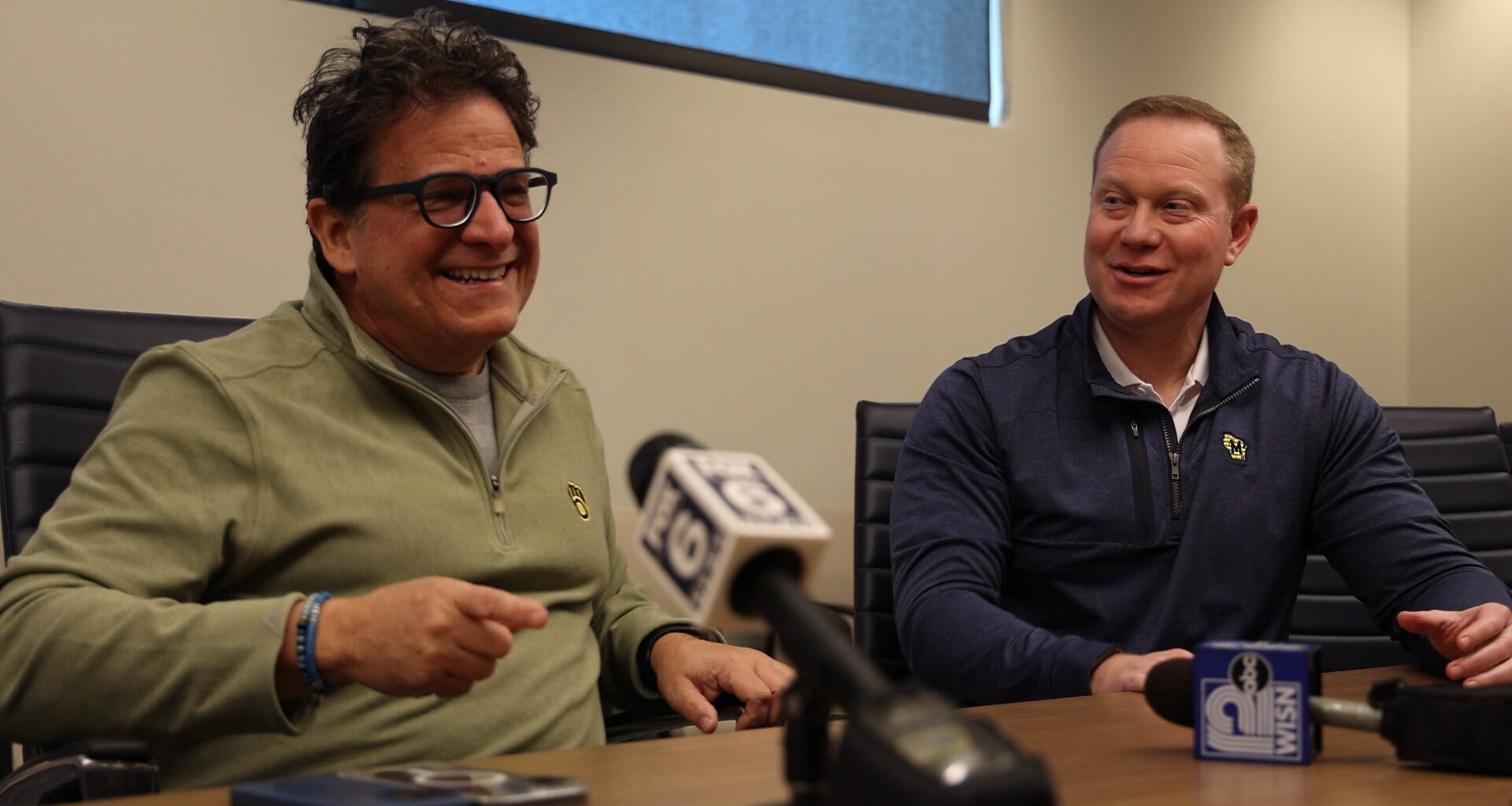
“I worry about the club in the city and the state. I want to be genuine with our fans and have them understand what we do and why we do it and to have confidence in us,” Attanasio told the assembled media on Tuesday in Phoenix.
He’s heard all of the critiques: spending, market size, why it can’t work in Milwaukee. Attanasio even heard it from the man he bought the team from in 2005, Commissioner Bud Selig. “He looked at me and he said, ‘Failure is not an option’ Just a little intimidating from the commissioner of baseball. You’re buying a team in the smallest market, with, you know, eleven or twelve losing seasons.”
Fast-forward to now, the Brewers have made the playoffs seven of the last eight seasons, twice making it to the League Championship series, but not yet back to the World Series. Still, organizationally they are admired across the game for what they are able to do with their limitations in the economics of the sport.
“I can’t hang a banner for the Baseball America top farm system, Executives of the Year banner across the board and great facilities,” Attanasio said, complimenting his President of Baseball Operations Matt Arnold and President of Business Operations Rick Schlesinger. “But I’m saying it starts from this macro perspective. Because if you get that wrong, it doesn’t matter. Then you can’t ‘thread the needle’ because you just have to get that right.”
“Thread the needle” has become the unofficial slogan of Pat Murphy and his ballclub for the 2026 season. Some fans may complain about a lack of spending on free agents and extensions, or trades that – at times – seem to be rooted in prospect acquisition over big league talent. But the way the Brewers continually thread the proverbial needle in the baseball world gives them kudos to consistently compete.
“There’s a lot of thought leadership in baseball. We’re looked at as ‘thought leaders,’ but you can get very much put in a box, say, well, ‘this is how we do things.’ And you don’t think outside the box, because when we see other teams that are smart and start with the Dodgers, everybody talks about the Dodgers payroll… It’s probably the smartest [baseball operations] group that there is,” Attanasio said with a smile, while also patting Arnold’s back jokingly with “no disrespect.”
Even as the temperature rises around potential labor strife ahead of the 2027 season, including the rumors about a salary cap, those discussions aren’t something Attanasio finds himself truly worried about. He warns there could be unforeseen consequences when you try to “fix” competitive balance.
“There’s a very active dialogue on all of that at the league level behind the scenes. In baseball we’re trying to have competitive balance so the fans can come out and have hope for all 30 teams … If there are some advantages that certain teams have because of what they’re doing, you got to be careful about taking those advantages away, because then maybe you’ll disrupt balance somewhat.”
Take those Dodgers, for instance, with the highest payroll in baseball at an estimated $394M – three times that of the Brewers estimated $130M. If you suddenly tell the Dodgers to lower that number on the field, what happens to the number they can pay their staff off the field? The coaches, analysts, trainers, the massive amount of jobs created by the data invasion into baseball.
“Whatever we can have in players, [the Dodgers] got more. Whatever guys Matt can hire and he hires the best and the brightest, they have more,” Attanasio said.
“We feel and we have to get up this way every morning that whatever the system is, however, it looks like the cards are stacked against us, we’re going to compete. We’ve done that for 21 years,” Attanasio said.
Eno Sarris of The Athletic reported in December that Major League Baseball is exploring standardizing technology access across the Minor Leagues. Sources tell WTMJ that if this legislation is passed within baseball, the impact would be felt immediately by the Brewers minor leaguers in 2027.
All of the years of investment in the minor leagues and the way the Brewers seemingly create big league talent out of thin air could be unfairly reined in. Just because other clubs don’t want to spend on minor league and development infrastructure, why do the teams that generate success from their system get unfairly impacted by it?
Leveling the playing field behind the scenes doesn’t help teams try to catch up to the Brewers, it pulls the Crew back like putting training wheels on a racing bike. They’ve trained themselves to handle the latest and best tech, hired and retained coaches and analysts that help bear fruit on the farm in the form of MLB-ready talent to help the ballclub.
The Brewers’ “exposure” in their facilities include the $60M they spent to renovate their spring training home, the $20M to construct a brand new academy for the youngest Brewers prospects in the Dominican Republic, and their acquisition of Single-A Carolina Mudcats in 2017 who are preparing to move 25 miles down the road to a brand new facility in Wilson, NC.
This is where I defend Attanasio and the front office to anyone who will listen. They aren’t an organization that just throws their hands in the air and complains “we can never do it like the big markets.” A quote from Arnold that stuck with me through the offseason was after the Dodgers’ World Series win, and he was asked about sort of the inevitability of it all with two of the top five payrolls in the sport playing on the game’s biggest stage.
“It’s not our job to figure out the economics of the sport. In our situation it’s ‘what are we going to do about it?’” Arnold said at the end-of-season press conference in October. “We’re gonna have the resources that we need, we have support from our ownership to put a quality product on the field. There are a lot of small market teams that can’t say that, and we can. It’s not all about the money.”
That’s what threading the needle looks like in my eyes.